

Taj Mahal Countertops: Cost, Finishes, Maintenance, and How to Specify
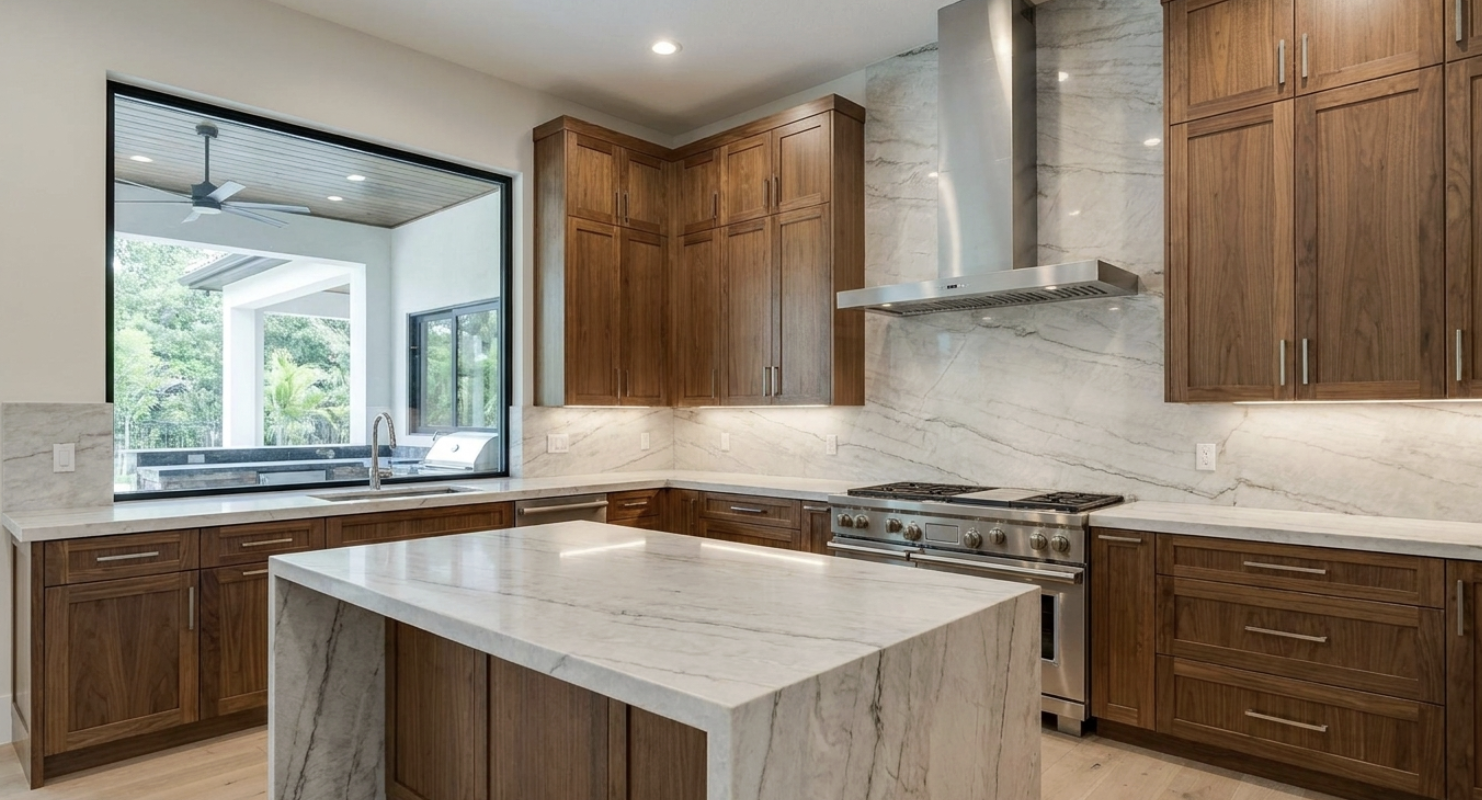
Complete guide to Taj Mahal quartzite countertops: cost, finishes, sealing, and how to specify
Taj Mahal countertops are made from natural quartzite (not engineered quartz) quarried in Ceará, Brazil. The stone features a warm ivory and cream base with flowing gold and taupe veining that resembles high-end marble but with Mohs 7 hardness (harder than granite). It does not etch from acids the way marble does. Installed cost ranges from $100 to $200 per square foot for most projects. Available in three finishes: polished (high gloss, maximum color depth), honed (smooth matte), and leathered (textured matte, hides fingerprints). Requires sealing every 12 to 18 months. For custom projects, slab selection should happen in person at the stone yard, with finish and edge profile decisions finalized before fabrication.
Taj Mahal countertops are the most requested quartzite variety for kitchen and bathroom applications in high-end residential renovation. The stone delivers the aesthetic of marble (warm ivory base, flowing gold veining) with the hardness and durability of quartzite (Mohs 7, harder than granite). That combination is why designers and homeowners keep returning to it: it looks like the stone they want and performs like the stone they need.
This guide covers what Taj Mahal quartzite is (and why it is not quartz), real cost breakdowns, all three finish options, honest pros and cons, sealing and maintenance, design pairings (cabinet colors, hardware, backsplash), slab selection, and how it compares to marble, granite, and engineered quartz. For readers comparing natural stone options, see our guides to Calacatta marble, soapstone countertops, and leathered quartzite.
What Are Taj Mahal Countertops?
Taj Mahal quartzite countertops are fabricated from Taj Mahal quartzite, a natural metamorphic stone quarried in the Ceará state of Brazil. The stone forms when sandstone is subjected to extreme heat and pressure over millions of years, producing a dense, crystalline structure composed almost entirely of interlocking quartz crystals. This geological process gives Taj Mahal its defining combination: the soft, warm appearance of marble with hardness that exceeds granite.
The appearance is distinctive. A warm ivory and cream base with flowing gold and taupe veining that moves organically across the slab. The veining is softer and more organic than Calacatta marble's bold, dramatic patterns. Each slab is unique. Color consistency, vein intensity, and background warmth vary from slab to slab, even within the same quarry lot.
Quartzite vs Quartz: The Critical Distinction
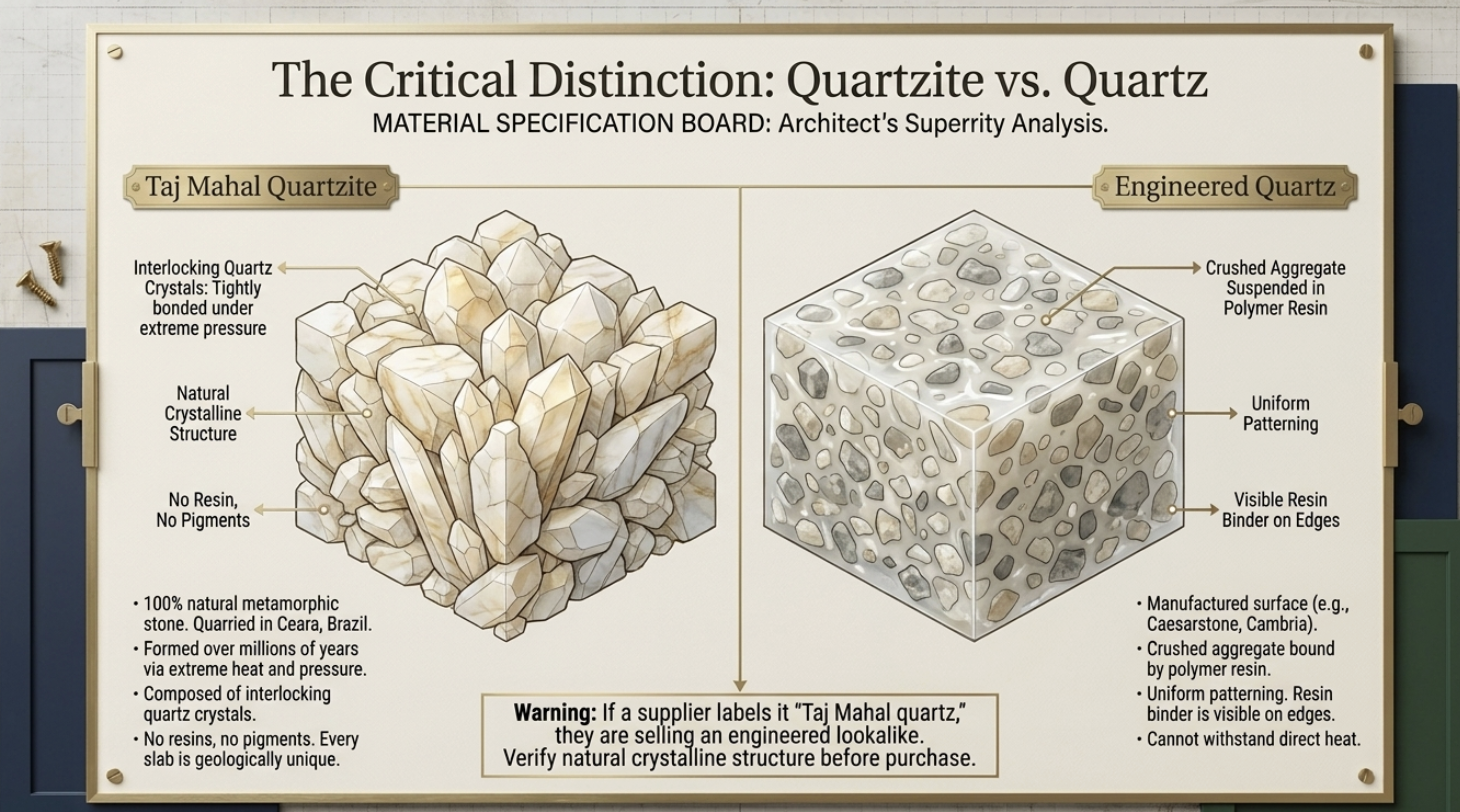
This is the most common source of confusion in the countertop market. Quartzite (Taj Mahal) is a natural stone quarried from the earth. Quartz (Caesarstone, Silestone, Cambria) is an engineered surface manufactured from crushed quartz bound with polymer resin. They are completely different materials with different properties, different maintenance requirements, and different price points.
Taj Mahal is 100% natural quartzite with no resins, no pigments, and no manufacturing. When a supplier labels it "Taj Mahal quartz countertop," they are either using incorrect terminology or selling an engineered quartz product designed to replicate the Taj Mahal look. Verify the material before purchasing. Natural quartzite has visible crystalline structure and natural variation. Engineered quartz has uniform patterning and a resin binder visible on the edges.
How Much Do Taj Mahal Countertops Cost?
Taj Mahal countertops cost $100 to $200 per square foot installed for most projects. This includes the slab, custom fabrication, and professional installation. Premium slabs with exceptional veining and color consistency can push above $200/SF. Budget slabs with more variation or less desirable patterns start at the lower end.
Here's where the money goes:
| Component | Low Range | Mid Range | High Range |
|---|---|---|---|
| Slab material (per SF) | $60 | $80 | $100+ |
| Fabrication (per SF) | $25 | $35 | $50 |
| Installation (per SF) | $15 | $22 | $30 |
| Total installed (per SF) | $100 | $137 | $200 |
| 40 SF kitchen total | $4,000 | $5,480 | $8,000 |
| 60 SF kitchen with island | $6,000 | $8,220 | $12,000 |
Factors that move the price: slab grade (premium vs standard veining), thickness (3CM is standard for countertops and costs more than 2CM), finish (leathered adds 10-15% over polished due to additional brush processing), edge profile complexity, cutout count, and geographic market. Quartzite's hardness also means fabrication costs more than granite or quartz because the diamond tooling wears faster.
Additional costs to budget:
| Add-On | Cost Range |
|---|---|
| Edge upgrade (ogee, mitered, beveled) | $20-$50 per linear foot |
| Waterfall side (per side) | $1,000-$3,000 |
| Full-height backsplash | $30-$80 per linear foot |
| Farm sink cutout | $200-$400 |
| Existing countertop removal | $50-$350 |
How Taj Mahal compares on cost: more expensive than most granite ($50-$150/SF installed) and engineered quartz ($50-$130/SF). Comparable to other premium quartzites like Sea Pearl and Super White. Less expensive than premium Calacatta marble ($150-$350+/SF).
Taj Mahal Countertop Finishes: Polished, Honed, and Leathered
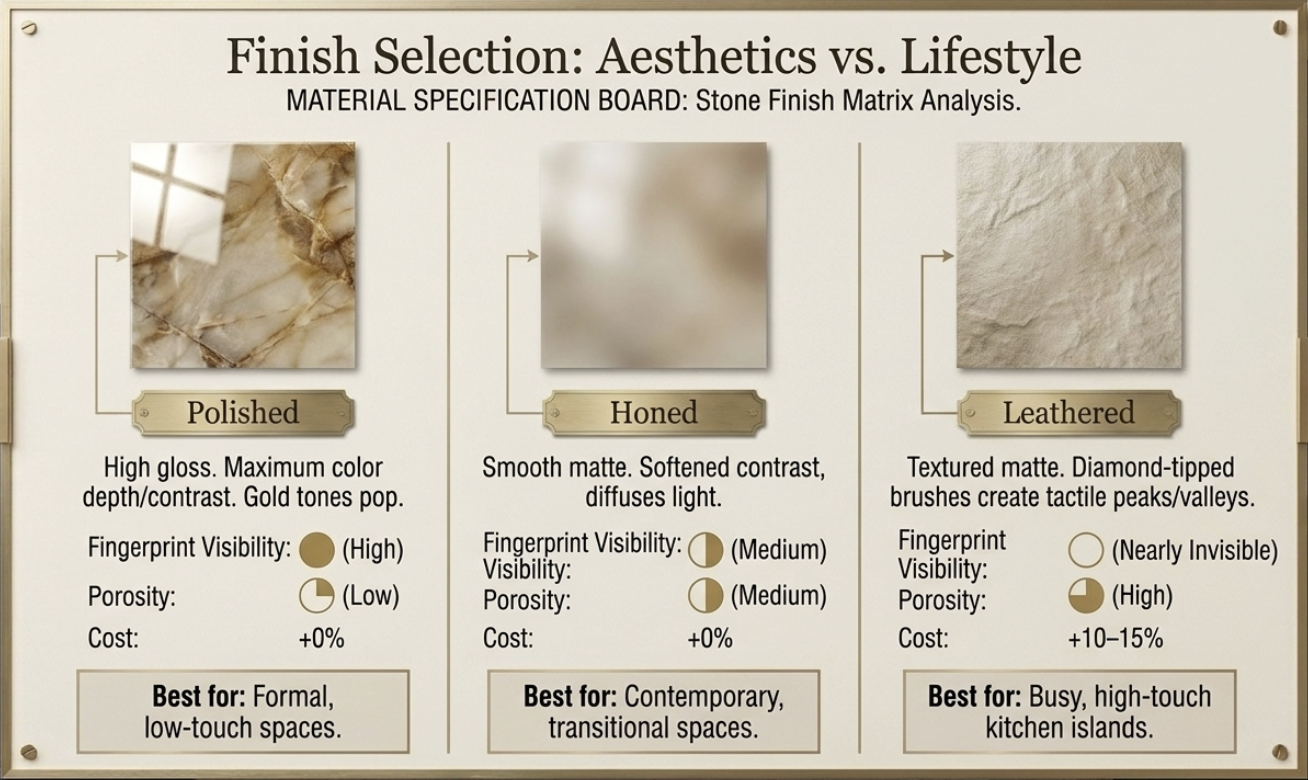
The finish changes how the stone looks, how it feels, and how much maintenance it asks for. Same slab, three different surfaces.
Polished
High gloss. Maximum color depth and veining contrast. The gold tones pop against the reflective ivory base. The surface reflects light, which can make kitchen spaces feel larger and brighter. Trade-off: polished Taj Mahal shows every fingerprint, water spot, and smudge. A busy kitchen island will look dirty within hours of cleaning. Polished requires the least sealing attention because the polishing process closes surface pores. Best for formal kitchens, low-touch surfaces, and spaces where the stone should command maximum attention.
Honed
Smooth matte with no gloss. The veining is visible but softer in contrast. The surface diffuses light rather than reflecting it, producing a calm, contemporary feel. Honed Taj Mahal hides fingerprints and water spots better than polished but not as well as leathered. The pores are slightly more open than polished, so more consistent sealing is needed. Best for contemporary kitchens, bathrooms, and transitional spaces where a quieter stone presence is appropriate.
Leathered
Textured matte with subtle peaks and valleys created by diamond-tipped brushes run across a honed surface. Leathered Taj Mahal hides fingerprints and smudges almost completely because the textured surface disperses light and absorbs the oils that create visible marks on smooth surfaces. It adds tactile depth that polished and honed cannot replicate. The most porous of the three finishes (most sealing attention needed). Costs 10-15% more than polished. Best for busy kitchens, high-touch islands, and homes with children. For the full deep-dive on the leathered finish, see our leathered quartzite guide.
| Feature | Polished | Honed | Leathered |
|---|---|---|---|
| Sheen | High gloss | Flat matte | Low sheen with texture |
| Fingerprint visibility | Very visible | Moderate | Nearly invisible |
| Porosity | Lowest | Moderate | Highest |
| Sealing frequency | Every 18-24 months | Every 12-18 months | Every 12-18 months |
| Color depth | Maximum | Slightly muted | Natural, organic |
| Texture | Glass-smooth | Satin-smooth | Tactile peaks and valleys |
| Cost premium | Baseline | Same as polished | +10-15% |
| Best for | Formal, low-touch | Contemporary, transitional | Busy kitchens, high-touch |
Taj Mahal Countertop Pros
Looks Like Marble, Performs Like Quartzite
The warm ivory base and gold veining deliver the marble aesthetic that homeowners want. The Mohs 7 hardness delivers the performance that kitchens demand. This is the fundamental value proposition of Taj Mahal quartzite countertops: the look of Calacatta or Carrara marble without the etching, the softness, or the constant maintenance anxiety.
Harder Than Granite
Mohs 7 for Taj Mahal quartzite versus Mohs 6-7 for most granite. The surface resists scratches, chips, and abrasion. A knife blade will dull before it scratches the stone. In practical terms, daily kitchen use (cutting boards, utensils, dishes, pots) does not damage the surface.
Does Not Etch from Acids
Unlike marble (which etches from lemon juice, vinegar, wine, and tomato sauce), Taj Mahal quartzite is chemically inert to household acids. A lemon wedge can sit on the surface for hours without leaving a mark. This is the single biggest advantage over Calacatta and Carrara marble for kitchen applications. It is also the reason designers increasingly specify Taj Mahal over marble for clients who want the aesthetic but cannot commit to the maintenance.
Heat Resistant
Hot pots, pans, baking sheets, and cast iron from the stove or oven can go directly onto the surface. Quartzite handles thermal cycling without cracking, scorching, or discoloring. This is a notable advantage over engineered quartz, where direct heat can damage the resin binder and leave permanent marks.
Every Slab Is Unique
No two Taj Mahal slabs share the same veining pattern, color intensity, or background tone. The stone is a geological artifact formed over millions of years. This uniqueness is what separates natural stone from any manufactured product and why homeowners who value authenticity gravitate toward quartzite.
Increases Property Value
Real estate professionals in NYC and South Florida recognize Taj Mahal quartzite as a premium indicator. A Taj Mahal kitchen island signals quality throughout the rest of the renovation in the same way that Calacatta marble does, but with better long-term durability and lower maintenance requirements.
Taj Mahal Countertop Cons
Requires Sealing
Taj Mahal quartzite is natural stone with some porosity. It requires sealing every 12 to 18 months with a penetrating sealer to maintain stain resistance. Without sealing, liquids can penetrate and discolor the stone over time. The water drop test indicates when resealing is needed: if drops of water darken the surface within a few minutes, it's time. This is less maintenance than marble (every 6-12 months) but more than engineered quartz (never).
Higher Cost Than Granite and Quartz
At $100 to $200/SF installed, Taj Mahal countertops are a premium material. They cost significantly more than standard granite ($50-$100/SF) and engineered quartz ($50-$130/SF). The premium reflects the stone's rarity, the difficulty of quarrying in Brazil, and the specialized diamond tooling required for fabrication. The cost is comparable to or less than Calacatta marble ($150-$350+/SF).
Requires an Experienced Fabricator
Quartzite's hardness (Mohs 7) means fabrication requires specialized diamond tooling and experienced operators. Not every countertop shop has the equipment or expertise to cut quartzite cleanly. Improper fabrication can result in chipping along cutouts, uneven edges, or cracked slabs. Ask the fabricator specifically about their quartzite experience (how many projects, which varieties, references) before committing.
Limited Color Range Within the Variety
Taj Mahal comes in warm ivory with gold and taupe veining. There is no cool-toned version, no bright white version, and no dramatic dark option. The variation between slabs is in veining intensity and background warmth, not in fundamental color. If the design calls for a cooler stone, Super White quartzite is the quartzite alternative. If it calls for bright white with bold veining, Calacatta marble or Calacatta quartz may be better options.
Sealing and Maintenance
Sealing: every 12 to 18 months with a penetrating (impregnating) sealer. Some fabricators recommend the first reseal at 6 months after installation, then annually or every 18 months as the stone stabilizes. Use the water drop test: place a few drops of water on the surface. If the stone darkens within a few minutes, the sealer has worn and it's time to reseal. The Natural Stone Institute recommends penetrating sealers over topical coatings for quartzite.
Daily cleaning: mild dish soap and warm water on a soft cloth. No specialty stone cleaners are required for daily use, though stone-specific cleaners are available for deeper cleaning. Avoid vinegar, citrus-based, bleach, or ammonia-based cleaners. These degrade the sealer over time, even though they won't damage the quartzite itself.
Stain prevention: wipe spills promptly. Sealed Taj Mahal quartzite resists wine, coffee, oil, and common kitchen liquids well. The stone is denser than marble and most granite, meaning it naturally absorbs less liquid even before sealing.
Etching: not a concern. Quartzite (Mohs 7) does not etch from household acids. Lemon juice, vinegar, tomato sauce, and wine are safe on the surface. This is the key maintenance advantage over marble, where acid contact is a constant concern.
Scratch resistance: daily kitchen use does not scratch Taj Mahal quartzite. Knife blades dull before the stone scratches. Heavy ceramic or cast iron dragged across the surface can occasionally leave marks from the object's material (iron deposits, not scratches in the stone), which can be cleaned off.
Design Pairings: Cabinet Colors, Hardware, and Backsplash
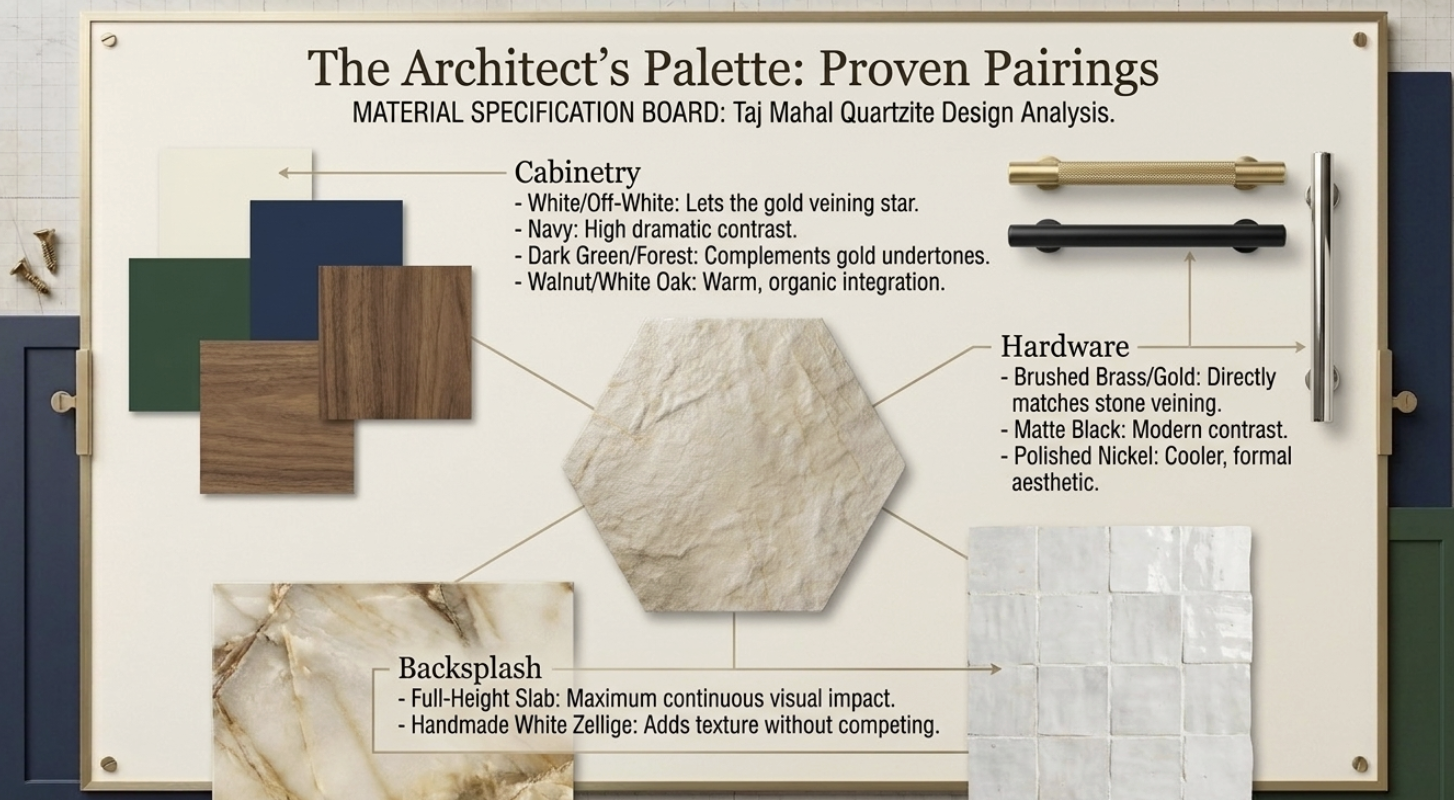
Taj Mahal's warm neutral palette makes it one of the most versatile countertop stones for kitchen design.
Cabinet Colors
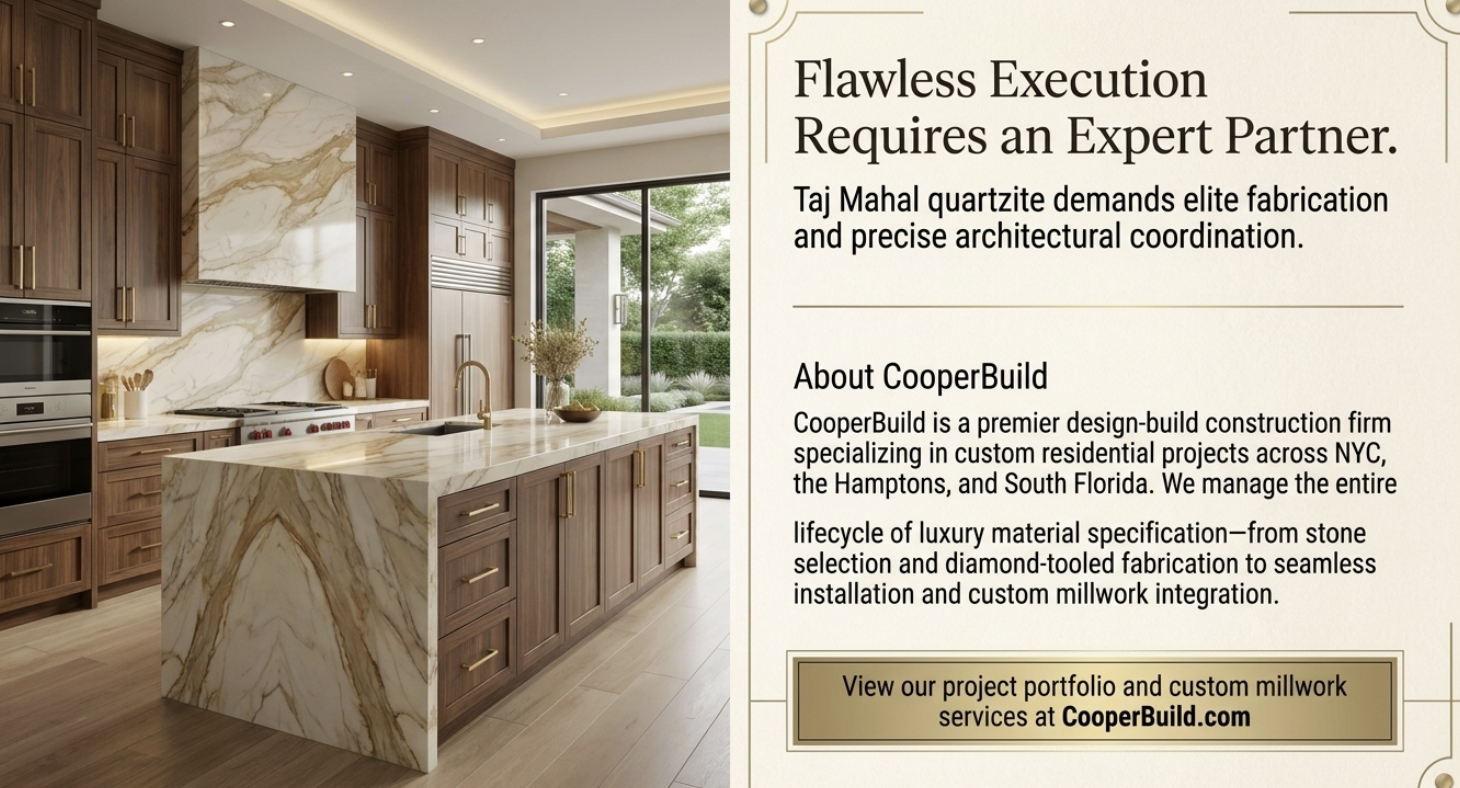
White and off-white shaker or flat-panel cabinets are the most popular pairing. The combination is clean and bright, letting the stone's gold veining be the focal point without visual competition. Navy cabinets create high contrast that frames the stone dramatically and draws out its warmth. Natural wood tones (walnut, white oak) complement the gold veining and produce a kitchen that feels warm and organic. Dark grey or charcoal cabinets produce a modern, sophisticated look. Dark green (forest, hunter, emerald) is gaining popularity as a high-contrast alternative to navy that pairs particularly well with Taj Mahal's gold undertones.
Hardware
Brushed brass and gold fixtures complement the gold veining in the stone directly. The metal and the veining speak the same color language. Polished nickel and chrome work with the ivory base for a cooler, more formal aesthetic. Matte black hardware adds modern contrast and pairs well with both light and dark cabinet colors.
Backsplash
The strongest option: Taj Mahal quartzite as a full-height backsplash using the same slab. This creates a continuous surface from countertop to upper cabinets with minimal seams and maximum visual impact. The stone's veining flows uninterrupted from counter to wall. White subway tile is the most common and most affordable tile pairing. Handmade zellige tile in white or neutral tones adds texture without competing with the stone.
How to Select a Taj Mahal Quartzite Slab
Visit the stone yard in person. No photograph or sample tile substitutes for seeing a full slab. Taj Mahal veining varies significantly from slab to slab: some have heavy gold movement, others are mostly ivory with barely visible veining.
Check veining direction. For kitchen islands, the veining typically runs lengthwise. For waterfall edges, consecutive slabs from the same block (book-matched) create symmetrical veining where the horizontal surface meets the vertical waterfall.
Verify background consistency. Some slabs have patches where the ivory shifts to grey or yellow. Decide whether these variations are acceptable or whether they'll fall in visible areas of the countertop layout.
Select all slabs from the same lot for multi-slab projects (L-shaped kitchens, island plus perimeter). Different lots from the same quarry can have noticeably different color temperatures and vein intensities.
Specify 3CM thickness (1-1/4") for countertops. The additional thickness provides structural integrity, a more substantial visual presence (especially on waterfall edges where the thickness is exposed), and better edge profile options than 2CM.
Confirm the finish before purchase. Polished, honed, and leathered are applied at the processing stage. The decision must be made before fabrication. Switching finishes after the slab is cut is not possible.
Ask the yard to apply mineral oil to a small section if you're considering a honed or leathered finish. Wetting the stone approximates how the finish will look once the surface is sealed and in daily use.
Taj Mahal Quartzite vs Marble vs Granite vs Engineered Quartz
The four materials homeowners most commonly compare during the countertop decision:
| Feature | Taj Mahal Quartzite | Calacatta Marble | Granite | Engineered Quartz |
|---|---|---|---|---|
| Material type | Natural quartzite | Natural marble | Natural granite | Engineered (quartz + resin) |
| Origin | Brazil | Italy | Worldwide | Manufactured |
| Mohs hardness | 7 | 3-4 | 6-7 | 7 |
| Etches from acids | No | Yes | No | No |
| Sealing required | Every 12-18 months | Every 6-12 months | Every 1-2 years | Never |
| Heat resistance | Excellent | Moderate | Good | Poor (resin damage) |
| Installed cost/SF | $100-$200 | $150-$350+ | $50-$150 | $50-$130 |
| Color range | Warm ivory/gold only | White with bold veining | Very wide | Virtually unlimited |
| Slab uniqueness | Every slab unique | Every slab unique | Every slab unique | Consistent |
| Maintenance | Moderate (seal + clean) | High (seal + avoid acids) | Moderate (seal + clean) | Low (clean only) |
| Lifespan | 50+ years | 20-50+ years | 20-50+ years | 15-25 years |
| Best for | Marble look + durability | Authenticity, focal points | Color variety, value | Zero maintenance |
Taj Mahal vs Calacatta Marble: Taj Mahal looks similar but does not etch from acids. Calacatta has brighter whites and bolder veining patterns. Taj Mahal is harder and requires less maintenance. Calacatta costs more. For homeowners who love the marble look but need kitchen-grade durability, Taj Mahal is the specification.
Taj Mahal vs Granite: Taj Mahal is harder (Mohs 7 vs 6-7) and has a more refined, marble-like appearance. Granite comes in far more colors and patterns. Taj Mahal costs more. Both require sealing. Granite is the better value for homeowners who want natural stone without the premium price.
Taj Mahal vs Engineered Quartz: Taj Mahal is natural (every slab unique). Quartz is manufactured (consistent from slab to slab). Taj Mahal handles heat (quartz cannot: hot pots damage the resin). Quartz never needs sealing. Quartz costs less. For homeowners who prioritize zero maintenance and unlimited color options, quartz is the practical choice. For homeowners who value natural stone authenticity, Taj Mahal delivers what quartz cannot.
For more natural stone comparisons, see What Is Soapstone? (a natural stone that never needs sealing) and What Is Calacatta? (the marble family overview).
Frequently Asked Questions
What are Taj Mahal countertops?
Countertops fabricated from Taj Mahal quartzite, a natural metamorphic stone quarried in Brazil with a warm ivory base and flowing gold veining. It is natural quartzite, not engineered quartz. The two are completely different materials.
Is Taj Mahal quartzite or quartz?
Quartzite. It is 100% natural stone quarried from the earth. Engineered quartz (Caesarstone, Silestone, Cambria) is a manufactured product made from crushed quartz bound with resin. If a supplier labels it "Taj Mahal quartz," verify whether they're selling natural quartzite or an engineered lookalike.
How much do Taj Mahal countertops cost?
$100 to $200 per square foot installed for most projects. A typical 40 SF kitchen: $4,000 to $8,000. A 60 SF kitchen with island: $6,000 to $12,000. Premium slabs and complex fabrication (waterfall edges, mitered profiles) push costs higher.
Does Taj Mahal quartzite stain?
Sealed properly (every 12-18 months), it resists staining well. The stone is denser than marble and most granite, so it naturally absorbs less liquid. Unsealed Taj Mahal can absorb liquids over time, especially darker substances like red wine or coffee. Prompt wipe-up and consistent sealing prevent staining.
Does Taj Mahal quartzite etch?
No. Quartzite (Mohs 7) is chemically inert to household acids. Lemon juice, vinegar, wine, and tomato sauce do not etch or dull the surface. This is the key advantage over marble, which etches from any acid contact.
What finish is best for Taj Mahal quartzite?
Polished for formal spaces and maximum color depth. Honed for contemporary kitchens and bathrooms where a matte look is preferred. Leathered for busy kitchens and high-touch islands where fingerprint resistance is the priority. The finish should match how the kitchen is used daily, not just how it photographs.
What cabinet colors go with Taj Mahal quartzite?
White (most popular, lets the stone be the focal point). Navy (high contrast, dramatic). Natural wood in walnut or white oak (draws out gold veining). Dark grey or charcoal (modern sophistication). Dark green (emerging pairing that complements the gold undertones).
Is Taj Mahal quartzite worth the price?
For homeowners who want the marble aesthetic with quartzite durability and no acid etching, yes. The stone performs for 50+ years with basic sealing. For homeowners prioritizing lowest cost or zero maintenance, engineered quartz delivers the practical benefits at a lower price point without the natural stone authenticity.
Taj Mahal countertops deliver the warm, marble-like aesthetic that homeowners want with the hardness and acid resistance that marble cannot provide. The specification decisions that matter: finish selection based on how the kitchen is actually used daily (polished for formal, honed for contemporary, leathered for busy), slab selection at the stone yard in person (not from photos), 3CM thickness for countertops, and sealing every 12 to 18 months.
If you are specifying Taj Mahal quartzite countertops for a kitchen or bathroom and need guidance on finish, slab selection, or fabricator coordination, start a conversation with us. CooperBuild is a design build construction company that coordinates stone selection, fabrication, and installation for custom residential projects in NYC, the Hamptons, and South Florida. See completed work in our project portfolio, or learn about our custom millwork services.
Specifying Taj Mahal Countertops?
CooperBuild coordinates stone selection, fabrication, and installation for custom residential projects in NYC, the Hamptons, and South Florida. From slab yard visits to finish confirmation with your fabricator, we help you specify Taj Mahal quartzite correctly for how you cook and live.
Start a ConversationSubscribe to Our Newsletter
Get the latest insights, trends, and news from the construction industry delivered straight to your inbox.
We respect your privacy. Unsubscribe at any time.