

What Is Soapstone? Properties, Uses, Cost, and Specification Guide
Complete guide to soapstone: properties, applications, cost, and how to specify
Soapstone is a natural metamorphic stone composed primarily of talc, quarried in Brazil, Virginia, India, and Scandinavia. It is naturally non-porous (never needs sealing), heat resistant (hot pots directly on the surface), and acid resistant (lemon, wine, and vinegar do not etch or stain it). The trade-offs: it is soft (Mohs 2.5-5 for countertop grade), scratches from daily kitchen use, and comes in a limited color range (shades of grey, from light silver to near-black, with some green or blue undertones). Soapstone darkens over time, which can be accelerated with mineral oil. Installed cost ranges from $70 to $120 per square foot, positioning it above basic granite and mid-range quartz but below high-end marble.
Soapstone is one of the most misunderstood natural stones in residential construction. Most homeowners have heard of granite, marble, and quartz. Fewer know that soapstone exists, and those who do often have incomplete information. "Isn't it too soft for a kitchen?" is the most common question. The answer is more nuanced than a yes or no.
Soapstone is the only natural countertop stone that never needs sealing. It is the only one where hot pots can be placed directly on the surface without damage. It is the only one that is completely unaffected by household acids. Those are significant advantages. The trade-off is softness: soapstone scratches more easily than any other countertop material.
This guide covers what soapstone is, its geological properties, what makes it unique, the honest downsides, cost comparisons to other stones, the full range of applications (countertops, fireplaces, sinks, bathrooms), the spiritual dimension that comes up frequently in search, maintenance, and how to decide whether soapstone is the right material for a specific project. For comparison with other natural stones, see our guides to Calacatta marble and the broader overview of What Is Calacatta?.
What Is Soapstone? Composition and Properties
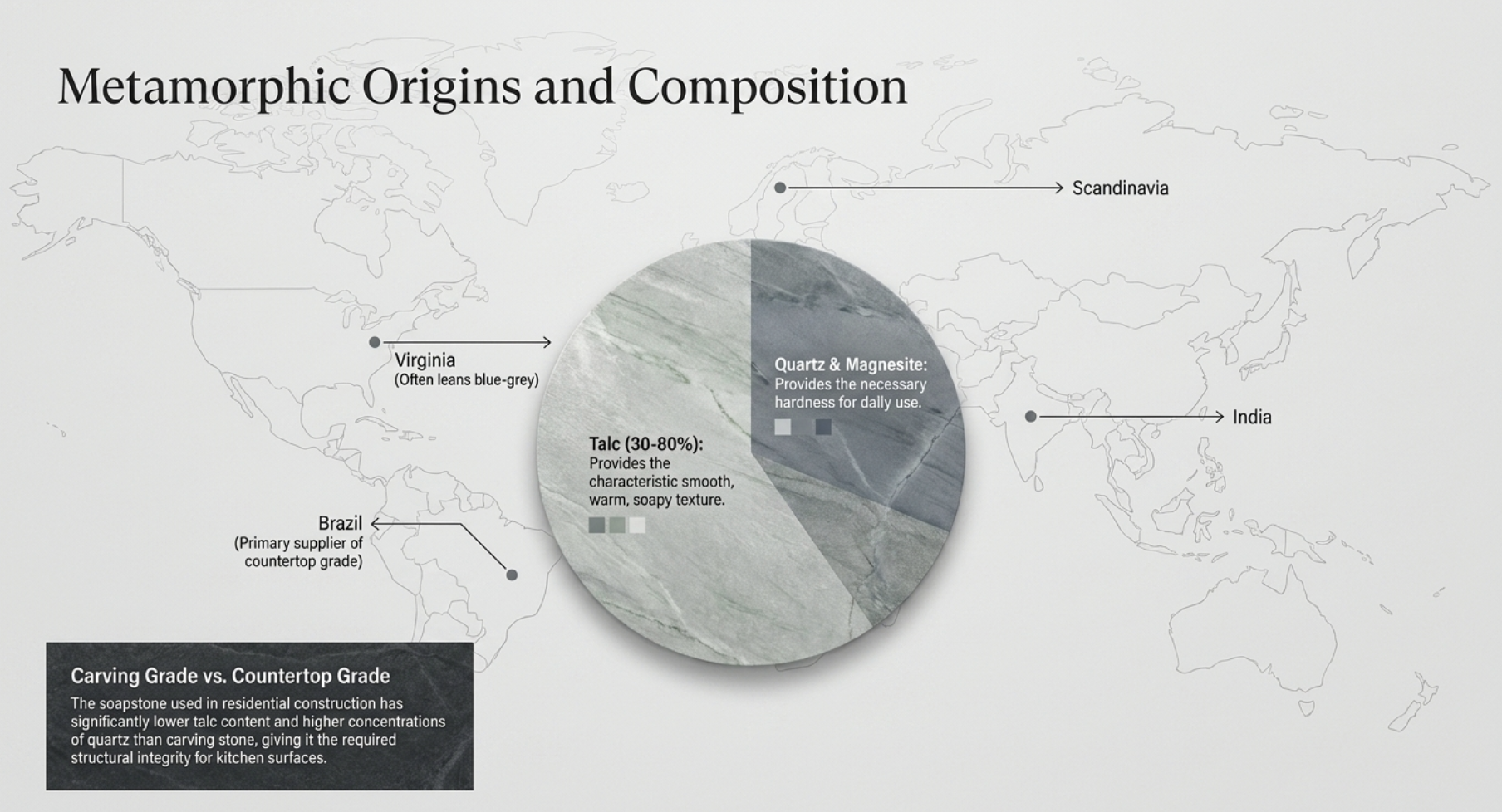
Soapstone (also called steatite) is a metamorphic rock composed primarily of talc (30-80%), along with chlorite, pyroxenes, micas, and carbonates. The high talc content gives soapstone its characteristic smooth, slightly "soapy" texture that inspired the name. When you run your hand across a soapstone surface, the feel is immediately distinct from granite or marble: softer, warmer, almost waxy.
Countertop-grade soapstone has lower talc content and higher concentrations of other minerals (particularly quartz and magnesite) than carving-grade stone, making it harder and more suitable for daily kitchen use. The distinction matters: the soapstone used for sculptures and carvings is much softer than the material specified for countertops.
The physical properties define the specification. Mohs hardness ranges from 2.5 to 5 for countertop grade, which is softer than granite (6-7), quartz (7), and quartzite (7-8). The stone is naturally non-porous with virtually zero water absorption. It is heat resistant to a degree no other countertop stone matches: hot pots, pans, and baking sheets can be placed directly on the surface without trivets, without cracking or scorching. It is acid resistant: unaffected by lemon juice, vinegar, wine, tomato sauce, and most household chemicals. Unlike marble, soapstone does not etch from acid contact. And unlike granite or quartz, soapstone feels warm to the touch because it absorbs and retains ambient heat.
Major quarrying regions include Brazil (which supplies the majority of countertop-grade soapstone), Virginia, India, Finland, and Scandinavia. The stone has been used by humans for thousands of years. Inuit peoples carved cooking vessels from it. Viking craftsmen used it for cookware and molds. Colonial-era New England homes had soapstone sinks that are still in use today, some over 150 years old. Science laboratory countertops were made almost exclusively from soapstone through the mid-20th century because of its chemical resistance, which is why hospitals, chemistry labs, and university research facilities relied on it for decades.
What Makes Soapstone Different from Other Natural Stones
Three properties set soapstone apart from every other countertop material on the market.
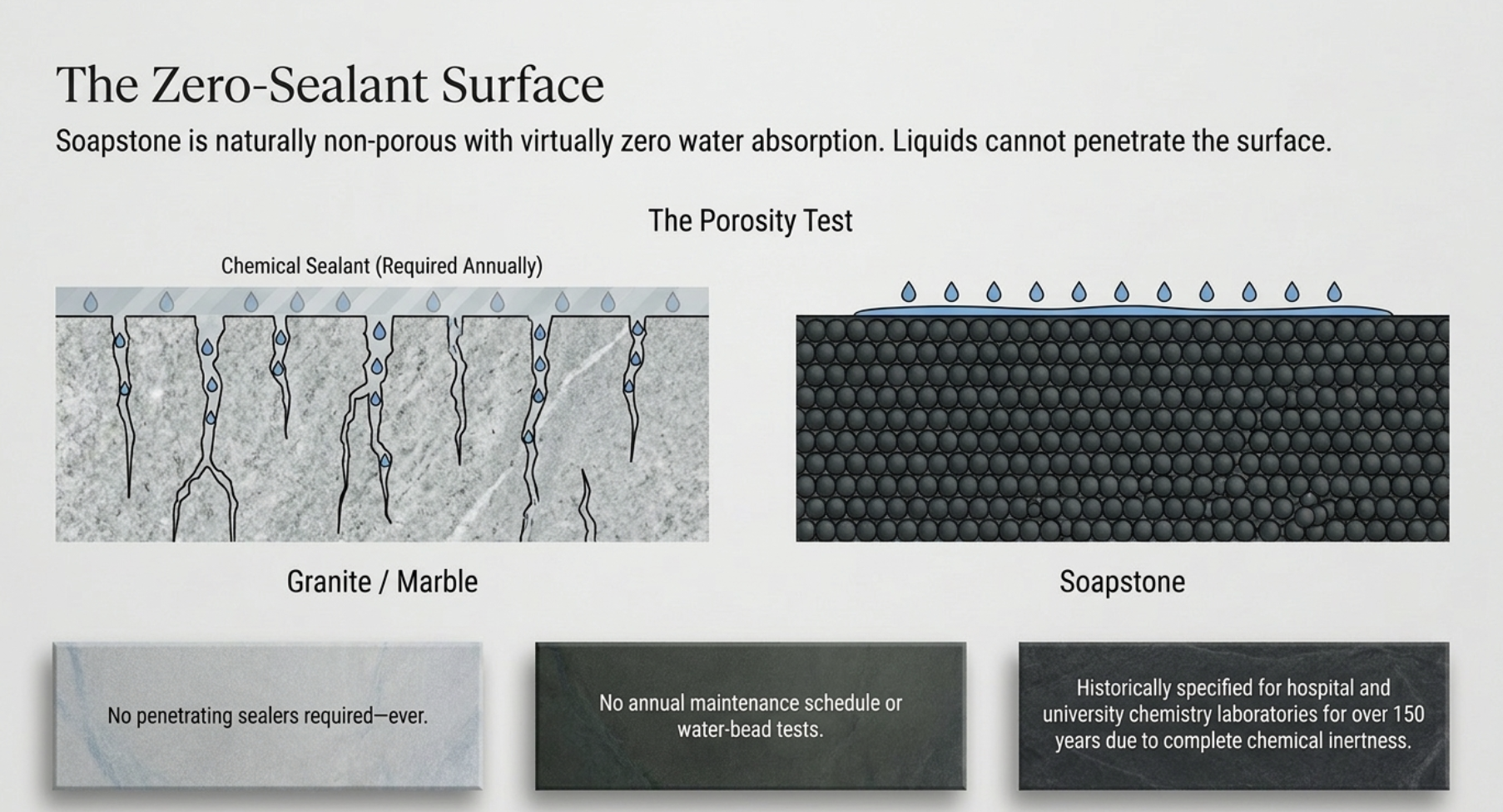
It is naturally non-porous. Granite, marble, quartzite, and limestone are all porous to varying degrees and require periodic sealing to prevent staining. Soapstone eliminates sealing entirely. No penetrating sealer, no annual maintenance schedule, no water bead test to check if the seal is still intact. Liquids cannot penetrate the surface. This is the property that made soapstone the standard for laboratory countertops for over a century.
It is heat resistant in a way no other countertop stone matches. The stone absorbs and distributes heat evenly rather than concentrating thermal stress at a single point. A cast iron skillet from a 500-degree oven can go directly onto soapstone without a trivet. No cracking, no scorching, no discoloration. This is also why soapstone was the material of choice for wood stove surrounds and fireplace linings in Scandinavian homes for centuries. The stone absorbs heat from the fire and radiates it slowly into the room for hours after the fire dies down.
It is acid resistant. Marble etches from a drop of lemon juice. Granite can stain from wine if the seal has worn. Soapstone is chemically inert to household acids. Wine, lemon juice, vinegar, tomato sauce, coffee can all sit on the surface without causing etching, staining, or any visible damage. This chemical resistance, combined with the non-porosity, is what made soapstone indispensable in laboratory settings.
The trade-off for these advantages is softness. Soapstone scratches more easily than any other countertop stone. A knife dragged across the surface will leave a visible mark. Pots and dishes can scratch the surface over time with daily use. The counterpoint: scratches can be sanded out with 220-grit sandpaper and a coat of mineral oil. Soapstone is one of the few countertop materials where surface damage is genuinely DIY-repairable at home in minutes.
The Downsides of Soapstone
What is the downside of soapstone? Three trade-offs should be understood before specifying it.
Softness and scratching. At Mohs 2.5-5, soapstone scratches from daily kitchen use. Cutting directly on the surface without a cutting board will leave marks. Sliding a heavy pot across the counter may scratch it. Dropping a utensil may dent it. The scratches are repairable (sand with 220-grit, then 400-grit, apply mineral oil), but the maintenance is ongoing. Some homeowners do this repair once a month. Others do it once a year and accept the accumulated marks as part of the stone's character. This is the number one reason homeowners choose against soapstone.
Limited color range. Soapstone comes in shades of grey: light silver-grey, medium grey, dark charcoal, and near-black. Some varieties include subtle green, blue, or brown undertones. There are no whites, no creams, no reds, no dramatic veining patterns. If the design calls for a bright white kitchen countertop or bold colored veining, soapstone is not the material. The palette is quiet and narrow.
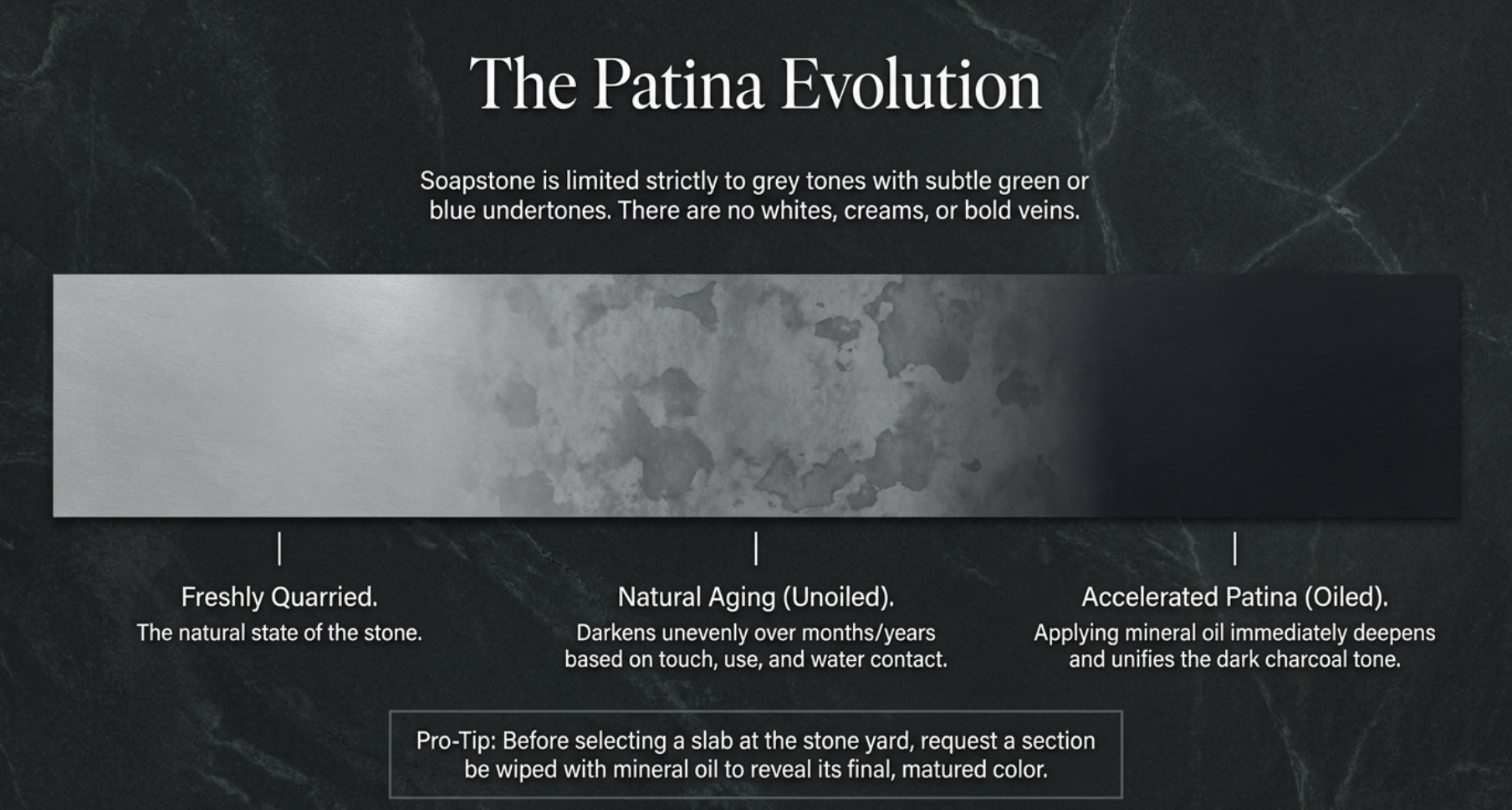
Darkening over time. Soapstone naturally darkens as it ages, especially in areas that receive frequent use or mineral oil application. The darkening can be accelerated and made uniform by applying mineral oil regularly. Some homeowners love this patina and see it as the stone developing character. Others dislike the inconsistent darkening that occurs when some areas of the countertop receive more use than others. The stone will eventually reach a consistent dark tone, but the transition period (which can last months to years depending on oiling frequency) can look uneven.
Soapstone Colors and How the Stone Ages
Freshly quarried soapstone ranges from light silver-grey to medium grey with subtle veining in lighter or darker tones. Some Brazilian varieties have green undertones. Some Virginia varieties lean blue-grey. The veining is always subtle compared to the dramatic patterns found in Calacatta marble or exotic quartzite.
Over time, soapstone darkens. Areas exposed to more use, more water contact, or more mineral oil darken faster, which can create an uneven appearance during the first year. Applying food-grade mineral oil accelerates and unifies the darkening process. The recommended protocol: apply mineral oil weekly for the first month after installation, then monthly for the first year, then every 3 to 6 months as the stone matures and stabilizes its color.
Mineral oil does not seal soapstone (the stone does not need sealing). It simply enhances the natural color and evens out the darkening. Some homeowners choose not to oil at all, letting the stone develop its patina naturally over years. This produces a lighter, more varied surface with areas of different darkness depending on use patterns. Both approaches are valid.
A tip from experienced fabricators: before selecting a slab at the stone yard, ask the yard to apply mineral oil to a section of the stone. This reveals how the slab will look after darkening and prevents the surprise of a dramatically different appearance after the first oiling at home.
How Much Does Soapstone Cost?
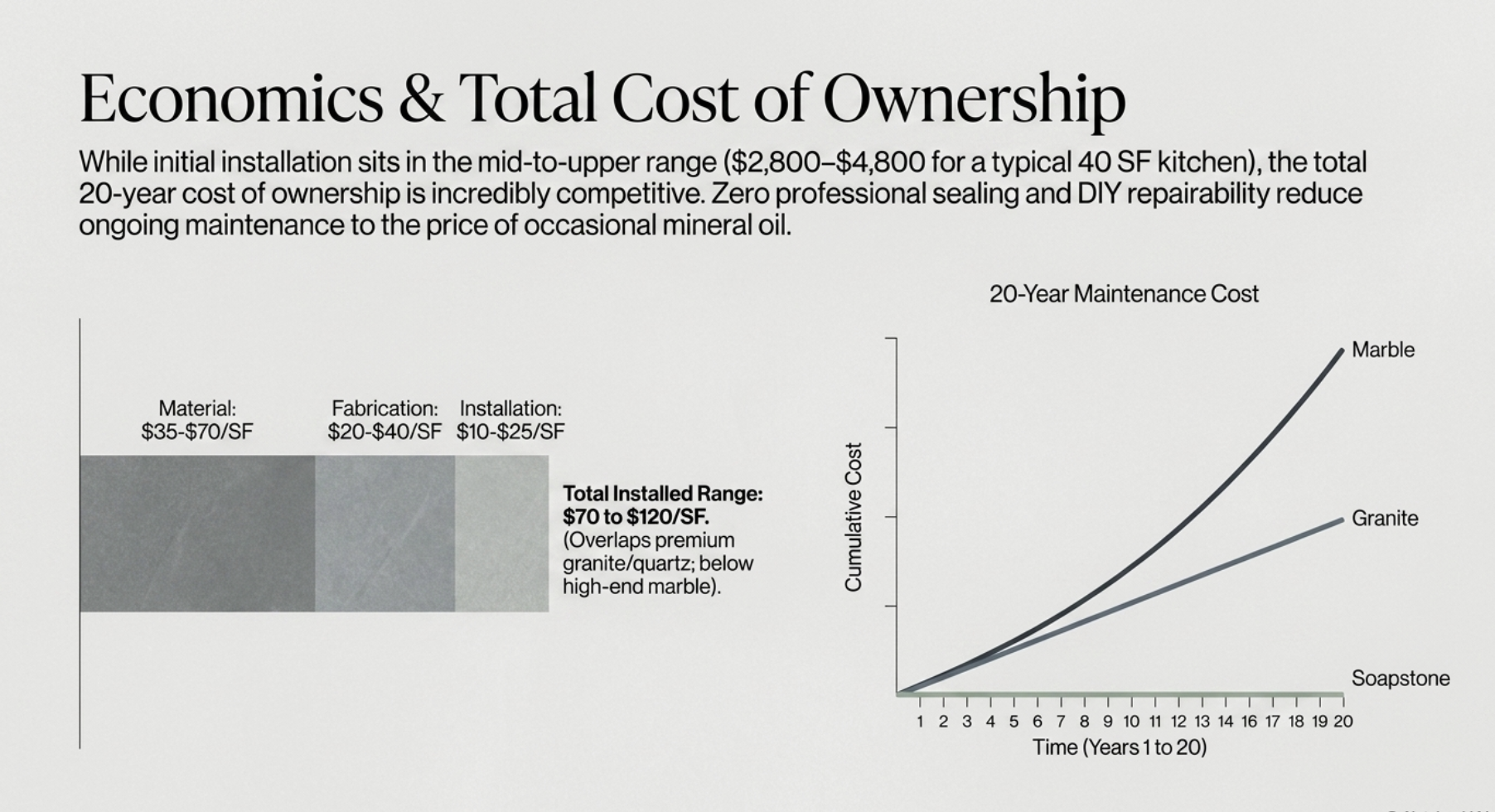
Is soapstone very expensive? Soapstone sits in the mid-to-upper range for natural stone countertops. Installed cost runs $70 to $120 per square foot, which includes material ($35-$70/SF depending on grade, color, and origin), fabrication ($20-$40/SF including edge profiling and cutouts), and installation ($10-$25/SF depending on complexity). For a typical 40 square foot kitchen, expect a total project cost of $2,800 to $4,800.
Is soapstone cheaper than quartz or granite? It depends on the grade being compared. Soapstone overlaps with premium granite and premium quartz in pricing. Basic granite and standard quartz cost less. High-end marble costs significantly more.
| Material | Installed Cost/SF | Sealing Required | Heat Resistant | Acid Resistant | Mohs Hardness | Color Range | Maintenance |
|---|---|---|---|---|---|---|---|
| Soapstone | $70-$120 | Never | Excellent | Excellent | 2.5-5 | Grey tones only | Oil + sand scratches |
| Granite | $50-$150 | Every 1-2 years | Good | Moderate | 6-7 | Very wide | Seal periodically |
| Quartz (engineered) | $50-$130 | Never | Moderate (no hot pots) | Good | 7 | Very wide | Wipe clean |
| Marble | $70-$350+ | Every 6-12 months | Moderate | Poor (etches) | 3-4 | White/grey/colored | Seal + avoid acids |
| Quartzite | $100-$200+ | Every 1-2 years | Good | Good | 7-8 | Wide | Seal periodically |
The total cost of ownership over a decade is more competitive than the installed price suggests. Soapstone has zero sealing costs (ever), zero professional restoration costs, and scratches can be repaired at home with sandpaper and mineral oil. Over a 20-year lifespan, the ongoing maintenance cost is essentially the price of a bottle of mineral oil every few months.
What Is Soapstone Used For?
Kitchen countertops are the most common residential application. The combination of heat resistance (hot pots directly on the surface), acid resistance (no etching from food acids), and zero sealing makes soapstone a practical kitchen surface despite the softness trade-off. The matte, natural aesthetic is particularly popular in NYC brownstone and farmhouse-style kitchen renovations where the material complements period architecture.
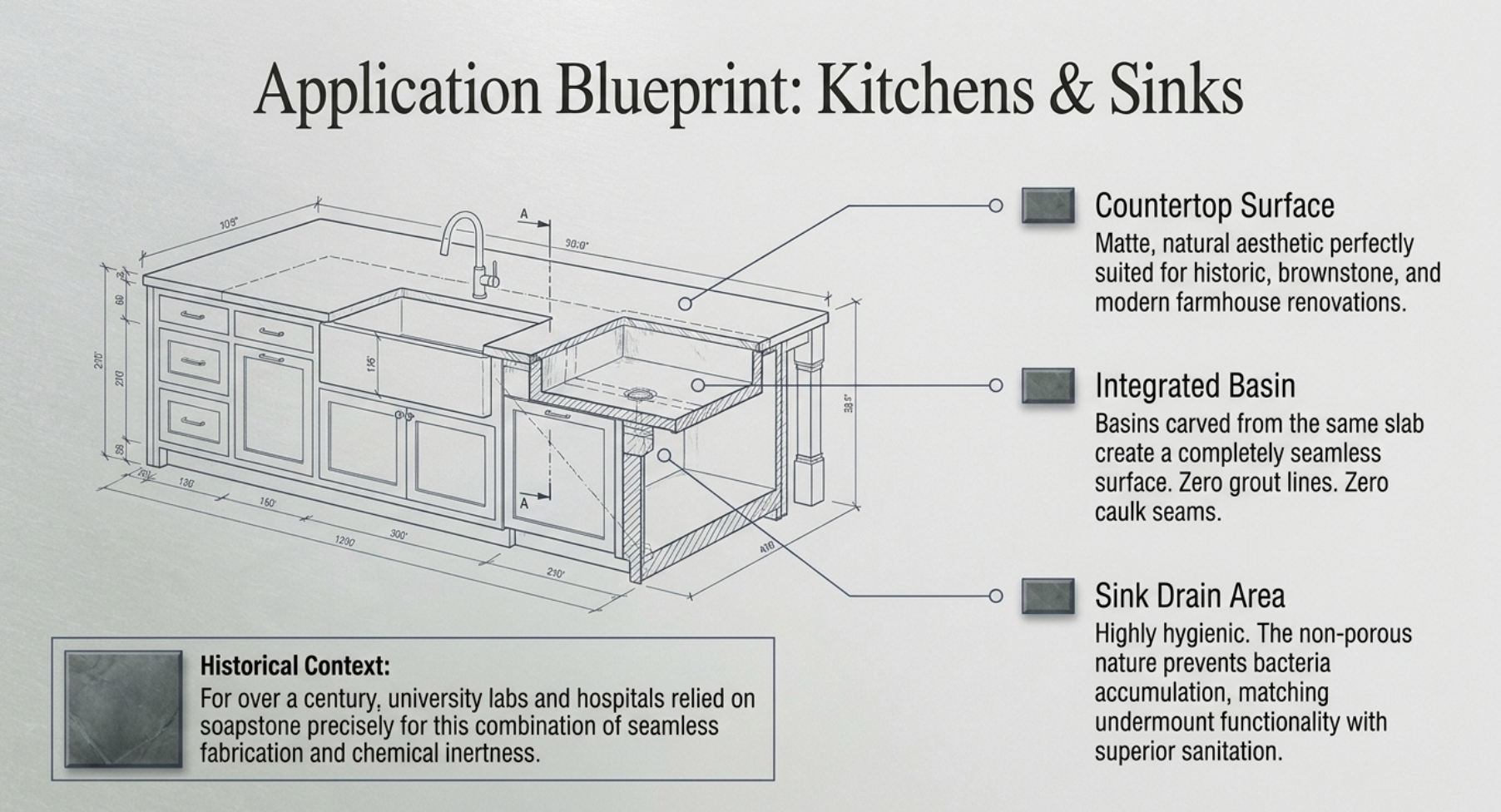
Integrated sinks are a specification option unique to soapstone among natural stones. A basin carved from the same slab as the countertop creates a completely seamless surface with no grout lines, no caulk seams, and no places for bacteria to accumulate. The non-porous nature of soapstone makes this application hygienic in a way that undermount sinks with separate countertops cannot match.
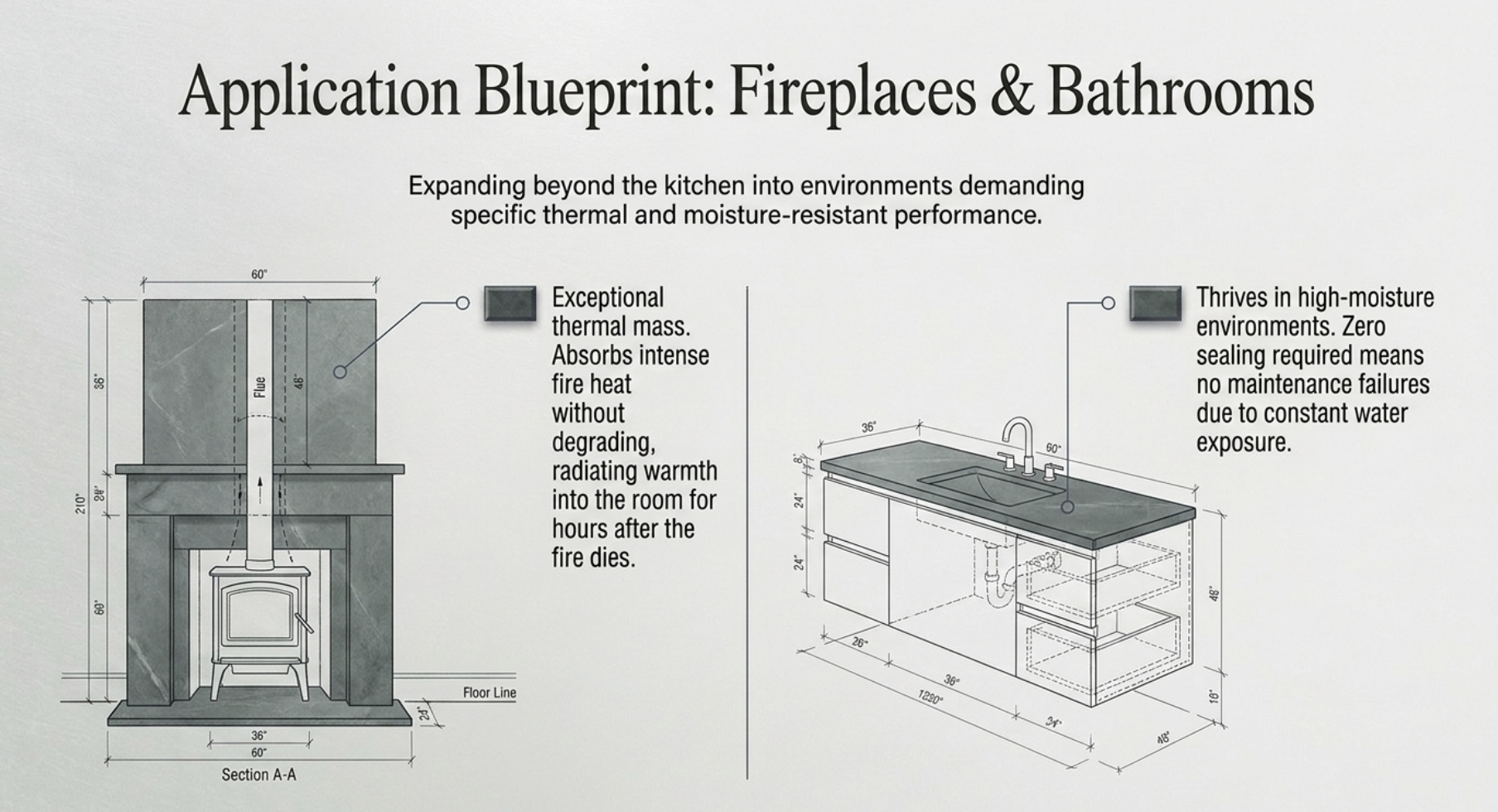
Fireplace surrounds take advantage of soapstone's extraordinary thermal mass. The stone absorbs heat from the fire and radiates it slowly into the room for hours afterward. Scandinavian craftsmen have built entire wood-burning stoves from soapstone for centuries precisely because the material handles extreme thermal cycling without cracking or degrading.
Bathroom vanities and surfaces benefit from the zero-maintenance properties. The limited color range (greys) works with many bathroom palettes, and the non-porous surface means no sealing is needed in the high-moisture bathroom environment.
Laboratory countertops are the historical application that proved soapstone's durability in demanding environments. University chemistry labs, hospitals, and research facilities used soapstone countertops for over 150 years because of its chemical resistance and ease of cleaning. As noted by the Natural Stone Institute, soapstone's non-reactive surface chemistry makes it one of the most practical natural stone surfaces for environments where chemical exposure is constant.
What Does Soapstone Do Spiritually?
In metaphysical and crystal healing traditions, soapstone (also called steatite) is associated with grounding, emotional stability, and calming energy. It is linked to the Root Chakra and the Earth element. Practitioners describe it as a stone that promotes truth, logic, and creative thinking while providing a stabilizing, protective energy. The Crystal Council's reference on steatite describes soapstone as an excellent conductor of energy that aids in healing by stabilizing ambient temperature.
The material's spiritual significance extends far beyond modern crystal healing. Soapstone has been carved into sacred amulets and ceremonial objects by cultures worldwide for thousands of years. Native American tribes used soapstone for ceremonial pipes and cooking vessels. Ancient Egyptians carved amulets and beads from it. Inuit peoples of Canada and Greenland used soapstone for tools, lamps, and spiritual carvings. Chinese civilizations worked soapstone during the Zhou dynasty (700-400 BC). Australian Aboriginal groups and multiple Indian civilizations between the 10th and 16th centuries also used soapstone in spiritual and ceremonial contexts.
While these spiritual properties fall outside the scope of construction specification, the question "what does soapstone do spiritually?" appears frequently in search results and deserves a factual, respectful answer. The material's human history extends far beyond countertops and fireplaces.
How to Maintain Soapstone
Daily cleaning: warm water and mild dish soap. No special stone cleaner required. No pH-neutral formulas needed. Soapstone is chemically inert, so virtually any household cleaner is safe on the surface. This is a significant advantage over marble (which requires pH-neutral cleaners to avoid etching) and granite (which can be damaged by acidic or abrasive cleaners on unsealed areas).
Mineral oil application: apply food-grade mineral oil with a soft cloth, let it soak for 20 to 30 minutes, then wipe off the excess. Monthly for the first year, then every 3 to 6 months. The oil deepens and evens the stone's color. It is cosmetic, not protective. Soapstone does not need protection because it is already non-porous.
Scratch repair: sand the scratched area with 220-grit sandpaper along the grain, follow with 400-grit for smoothness, then apply mineral oil to the sanded area. The entire countertop can be resurfaced this way in 5 to 10 minutes. Keep a small piece of sandpaper and a bottle of mineral oil under the sink. This is the only countertop material where homeowners can perform true surface repair at home without professional help.
Does soapstone need to be sealed? No. Never. Soapstone is naturally non-porous and never requires sealing of any kind. Mineral oil is applied for cosmetic purposes (deepening color and evening the patina), but it is not a sealant and serves no protective function.
Soapstone vs Granite vs Quartz: How to Choose
The choice between soapstone, granite, and quartz comes down to which trade-offs matter most for the specific household and application.
Choose soapstone if heat resistance is a priority (placing hot cookware directly on the surface without trivets), acid resistance matters (no etching from food acids), zero sealing is valued, the grey color palette works with the design, and the patina that develops over time is appealing rather than concerning. The softness trade-off is acceptable if the household is comfortable with periodic sanding.
Choose granite if hardness and scratch resistance are priorities (Mohs 6-7), a wider color range is needed (granite comes in hundreds of colors and patterns), and the homeowner is willing to seal periodically (every 1-2 years for most granites).
Choose quartz if zero maintenance is the top priority (no sealing, no oiling, no sanding), visual consistency matters (engineered quartz is uniform from slab to slab), a wide color range is needed (quartz is manufactured in virtually any color and pattern), and the household wants the hardest possible surface (Mohs 7). The trade-off: quartz is not heat resistant. Hot pots can damage the resin binder.
Choose marble if authenticity and dramatic veining are paramount, the homeowner accepts maintenance (sealing every 6-12 months plus acid avoidance), and the project calls for a bright white background with bold veining that soapstone cannot provide. See our Calacatta marble guide for the full natural marble specification reference.
Frequently Asked Questions
What is the downside of soapstone?
Soapstone is soft (Mohs 2.5-5) and scratches from daily kitchen use. The color range is limited to shades of grey with subtle green or blue undertones. The stone darkens over time, and the transition period can look uneven until the patina stabilizes. Scratches are repairable with sandpaper, but the maintenance is ongoing.
Is soapstone very expensive?
Soapstone costs $70 to $120 per square foot installed, positioning it in the mid-to-upper range for natural stone countertops. It costs more than basic granite and standard quartz but less than high-end marble and exotic quartzite. The total cost of ownership is competitive because soapstone never needs sealing or professional restoration.
Is soapstone cheaper than quartz or granite?
Soapstone ($70-$120/SF installed) overlaps with premium granite ($80-$150/SF) and premium quartz ($80-$130/SF). Basic granite and standard quartz ($50-$80/SF) cost less. High-end marble ($150-$350+/SF) costs significantly more. Over a 20-year lifespan, soapstone's zero-sealing advantage reduces total ownership cost.
Does soapstone need to be sealed?
No. Soapstone is naturally non-porous and never requires sealing. Mineral oil is applied optionally to deepen the stone's color and even out the patina, but it is cosmetic, not protective.
Does soapstone darken over time?
Yes. Soapstone naturally darkens from light grey to dark grey or charcoal over months to years. Applying mineral oil accelerates and unifies this process. Without oil, the darkening happens unevenly as different areas receive different amounts of use and moisture.
What does soapstone do spiritually?
In metaphysical traditions, soapstone is associated with grounding, emotional stability, and calming energy. It is linked to the Root Chakra and has been used in spiritual and ceremonial contexts by cultures worldwide for thousands of years, including Native American tribes, ancient Egyptians, Inuit peoples, and Chinese civilizations.
Soapstone is a natural stone with a unique set of properties: non-porous, heat resistant, acid resistant, warm to the touch, and it never needs sealing. The trade-offs (softness, limited color range, darkening over time) are real and should be understood before specifying. For kitchens where heat resistance and zero sealing matter, for fireplaces where thermal mass is the priority, and for bathrooms where low maintenance is valued, soapstone is a strong option that many homeowners overlook.
If you are considering soapstone for a kitchen, bathroom, or fireplace surround and need guidance on slab selection, fabrication, or how it compares to other stones for your specific application, start a conversation with us. CooperBuild works with the full range of natural stone options for custom residential projects in NYC, the Hamptons, and South Florida. See completed examples in our project portfolio, or learn about our custom millwork services where stone countertop coordination is part of the process.
Sources & Additional Reading
Considering Soapstone for Your Project?
CooperBuild works with the full range of natural stone options for custom residential projects in NYC, the Hamptons, and South Florida. From slab selection to fabrication and installation, we help you choose the right material for how you actually live.
Start a ConversationSubscribe to Our Newsletter
Get the latest insights, trends, and news from the construction industry delivered straight to your inbox.
We respect your privacy. Unsubscribe at any time.