

What Is Calacatta? The Complete Guide to Marble, Quartz, and Porcelain
Understanding all Calacatta options: natural marble, engineered quartz, and porcelain
Calacatta is a family of premium Italian white marbles quarried in the Apuan Alps near Carrara, Italy. It is defined by a bright white background with bold, dramatic veining in gold, grey, brown, or violet. Calacatta is rarer and more expensive than Carrara marble, with natural slabs ranging from $150 to $350+ per square foot installed. Calacatta quartz (engineered) and Calacatta porcelain (large-format tile) offer the aesthetic at lower price points with less maintenance. This guide covers the major varieties (Gold, Borghini, Viola, Oro, Lincoln, Macchia Vecchia), material comparisons (marble vs quartz vs porcelain), cost ranges, popular applications, and how to choose the right Calacatta surface for your project.
"Calacatta" is one of the most searched stone terms in residential renovation. It is also one of the most misunderstood. It is not one stone. It is a family of Italian marbles, and the name now extends to engineered quartz and porcelain products that replicate the Calacatta aesthetic. Homeowners confuse it with Carrara. Designers debate natural marble versus quartz. Slab yards stock a dozen named varieties, and each looks completely different from the next.
This guide covers what calacatta actually is, where it comes from, the six major varieties, the difference between natural marble and engineered alternatives, how it compares to Carrara, real cost ranges, popular applications, and how to choose the right Calacatta surface for any project. On the Carroll Gardens bath renovation in Brooklyn, CooperBuild specified Calacatta Turquoise Honed 2CM by Bas Stone across six distinct applications from a single lot. That kind of multi-application specification is where these details matter most.
What Is Calacatta?
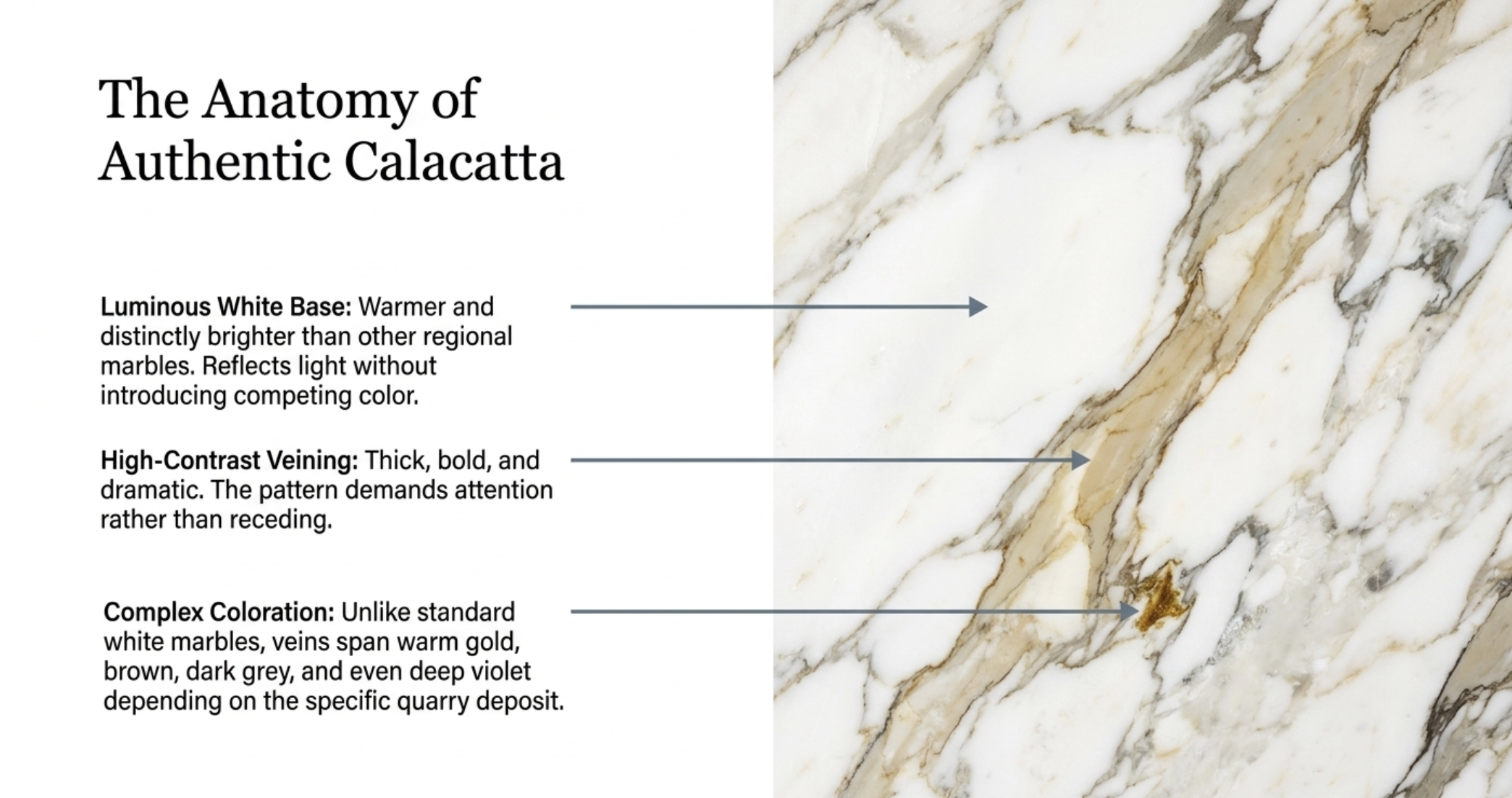
Calacatta marble is a premium Italian natural stone quarried from the Apuan Alps near Carrara in the Tuscany region of Italy. It is a metamorphic rock (limestone transformed by heat and pressure over millions of years) classified within the broader family of Carrara-region marbles. What distinguishes Calacatta from other white marbles is the combination of a bright, clean white background with bold, dramatic veining. The veins range from warm gold and brown to dark grey to deep violet depending on the specific quarry deposit.
Calacatta has been quarried since Roman times. The deposits that produce it are limited to specific zones higher in the Apuan Alps, making it significantly rarer than Carrara marble. This scarcity, combined with the visual drama of the stone, is what makes Calacatta one of the most sought-after surface materials in luxury residential construction. Each slab is completely unique, with veining patterns that cannot be replicated.
For a deeper look at natural Calacatta marble, its properties, sealing, and maintenance, see our complete guide to Calacatta Marble: Everything You Need to Know.
Where Does Calacatta Marble Come From?
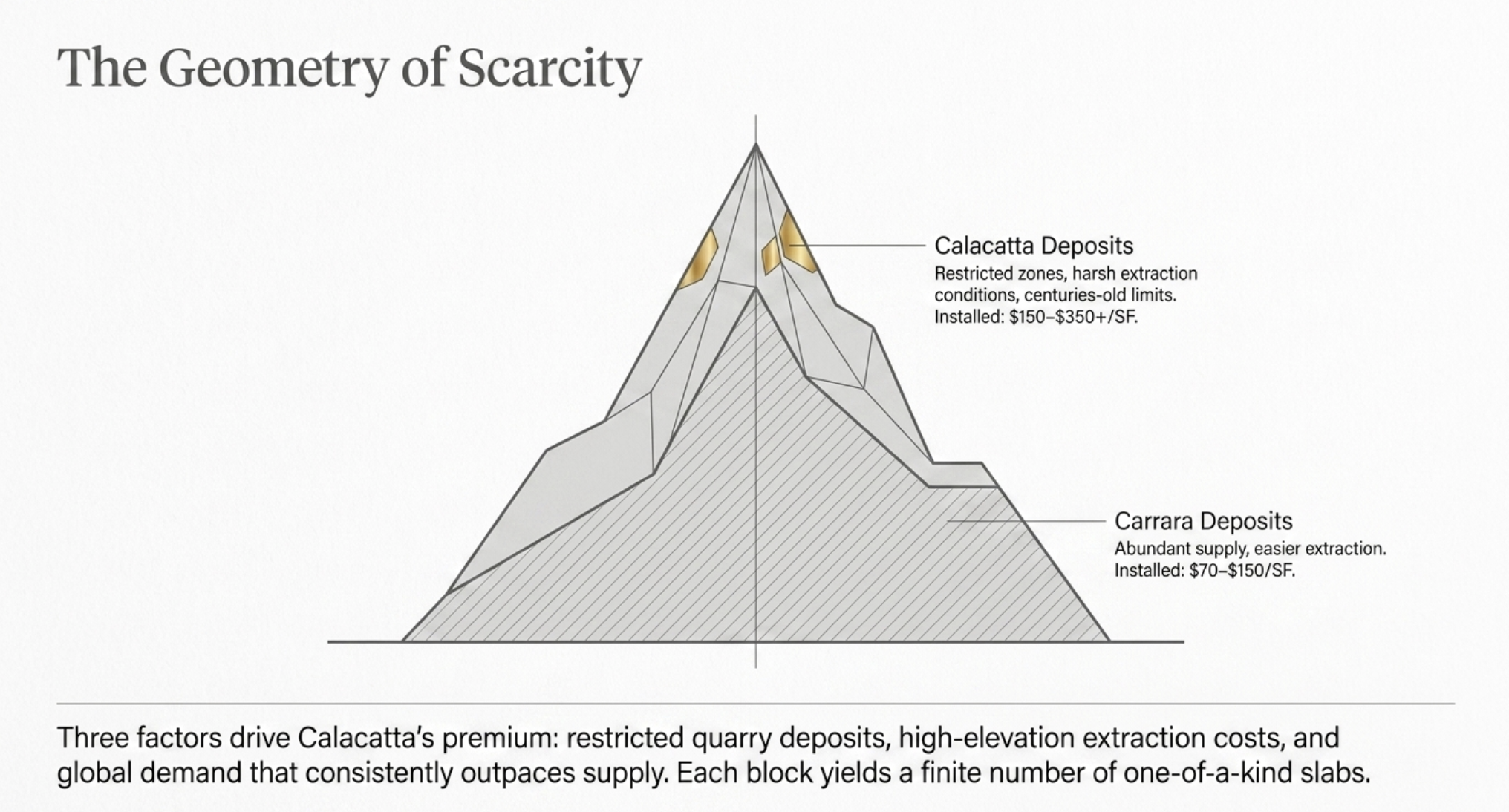
All Calacatta marble originates from quarries in the Apuan Alps, a mountain range in the Carrara region of Tuscany, Italy. The same mountain range produces Carrara marble, but Calacatta is extracted from more limited, specific deposits at higher elevation. These restricted quarry zones are centuries old, and the geological conditions at each deposit (mineral content, pressure, temperature during formation) determine the veining characteristics of the stone pulled from that location. This is why so many named varieties exist: each name corresponds to a specific quarry or deposit.
The quarrying process involves extracting large blocks from the mountainside using diamond wire saws. The blocks are transported to cutting facilities and sliced into individual slabs. Each block yields a finite number of slabs, and no two are identical. Even consecutive slabs from the same block will have slightly different veining patterns.
What does calacatta mean? The name refers to the specific quarry area in the Apuan Alps. It is not a descriptive term. It is a geographic origin marker, similar to how Champagne refers to wine from a specific French region. Stone marketed as "Calacatta" that originates from Turkey, China, or Brazil is not authentic Calacatta.
Why is Calacatta so expensive? Three factors: limited quarry deposits (far less available than Carrara), high extraction cost (the deposits are at higher elevation and harder to access), and global demand that consistently outpaces supply.
What Makes Calacatta Different?
Three characteristics define Calacatta and separate it from Carrara, Statuario, and other white marbles.
Background color. Calacatta has a bright, clean white base. Carrara trends grey or blue-grey. This brightness is what makes Calacatta read as a premium stone in person. The white is warmer and more luminous than most other white marbles.
Veining. Calacatta veins are thick, bold, and dramatic with high contrast against the white background. Carrara veining is softer, more feathery, and lower contrast. Calacatta's veining demands attention. Carrara's veining recedes.
Vein color. Calacatta veining ranges from warm gold and brown to dark grey to violet, depending on the variety. Carrara veining is almost exclusively grey. This color variation is what gives each Calacatta variety its distinct identity and why designers select specific varieties for specific applications.
Types of Calacatta
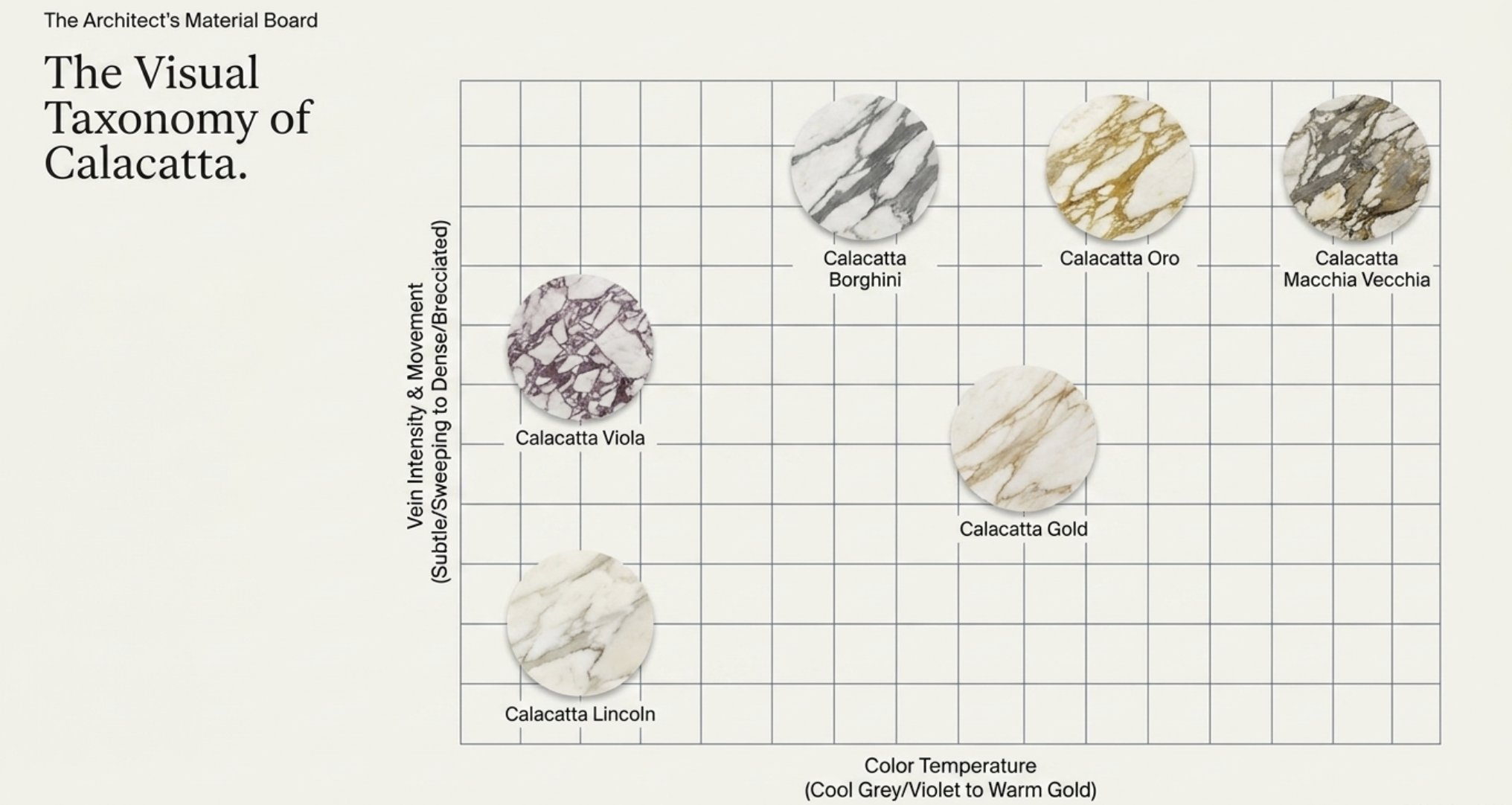
"Calacatta" is not a single stone. Each named variety comes from a specific quarry or deposit with distinct visual characteristics. These are the six varieties most commonly specified in residential and commercial projects.
Calacatta Gold
The most recognized Calacatta variety. Bright white background with warm gold and brown veining that flows in broad, sweeping patterns. Calacatta Gold is the most available of the Calacatta varieties, which makes it the least expensive (though still significantly more than Carrara). It is the default specification for Calacatta kitchen countertops and islands where the designer wants the classic Calacatta look. The gold tones work particularly well in kitchens with warm lighting and natural wood cabinetry. Installed cost typically runs $150 to $250 per square foot.
Calacatta Borghini
Similar to Gold but with thicker grey veining and less gold coloration. The veining movement is bolder and more dramatic, with larger, more defined patterns that read from across a room. Borghini is often specified for statement pieces: a single kitchen island, a fireplace surround, a feature wall where the stone is the focal point and needs to carry the visual weight of the space. More limited availability than Gold. Installed cost: $200 to $300+ per square foot.
Calacatta Oro
"Oro" means gold in Italian, and this variety delivers: heavy, saturated gold veining on a warm white background. The gold is richer and more pronounced than Calacatta Gold. Calacatta Oro produces a warmer, more opulent look that pairs well with traditional and transitional interior styles. The strong gold tones make it a popular choice for formal kitchens, master bath vanities, and entry foyers where warmth and richness are the design priority.
Calacatta Lincoln
Grey-brown veining on a creamy white background. Named after the Lincoln quarry, this variety has a softer character than Borghini and a warmer tone than standard grey-veined varieties. The veining is moderate in scale, neither as bold as Borghini nor as subtle as Carrara. Calacatta Lincoln has grown in popularity for bathroom applications where a quieter Calacatta presence is appropriate. The creamy background softens the overall impression.
Calacatta Viola
Distinctive purple, burgundy, and violet veining on a white background. The pattern is brecciated (broken, mosaic-like), giving it an entirely different character from the flowing veins of Gold or Borghini. Calacatta Viola has gained significant prominence in high-end design in recent years. It is highly distinctive and polarizing: designers either specify it deliberately or avoid it entirely. There is no mistaking Viola for any other stone. Installed cost: $250 to $350+ per square foot.
Calacatta Macchia Vecchia
Dense, dramatic veining covering most of the slab surface, leaving less white background visible than any other Calacatta variety. "Macchia Vecchia" translates roughly to "old stain," describing the stone's heavily marked appearance. This is Calacatta at its most dramatic: high movement, high contrast, and a visual intensity that works best as a single focal point (a fireplace face, a feature wall, or a powder room vanity) rather than across a large continuous surface.
Calacatta Marble vs Carrara Marble
These are the two Italian white marbles that architects and designers encounter most frequently. Both come from the Carrara region of Tuscany. Both are calcium carbonate with similar hardness (Mohs 3-4) and similar maintenance requirements. The differences are visual and economic.
Carrara has a light grey to blue-grey background with soft, feathery grey veining. It is the most available Italian white marble and the most affordable. Carrara is the workhorse: large-format flooring, full bathroom cladding, kitchen countertops where a softer, less dramatic stone is appropriate. Calacatta has a bright white background with bold, dramatic veining in gold, brown, or grey. It is rarer, more expensive, and more visually assertive. Calacatta is the statement stone.
Calacatta Marble vs Quartz
Natural calacatta marble is porous (requires sealing every 6 to 12 months), etches from acidic contact (lemon, wine, vinegar), and develops a patina over years of use. Every slab is unique. It is quarried in Italy. Mohs hardness is 3-4.
Calacatta quartz is engineered stone: ground natural quartz bound with polymer resin, with Calacatta-pattern veining printed or embedded during manufacturing. It is non-porous (no sealing), does not etch, and is consistent from slab to slab. Mohs hardness is 7. It costs less: $60 to $120 per square foot installed versus $150 to $350+ for natural marble.
Calacatta Quartz: The Modern Alternative
Calacatta quartz is an engineered surface designed to replicate the Calacatta marble aesthetic without the porosity, etching, or maintenance. It is manufactured by binding ground natural quartz with polymer resin, then printing or embedding Calacatta-pattern veining during the production process. The result is a surface that reads as Calacatta from a normal viewing distance but is functionally closer to granite in durability.
Major products include Caesarstone Calacatta Maximus (5031), Silestone Calacatta Gold, MSI Calacatta Classique, and Cambria Brittanicca. Each brand's interpretation of the Calacatta pattern differs: some are bolder, some subtler, some warmer, some cooler. Unlike natural marble, quartz slabs are consistent from one to the next. No slab yard visit is required because the product looks the same in every shipment.
The trade-off is authenticity. Close up, the veining pattern in engineered quartz reads differently than natural marble. The depth, translucency, and organic irregularity of real Calacatta cannot be fully replicated. For high-use family kitchens where maintenance tolerance is low, quartz is the practical choice. For spaces where the stone itself is the design statement, natural marble delivers what quartz cannot.
Calacatta Porcelain
The newest format in the Calacatta family. Large-format porcelain slabs (up to 120" x 60") use digital inkjet printing technology to replicate Calacatta veining on a ceramic body. The result is a surface that approximates the Calacatta look with extreme durability: harder than both marble and quartz, completely non-porous, heat-resistant, UV-stable, and suitable for outdoor applications.
Porcelain slabs are thinner than marble or quartz (typically 6mm to 12mm versus 20mm to 30mm for natural stone). This lower weight allows installation on walls, backsplashes, and surfaces where natural marble would be too heavy. The material is less expensive than both natural marble and premium quartz, making it the most budget-friendly path to a Calacatta aesthetic.
The trade-off: the most discerning eye can distinguish porcelain from natural marble, particularly at the edges and in how light interacts with the surface. The veining pattern repeats across production runs. For large commercial applications, outdoor kitchens, or high-traffic areas where durability outweighs material authenticity, Calacatta porcelain is a strong specification.
Popular Uses for Calacatta
Kitchen countertops are the most common application. Calacatta Gold is the default specification for kitchen islands, particularly in open-plan layouts where the island is the visual center of the room. A Calacatta countertop on a 10-foot island with a waterfall edge is one of the most requested surfaces in NYC residential renovation.
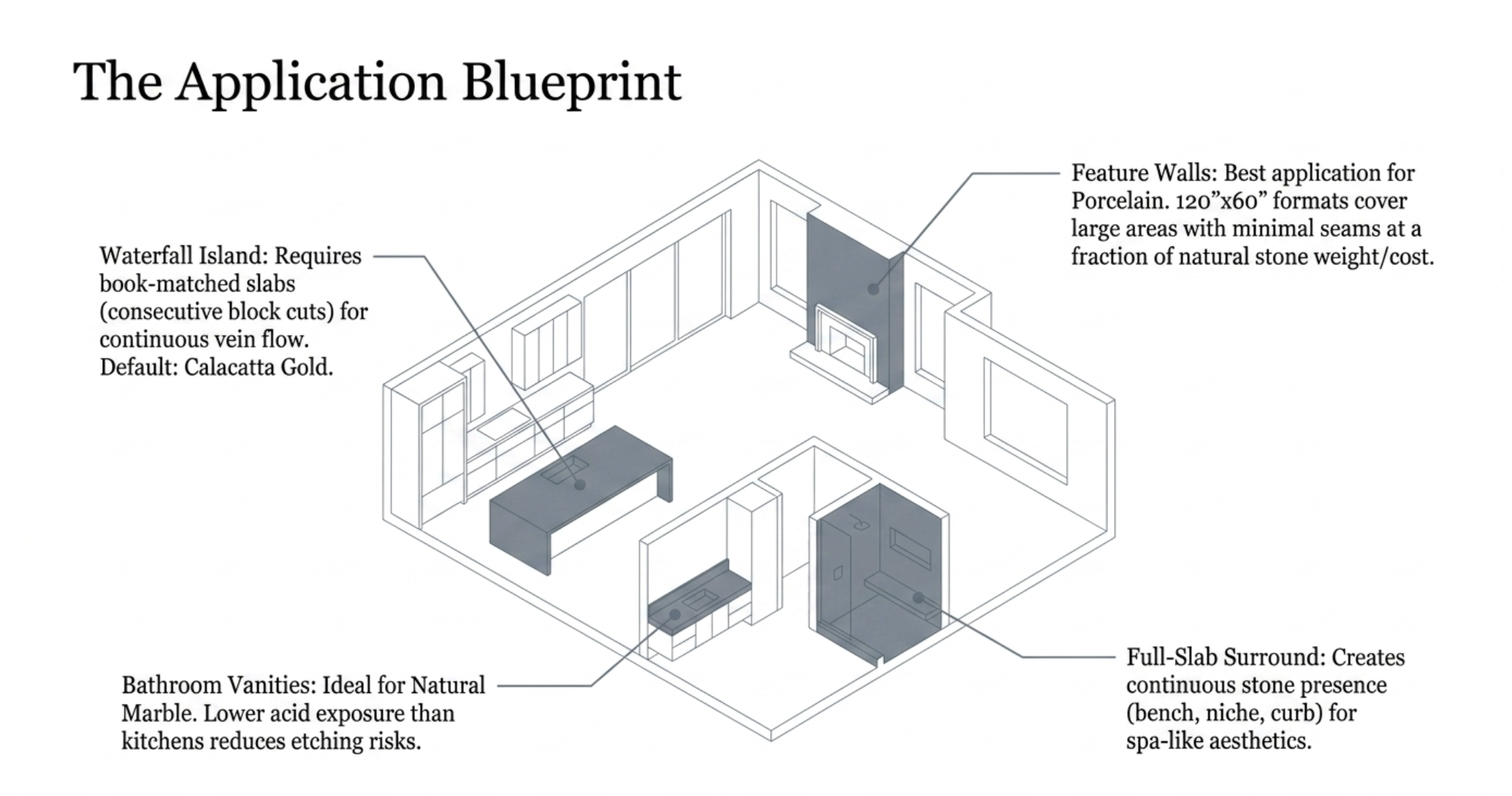
Waterfall islands take the countertop specification further by wrapping the slab from the horizontal surface down the sides, creating a continuous flow of veining from top to floor. This application requires book-matched slabs (consecutive cuts from the same block) for the veining to read as continuous across the seams.
Bathroom vanities are an excellent application for natural Calacatta marble. The bathroom environment has far less acid exposure than a kitchen, meaning the stone etches less in daily use. A Calacatta vanity top with a matching backsplash creates a cohesive focal point.
Shower walls and full-slab shower surrounds create dramatic, spa-like enclosures. On CooperBuild's Carroll Gardens project, Calacatta Turquoise Honed 2CM was used for the steam shower bench, shower niche, shower curb, and wall base, creating a continuous stone presence across multiple surfaces within the enclosure.
Fireplace surrounds use a single Calacatta slab as the fireplace face, creating a focal point that anchors the room. Borghini and Macchia Vecchia, with their bolder veining, work particularly well in this application.
Feature walls use full-height marble or porcelain slabs behind a dining area, entry, or living room. This is where Calacatta porcelain excels: the large format (up to 120" x 60") covers a full wall with minimal seams at a fraction of the cost of natural marble.
Why New York City and Miami Homeowners Love Calacatta
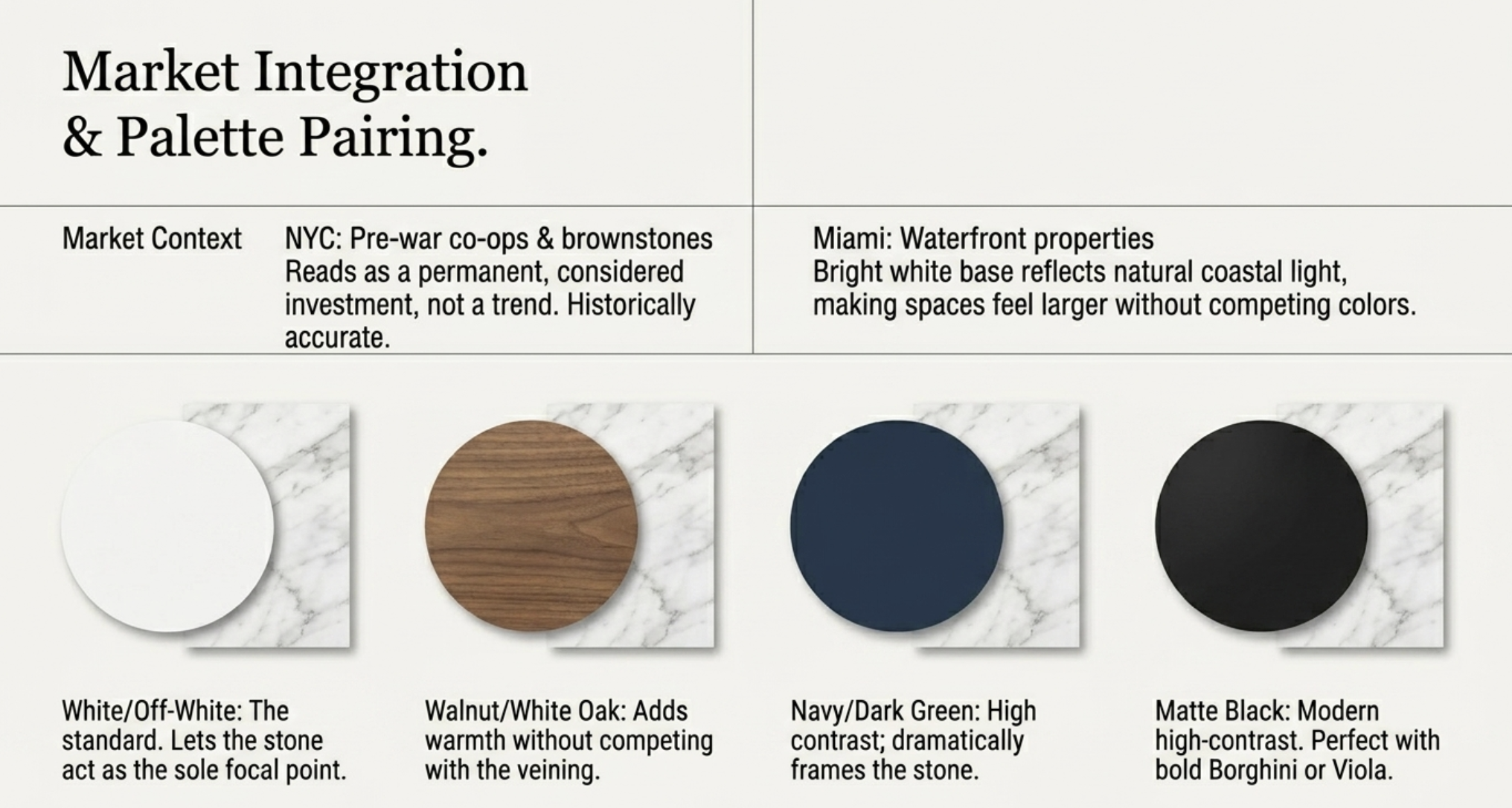
The luxury residential markets in NYC and South Florida gravitate toward Calacatta for practical reasons beyond aesthetics. In pre-war Manhattan co-ops and brownstones, a Calacatta kitchen island or bathroom vanity reads as a considered investment, not a trend. The material has been specified in high-end interiors for centuries. It does not date the way patterned tiles or colored stone can.
In Miami waterfront properties, the bright white background works with the natural light and coastal palette that defines South Florida interior design. The stone reflects light without introducing competing color, making spaces feel larger and more open.
Calacatta works equally well in modern minimalist interiors (clean slab with minimal veining) and traditional interiors (dramatic veining with classic proportions). The color palette is inherently neutral: white, gold, grey. It does not compete with other materials in the room. Real estate professionals recognize Calacatta as a premium indicator that signals quality throughout the rest of the construction.
How Much Does Calacatta Cost?
Costs vary significantly by material format, variety, and project complexity. These are installed ranges (material, fabrication, templating, and installation included).
Natural Calacatta Marble: $150 to $350+ per square foot installed. Calacatta Gold sits at the lower end ($150-$250). Borghini and Viola command the upper range ($250-$350+). Slab cost is typically 40-50% of the total, with fabrication, templating, and installation making up the rest. Edge profiles, cutout complexity, and seam count affect the fabrication portion.
Calacatta Quartz: $60 to $120 per square foot installed. Less variation between brands. Fabrication is simpler than natural marble because quartz does not etch or chip as easily during cutting.
Calacatta Porcelain: $30 to $80 per square foot installed. The most affordable format. Installation requires specialized large-format tile handling and trained installers, but the material cost is substantially lower than marble or quartz.
These are ranges, not quotes. Actual project costs depend on slab selection, edge profiles, cutout complexity, seam count, access logistics, and fabricator pricing in the local market.
How to Choose the Right Calacatta Surface
Four factors determine which Calacatta format is right for a specific project.
Budget is the most straightforward filter. Natural marble is 2-3x the cost of quartz and 4-5x the cost of porcelain. If budget is the primary constraint, quartz or porcelain delivers the Calacatta aesthetic at a significantly lower installed cost.
Maintenance preference separates the three formats clearly. Natural marble requires sealing every 6-12 months and careful daily use (pH-neutral cleaners, no acidic contact, immediate spill cleanup). Quartz and porcelain require nothing. For households with young children, heavy kitchen use, or low tolerance for maintenance rituals, quartz is the practical choice.
Design goals come down to authenticity and uniqueness. If every slab being a one-of-one geological artifact matters, natural marble is the only option. Quartz slabs are consistent from one to the next, and porcelain patterns repeat across production runs. For a statement kitchen island or feature wall where the stone itself is the design centerpiece, natural marble delivers what engineered products cannot replicate.
Traffic levels affect long-term performance. High-traffic kitchens with daily cooking favor quartz (harder, no etching). Lower-traffic bathrooms, powder rooms, and feature walls favor natural marble (the maintenance burden is lower when acid exposure is minimal). Outdoor applications and commercial spaces favor porcelain (UV-stable, heat-resistant, extreme durability).
Frequently Asked Questions
Is Calacatta real marble?
Yes. Calacatta is natural marble quarried in the Apuan Alps near Carrara, Italy. The name also applies to quartz and porcelain products that replicate the Calacatta aesthetic, but the original Calacatta is authentic Italian metamorphic stone. When a specification reads "Calacatta marble," it refers to the natural quarried product.
Is Calacatta better than Carrara?
They serve different purposes. Calacatta is brighter, bolder, and more expensive. Carrara is softer, more available, and more affordable. Neither is objectively better. Calacatta is the statement stone for focal points. Carrara is the workhorse for large continuous surfaces. The right choice depends on the design intent and budget.
Is Calacatta quartz expensive?
Calacatta quartz ranges from $60 to $120 per square foot installed. This is less expensive than natural Calacatta marble ($150-$350+) but more expensive than basic quartz ($40-$60). The premium over basic quartz reflects the more complex veining patterns and the brand positioning of Calacatta-named products.
Does Calacatta go out of style?
White marble with bold veining has been specified for centuries, from Roman architecture through Renaissance interiors to contemporary luxury residences. Calacatta's neutral palette (white, gold, grey) works with nearly any design direction. It is not trend-dependent. The material predates every current interior design trend and will outlast them.
What cabinet colors work best with Calacatta?
White and off-white cabinets are the most common pairing, letting the stone be the focal point. Navy and dark green create high contrast that frames the stone dramatically. Natural wood tones (walnut, white oak) add warmth without competing with the veining. Black cabinetry produces a high-contrast modern look that works particularly well with bolder varieties like Borghini and Viola.
What does calacatta mean?
The name refers to the specific quarry area in the Apuan Alps near Carrara, Italy. It is a geographic origin marker, not a descriptive term. Similar to how "Champagne" identifies sparkling wine from a specific French region, "Calacatta" identifies marble from a specific set of Italian quarry deposits.
Why is Calacatta so expensive?
Three factors compound to create the premium. Limited quarry deposits produce far less stone per year than the massive Carrara deposits. The Calacatta deposits are at higher elevation and harder to access, increasing extraction cost. Global demand for the material consistently outpaces supply, particularly for premium varieties like Borghini and Viola.
Calacatta is not one stone. It is a family of materials spanning natural Italian marble, engineered quartz, and large-format porcelain, each offering the distinctive white-and-veined aesthetic at different price points and maintenance levels. Natural Calacatta marble is the authentic product (quarried in Italy, every slab unique, requires care). Calacatta quartz delivers the look with zero maintenance and lower cost. Calacatta porcelain is the most durable and most affordable format. The right choice depends on budget, maintenance tolerance, design goals, and how the surface will be used daily.
If you are specifying Calacatta for a project and need guidance on variety selection, material format, or fabricator coordination, start a conversation with us. CooperBuild coordinates stone selection, fabrication, and installation for custom residential and commercial projects in NYC, the Hamptons, and South Florida. On the Carroll Gardens bath renovation, we specified Calacatta Turquoise Honed 2CM across six applications from a single lot. See more examples in our project portfolio, or learn about our custom millwork services.
Specifying Calacatta for Your Project?
CooperBuild coordinates stone selection, fabrication, and installation for custom residential and commercial projects in NYC, the Hamptons, and South Florida. From variety selection to seam planning, we manage the details that make Calacatta specification work.
Start a ConversationSubscribe to Our Newsletter
Get the latest insights, trends, and news from the construction industry delivered straight to your inbox.
We respect your privacy. Unsubscribe at any time.