

Calacatta Marble: Everything You Need to Know
Complete guide to natural Calacatta marble: properties, sealing, etching, and specification
Calacatta marble is a natural Italian white marble quarried in the Apuan Alps near Carrara, with a bright white background and bold veining in gold, grey, brown, or violet. It is a calcium carbonate stone with Mohs hardness of 3-4, meaning it is softer than granite and quartz. It is porous (requires sealing every 6-12 months) and etches from acidic contact (lemon, wine, vinegar), though etching is a surface reaction, not a stain. Honed finishes hide etching better than polished. Major varieties include Calacatta Gold, Borghini, Oro, Lincoln, Viola, and Macchia Vecchia. For custom projects, slab selection should happen in person at the stone yard, and finish selection (polished vs honed) should be finalized before fabrication begins.
This guide focuses exclusively on natural Calacatta marble: the quarried Italian stone, its geological properties, its varieties, its maintenance realities, and how to specify it correctly for a custom project.
Every client considering natural Calacatta marble raises two concerns: maintenance and durability. Both are valid. Calacatta marble requires care. It etches from acid contact. It needs sealing. It develops a patina over years of use. These are not drawbacks to hide. They are characteristics of the material that should be understood before approving a specification.
This guide covers the geological properties, how the stone is quarried and processed, the major varieties, sealing and etching realities, finish options (polished, honed, leathered), slab selection at the stone yard, fabrication and installation, and how the material ages. On the Carroll Gardens bath renovation in Brooklyn, CooperBuild specified Calacatta Turquoise Honed 2CM by Bas Stone across six applications from a single lot: vanity countertops, backsplashes, steam shower bench, shower niche, shower curb, and wall base.
What Is Calacatta Marble? Origin and Geological Properties
Calacatta marble is a metamorphic rock: limestone that was transformed by extreme heat and pressure deep within the Apuan Alps over millions of years. The mineral composition is primarily calcium carbonate (CaCO3), with trace minerals (iron oxide, clay, mica) creating the colored veining. The specific mineral content at each quarry deposit determines the vein color. Iron-rich deposits produce gold and brown veining. Deposits with different trace minerals produce grey, green, or violet veining.
The physical properties matter for specification. Mohs hardness is 3-4, which means Calacatta is softer than granite (6-7) and significantly softer than engineered quartz (7). Density is approximately 2.7 g/cm3. The stone is porous, with a water absorption rate of 0.2-0.5% depending on the specific slab. It has thermal sensitivity: placing a hot pot directly on a polished surface can cause thermal shock (a sudden temperature change that may crack or discolor the stone).
All Calacatta marble originates from quarries in the Apuan Alps near Carrara, in the Tuscany region of Italy. The deposits sit higher in the mountain range than the more accessible Carrara marble deposits, which is why extraction is more difficult and the stone costs more. Blocks are cut from the mountainside using diamond wire saws, transported to processing facilities, and sliced into slabs typically 2CM (3/4") or 3CM (1-1/4") thick. Each block yields a finite number of slabs, and no two are identical.
Calacatta Marble Varieties
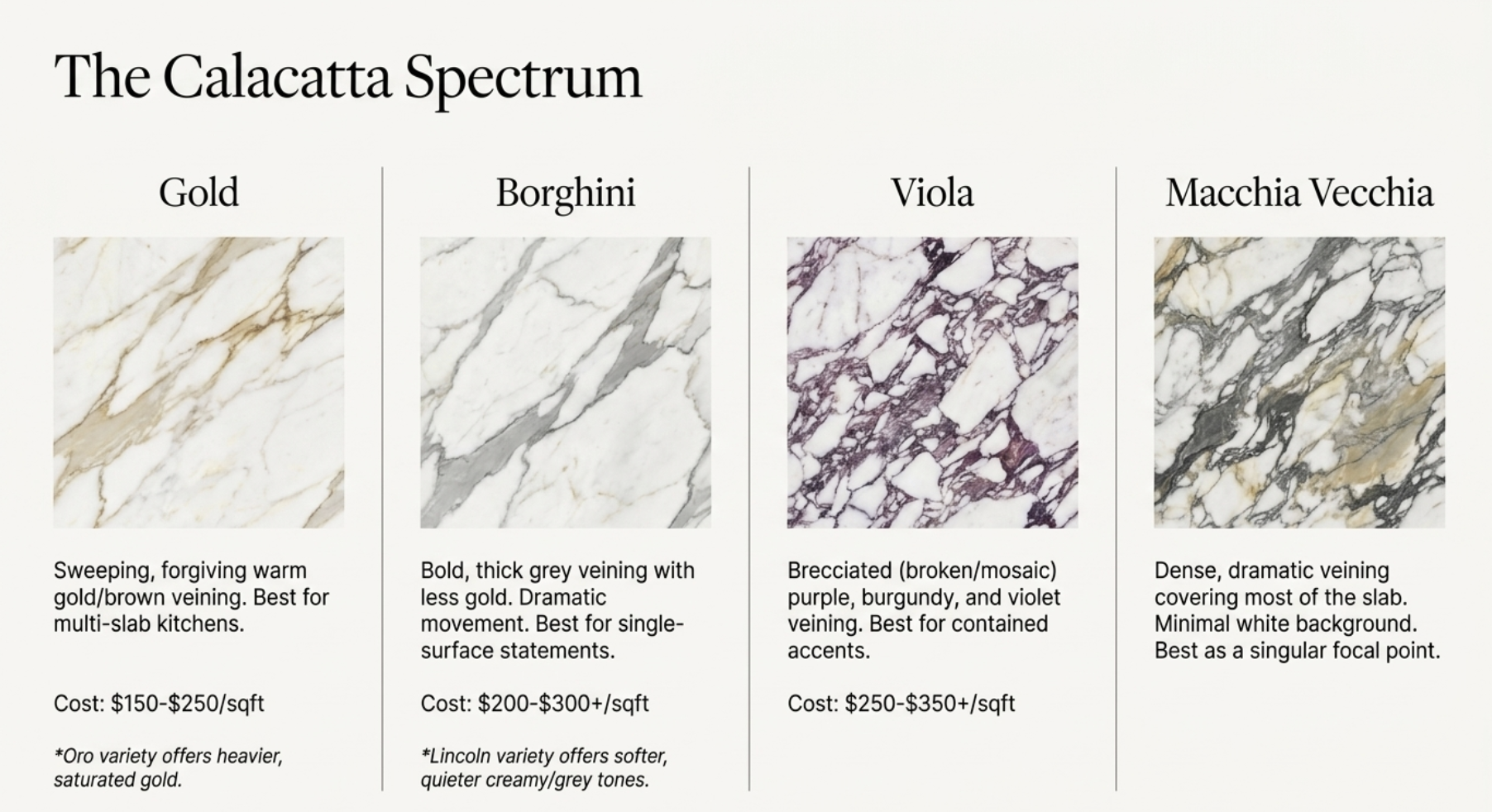
"Calacatta" is not one stone. Each named variety comes from a specific quarry or deposit with distinct veining, color, and character. Selecting the right variety is as important as selecting the right finish, because each variety behaves differently at scale. Some work beautifully across a 12-foot kitchen island. Others are better suited to a single accent surface.
Calacatta Gold
The most available, most specified, and most forgiving Calacatta variety. Bright white background with warm gold and brown veining that flows in broad, sweeping patterns. Calacatta Gold is the default specification for kitchen countertops and islands because the veining is consistent enough that book-matching (aligning consecutive slabs for symmetrical veining across seams) is achievable on most blocks. The gold tones pair well with warm lighting and natural wood cabinetry. Installed cost: $150 to $250 per square foot.
Calacatta Borghini
Thicker grey veining with less gold coloration. The veining movement is bolder and more dramatic, with larger, more defined patterns that read from across a room. Borghini is best for single-surface statements: one kitchen island, one fireplace face, one feature wall. It is less suitable for large multi-slab kitchens because the heavy veining makes seam alignment more challenging. The drama is the point, and containing it to one surface lets it work. Installed cost: $200 to $300+ per square foot.
Calacatta Viola
Distinctive purple, burgundy, and violet veining on a white background. The pattern is brecciated (broken, mosaic-like), giving it an entirely different character from the flowing veins of Gold or Borghini. Calacatta Viola is best for accent applications: a powder room vanity, a feature wall, a fireplace surround. The brecciated pattern makes seam alignment across large continuous runs nearly impossible, so the application should be sized to a single slab or a contained area. Installed cost: $250 to $350+ per square foot.
Calacatta Oro, Lincoln, and Macchia Vecchia
Calacatta Oro (Italian for "gold") delivers heavier, more saturated gold veining than standard Gold. The warmth is more pronounced, making it popular for traditional and transitional interiors. Calacatta Lincoln features grey-brown veining on a creamy white background, softer and quieter than Borghini, increasingly specified for bathroom vanities where a subtle Calacatta presence is appropriate. Calacatta Macchia Vecchia is the most dramatic: dense veining covering most of the slab surface with minimal white background visible. Best as a single focal point (fireplace face, powder room feature wall) rather than across a large continuous surface.
Sealing Calacatta Marble
Natural Calacatta marble is porous. Unsealed, it absorbs liquids (water, oil, wine, coffee) that penetrate the surface and leave stains. Sealing fills the stone's microscopic pores with a penetrating (impregnating) sealer that slows liquid absorption. It does not make the stone waterproof. It buys time: a sealed surface gives 5 to 15 minutes to wipe a spill before it stains, versus seconds on an unsealed surface.
How often do you seal Calacatta marble? Every 6 to 12 months for kitchen countertops (high use, frequent liquid contact). Every 12 to 18 months for bathroom vanities and shower walls (lower acid exposure, less frequent spills). The variance depends on how heavily the surface is used.
The sealer products that perform best on Calacatta are penetrating/impregnating sealers (not topical coatings, which sit on the surface and can yellow or peel). Reliable options include StoneTech BulletProof, Laticrete StoneShield, and Tenax Hydrex. Application is straightforward: clean the surface thoroughly, apply sealer with a soft cloth, let it dwell for 10 to 15 minutes, wipe off excess, and allow 24 hours to cure before use.
The water test confirms whether the seal is still intact: drip a small amount of water on the surface. If it beads up, the sealer is working. If the water darkens the stone (absorbs in), it's time to reseal.
Etching: What It Is and How to Handle It
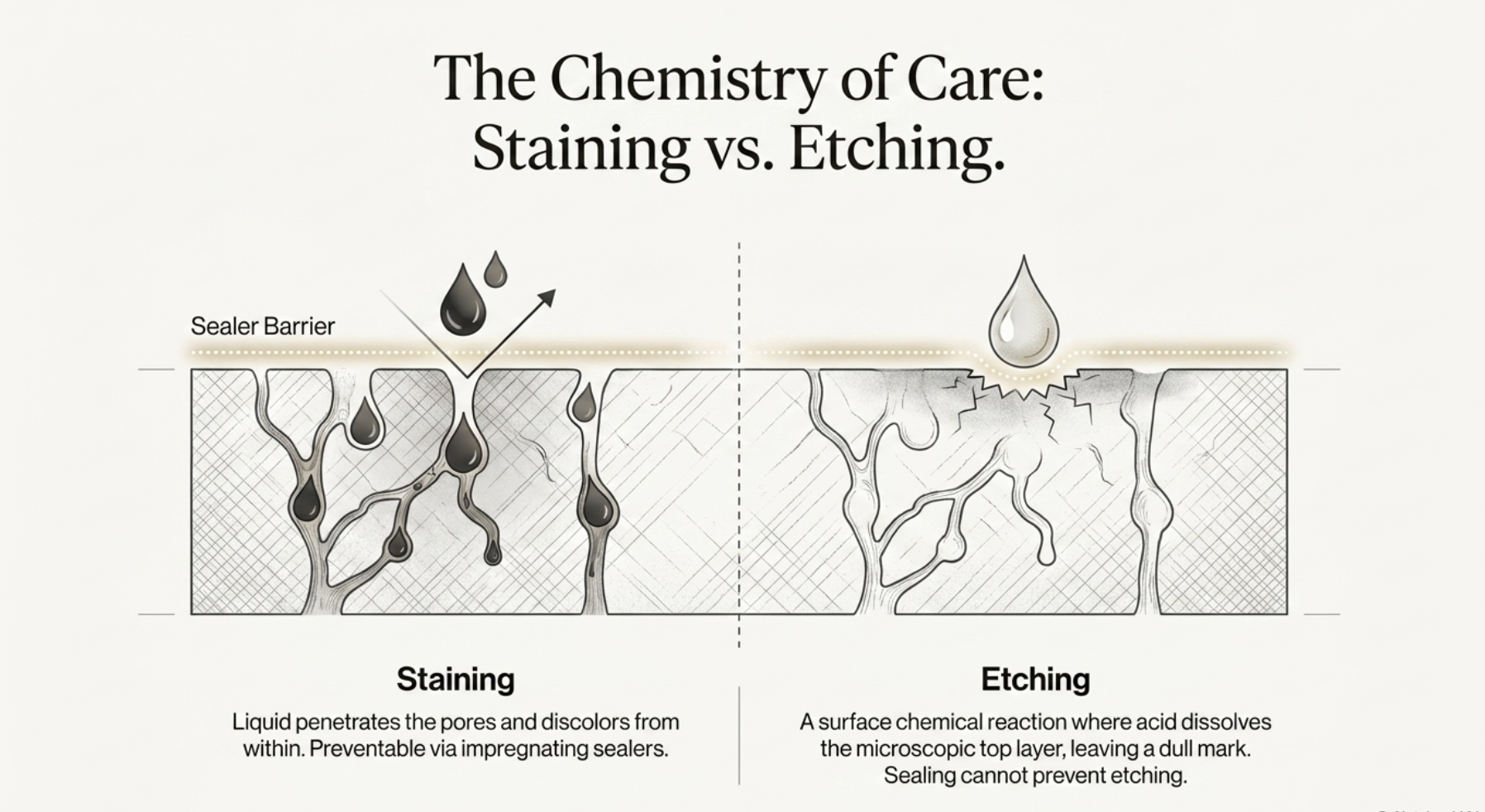
Etching is the number one concern for Calacatta marble in kitchens, and it is also the most misunderstood aspect of marble care.
Marble is calcium carbonate. Contact with acidic substances (lemon juice, vinegar, wine, tomato sauce, some cleaning products) causes a chemical reaction that dissolves a microscopic layer of the stone surface. This leaves a dull spot on polished surfaces. That dull spot is an etch mark.
The critical distinction: etching is not staining. Staining happens when a liquid penetrates into the stone and discolors it from within. Sealing prevents staining by blocking the pores. Etching happens when an acid reacts with the surface. Sealing does not prevent etching because the reaction occurs on the surface, not inside the stone. A perfectly sealed Calacatta countertop will still etch if lemon juice sits on it for 30 seconds. This is the single most important fact to communicate to a client before they approve a marble specification.
How etching shows depends on the finish. On polished marble, etch marks appear as dull rings or spots against the glossy surface. The contrast between the gloss and the dull mark makes etching very visible. On honed marble, etching is far less noticeable because the surface is already matte. There is no gloss-to-dull contrast. This is one of the strongest arguments for specifying a honed finish in kitchen applications.
Light etching can be buffed out at home with marble polishing powder and a soft cloth. Deeper etching requires professional re-honing. Many homeowners who live with marble over time learn to accept minor etching as part of the stone's patina, similar to how a leather bag or a hardwood floor develops character with use.
Polished vs Honed vs Leathered Calacatta Marble
The finish selection affects appearance, maintenance, and how etching shows. This is a specification decision that must be finalized before fabrication begins, because the finish is applied at the processing facility and cannot be easily changed after installation.
Polished
High gloss. Maximum veining contrast and color depth. The veins pop against the reflective surface. The white background appears brighter and more luminous. Polished Calacatta is the stone at its most dramatic. The trade-off: etching shows most visibly on polished surfaces because dull spots contrast sharply with the surrounding gloss. Best for low-use, low-acid applications: feature walls, fireplace surrounds, powder room vanities, and surfaces that will not have daily food contact.
Honed
Matte finish. The veining is still visible but with softer contrast. The surface has a smooth, flat appearance without reflectivity. Honed Calacatta hides minor etching significantly better than polished because the surface is already non-reflective. This is CooperBuild's standard for bathroom applications. The Carroll Gardens project specified honed 2CM throughout all six stone applications. Honed is the recommended finish for kitchen countertops where the homeowner wants natural marble but also wants to minimize the visual impact of daily use.
Leathered
Textured matte. Produced by running the honed surface through an abrasive brush that creates a soft, tactile texture. Leathered Calacatta masks imperfections even better than honed. It also resists fingerprints and water spots, making it practical for kitchen islands where hands touch the stone constantly. Less common for Calacatta than polished or honed, but gaining popularity on islands and bar tops.
| Finish | Appearance | Etching Visibility | Maintenance Level | Best For |
|---|---|---|---|---|
| Polished | High gloss, maximum contrast | Very visible (dull spots on gloss) | Highest | Feature walls, fireplaces, powder rooms |
| Honed | Matte, softer contrast | Low (already non-reflective) | Moderate | Kitchens, bathrooms, vanities, showers |
| Leathered | Textured matte | Very low (texture masks marks) | Moderate | Islands, bar tops, high-touch surfaces |
Can You Use Calacatta Marble in Kitchens and Bathrooms?
Yes. With informed expectations.
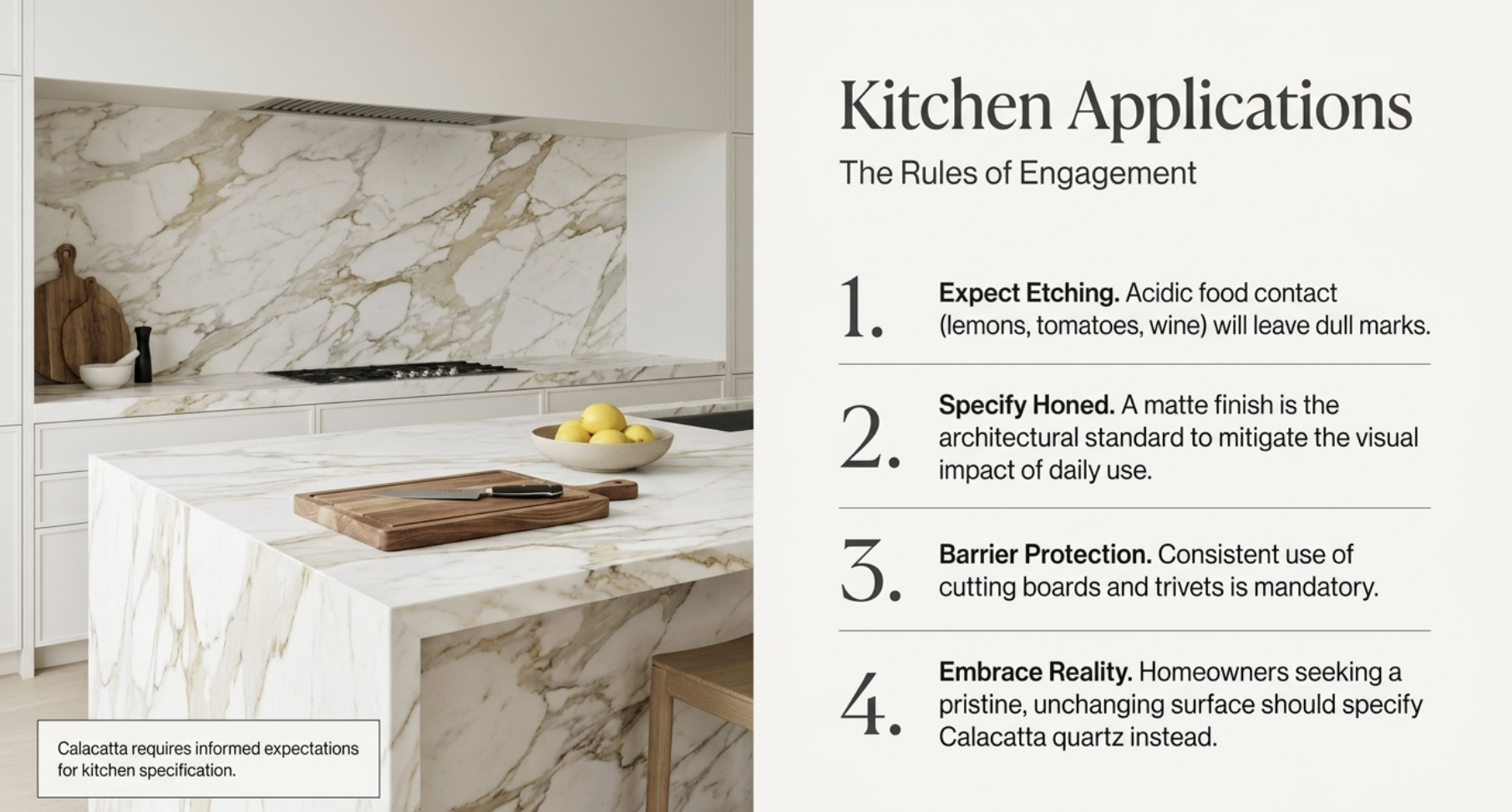
Kitchens. Calacatta marble is used on kitchen countertops in high-end renovations daily. The key is setting expectations before installation. The stone will etch from acidic food contact. It requires sealing every 6 to 12 months. It will develop a patina over years of use. Homeowners who accept this and use cutting boards and trivets consistently love their marble kitchens. Homeowners who want a pristine, unchanging surface should specify Calacatta quartz instead. Honed finish reduces visible etching and is the recommended specification for kitchen applications.
Bathrooms. Calacatta marble is an excellent bathroom surface. Bathrooms have far less acid exposure than kitchens. There are no lemons, no vinegar, no tomato sauce on a vanity top. Vanity countertops, shower walls, shower niches, and benches all perform well with basic sealing and pH-neutral cleaners. The Carroll Gardens project used Calacatta Turquoise Honed 2CM for the vanity countertop, backsplash, steam shower bench, shower niche, shower curb, and wall base. The honed finish was specified because the bathroom environment, while lower-acid, still involves daily water contact.
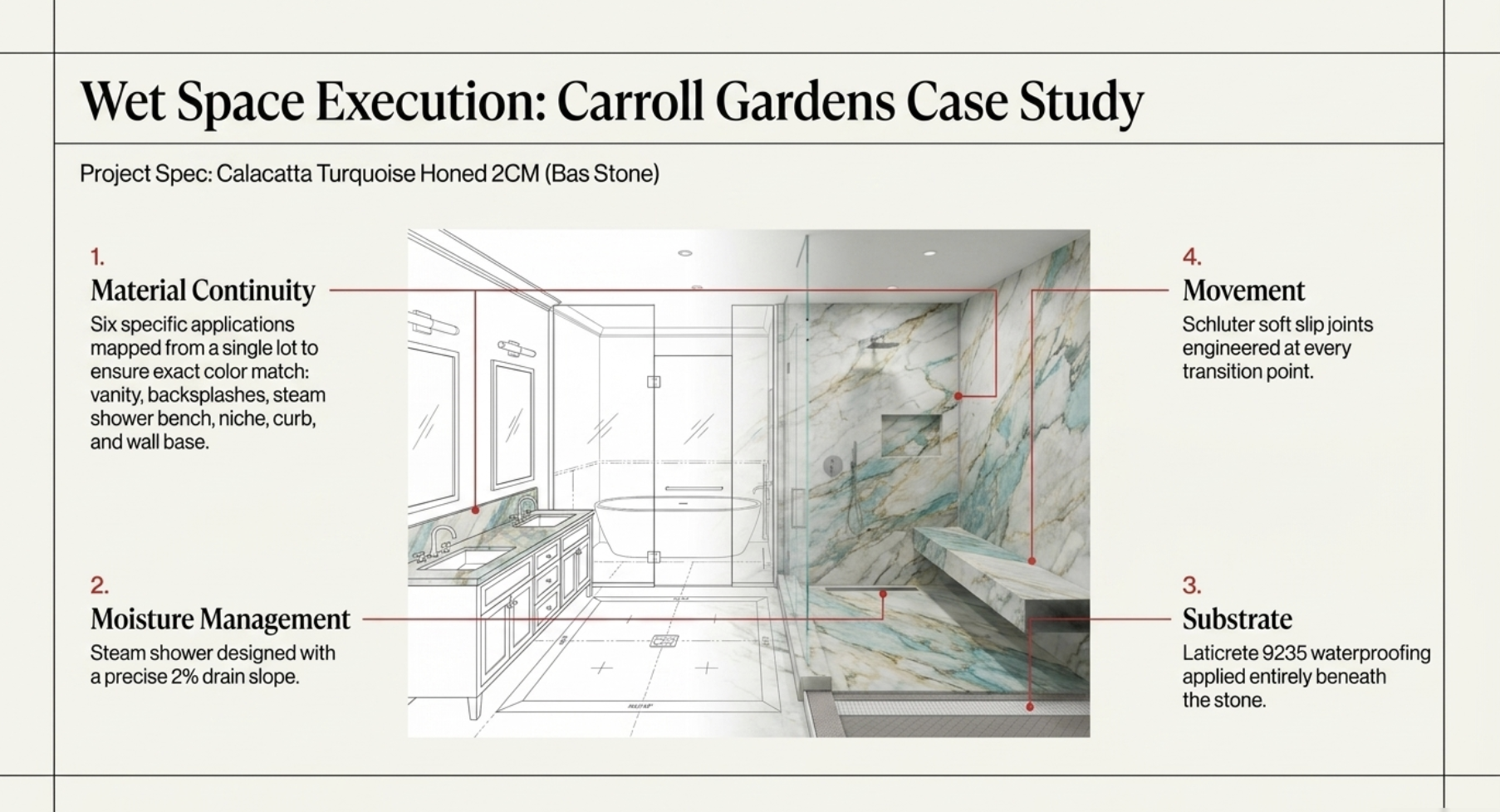
Showers. Natural marble in showers requires consistent sealing and proper drainage design. Standing water accelerates staining even on sealed stone. The steam shower in the Carroll Gardens project was designed with 2% slope to drain, Laticrete 9235 waterproofing under the stone, and Schluter soft slip joints at every transition to manage moisture.
How to Select a Calacatta Marble Slab
Never select Calacatta marble from a 4x4 sample or a catalog photo. Every slab is different. The veining, background color, and pitting vary from slab to slab, even within the same lot. The specification process starts at the stone yard.
Visit in person. View full slabs standing upright under consistent lighting. Photos on a website or a supplier's catalog do not capture how the stone reads at full scale. A vein that looks dramatic on a 4x4 sample may look entirely different across a 60 x 120-inch slab.
Check veining direction. The veins should flow in a direction that complements the countertop layout. On kitchen islands, veining typically runs lengthwise. On waterfall edges, the veining should wrap continuously from the top surface down the sides, which requires book-matched slabs.
Verify background consistency. Examine the full slab for muddy patches, discoloration, or excessive pitting. Some slabs have sections where the white background shifts to grey or yellow. These areas may be hidden by countertop cutouts (sink, cooktop), or they may end up as the most visible section of the surface.
Select from the same lot. For multi-slab applications (L-shaped kitchens, large islands, bathroom vanity plus backsplash), all slabs should come from the same lot. Different lots from the same quarry can have noticeably different background color or vein intensity.
Request book-matching. For waterfall islands or seamless adjacent slabs, ask for consecutive slabs from the same block. The fabricator cuts the block sequentially, producing mirror-image slabs that create symmetrical veining across seams. Not all blocks are available for book-matching, so this must be requested at the time of slab selection.
Confirm the hold. Most yards hold selected slabs for 48 to 72 hours. Confirm the hold in writing (email, not verbal) with the specific slab numbers noted.
Fabrication and Installation
After slab selection, the fabricator visits the project site to create a template. The template captures exact countertop dimensions, cutout locations (sinks, cooktops, faucet holes), edge profile selections, and seam positions.
Seam planning matters on Calacatta. The bold veining makes poorly aligned seams more visible than on uniform, low-contrast stones like Carrara. A skilled fabricator aligns veining direction across seams so the pattern reads as continuous. Review the seam plan before the fabricator cuts.
Edge profiles affect both cost and aesthetic. Eased (slight round on the top edge) is the most common and produces the cleanest modern look. Beveled (angled cut) adds more visual weight. Ogee (S-curve) reads as traditional. Mitered (45-degree join creating a thick-slab appearance) is popular on waterfall islands. The edge profile should be specified during the template stage.
Installation follows fabrication. Slabs are transported in padded A-frames, moved into position with suction cup lifts, and set on a thin bed of silicone or epoxy. Seam adhesive is color-matched to the stone. The first seal is applied after installation. The surface should cure for 24 hours before use.
CooperBuild's approach: the shop drawings show every stone piece with dimensions, edge treatment, seam positions, and waterproofing details (for wet applications like showers) before fabrication begins. On the Carroll Gardens project, this process documented six distinct stone applications from a single lot, ensuring consistent color and veining allocation across all surfaces.
The Patina Question: How Calacatta Marble Ages
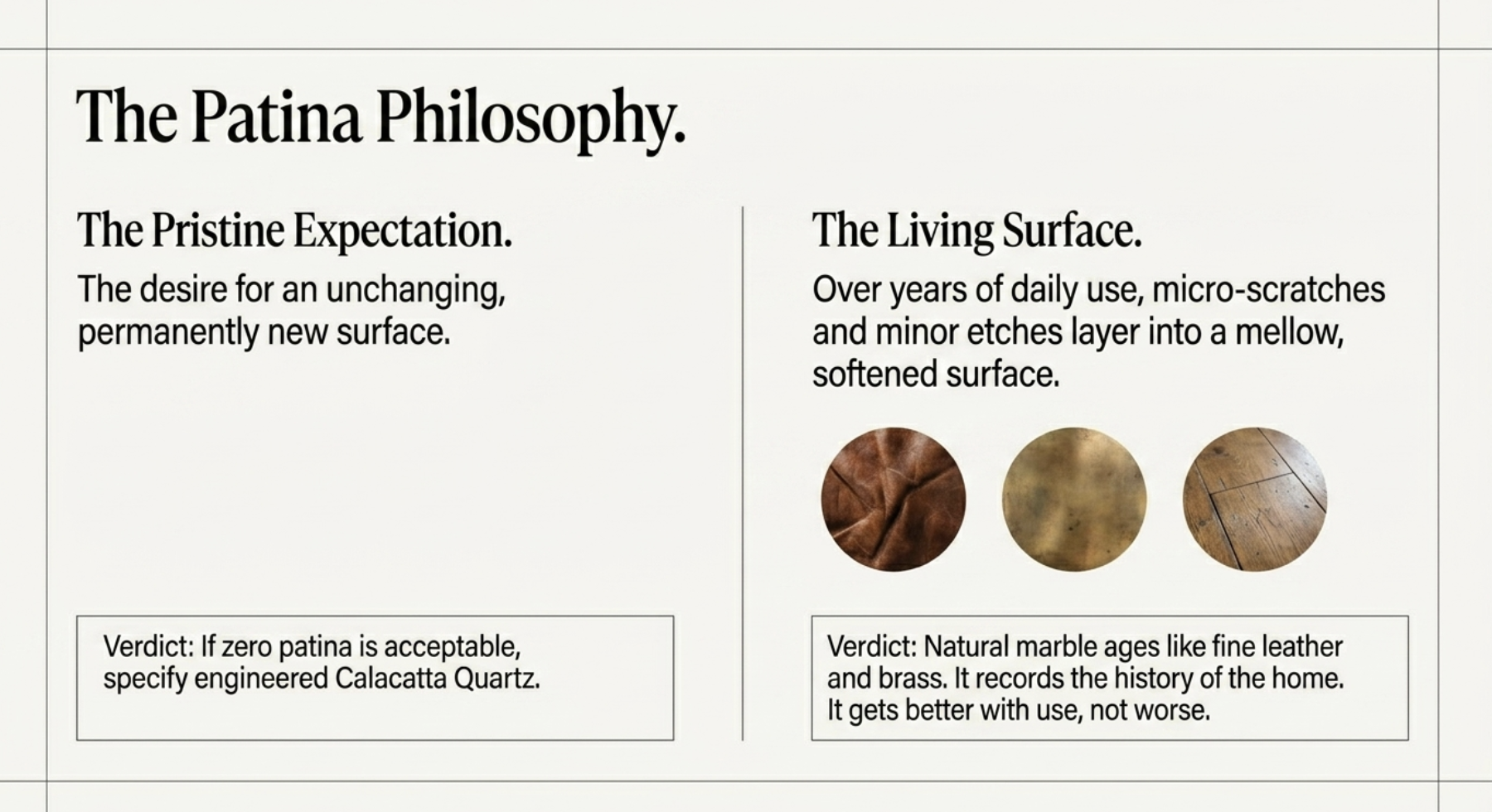
Over years of daily use, natural marble develops a patina. Micro-scratches accumulate. Minor etch marks layer over each other. The surface softens from its original crispness into something mellower. A 10-year-old Calacatta countertop does not look like a newly installed one. The stone records the life that happens on it.
Some designers and homeowners consider this part of the material's character. Marble ages the way leather, brass, and wide-plank hardwood floors age: it gets better with use, not worse. The patina tells a story. Others want a surface that looks new indefinitely. Both positions are entirely valid.
The answer to the patina question determines the specification. If the patina is embraced, natural Calacatta marble ages in a way that no engineered surface can replicate. If patina is unacceptable, Calacatta quartz delivers the aesthetic without the evolution. The material performs either way. The question is what the homeowner wants from it.
Calacatta marble is a natural material with real limitations (porosity, etching, maintenance) and real strengths (uniqueness, depth, character, the way it ages). The specification decisions that matter: variety selection at the slab yard (Gold for consistency, Borghini for drama, Viola for distinctiveness), finish selection (honed for daily-use surfaces, polished for low-contact features), consistent sealing every 6 to 12 months, and accepting that the stone will evolve over time.
This is not a low-maintenance surface. It is a considered investment in a material that no engineered product can fully replicate.
If you are specifying natural Calacatta marble for a project and need guidance on slab selection, fabricator coordination, or installation, start a conversation with us. CooperBuild coordinates stone selection, fabrication, and installation for custom projects in NYC, the Hamptons, and South Florida. On the Carroll Gardens bath renovation, we specified Calacatta Turquoise Honed 2CM by Bas Stone across six applications from a single lot, including the steam shower bench, niche, curb, and wall base. See more completed work in our project portfolio, or learn about our custom millwork services.
Specifying Natural Calacatta Marble for Your Project?
CooperBuild coordinates stone selection, fabrication, and installation for custom residential and commercial projects in NYC, the Hamptons, and South Florida. From slab yard visits to seam planning, we manage the details that make natural marble specification work.
Start a ConversationSubscribe to Our Newsletter
Get the latest insights, trends, and news from the construction industry delivered straight to your inbox.
We respect your privacy. Unsubscribe at any time.