

Soapstone Countertops: Cost, Pros, Cons, and What to Expect
Complete guide to soapstone kitchen countertops: cost, pros and cons, care, and comparisons
Soapstone countertops cost $70 to $120 per square foot installed ($2,800 to $4,800 for a typical 40 SF kitchen). The pros: naturally non-porous (never needs sealing), heat resistant (hot pots directly on the surface), acid resistant (no etching from food acids), and antibacterial. The cons: soft (Mohs 2.5-5, scratches from daily use), limited to grey tones, and darkens over time. Scratches are DIY-repairable with sandpaper and mineral oil. Soapstone countertops last 20 to 100+ years with basic care. They are a strong fit for homeowners who value low-chemical maintenance and heat resistance, and who are comfortable with a stone that develops a patina over time.
Soapstone countertops are one of the most practical natural stone surfaces available for kitchens and bathrooms, and also one of the most overlooked. Most homeowners research granite, marble, and quartz first. Soapstone is the fourth option that rarely gets the attention it deserves, despite being the only natural countertop stone that never needs sealing, handles direct heat from cookware, and is completely unaffected by household acids.
This guide covers real cost breakdowns, the honest pros and cons that matter in daily kitchen use, what the first year of ownership actually looks like (month by month), how to select a slab, edge profile options, cleaning and care, and how soapstone compares to granite and quartz. For the broader material overview (geological properties, quarrying, spiritual significance, and all applications beyond countertops), see What Is Soapstone?.
What Are Soapstone Countertops?
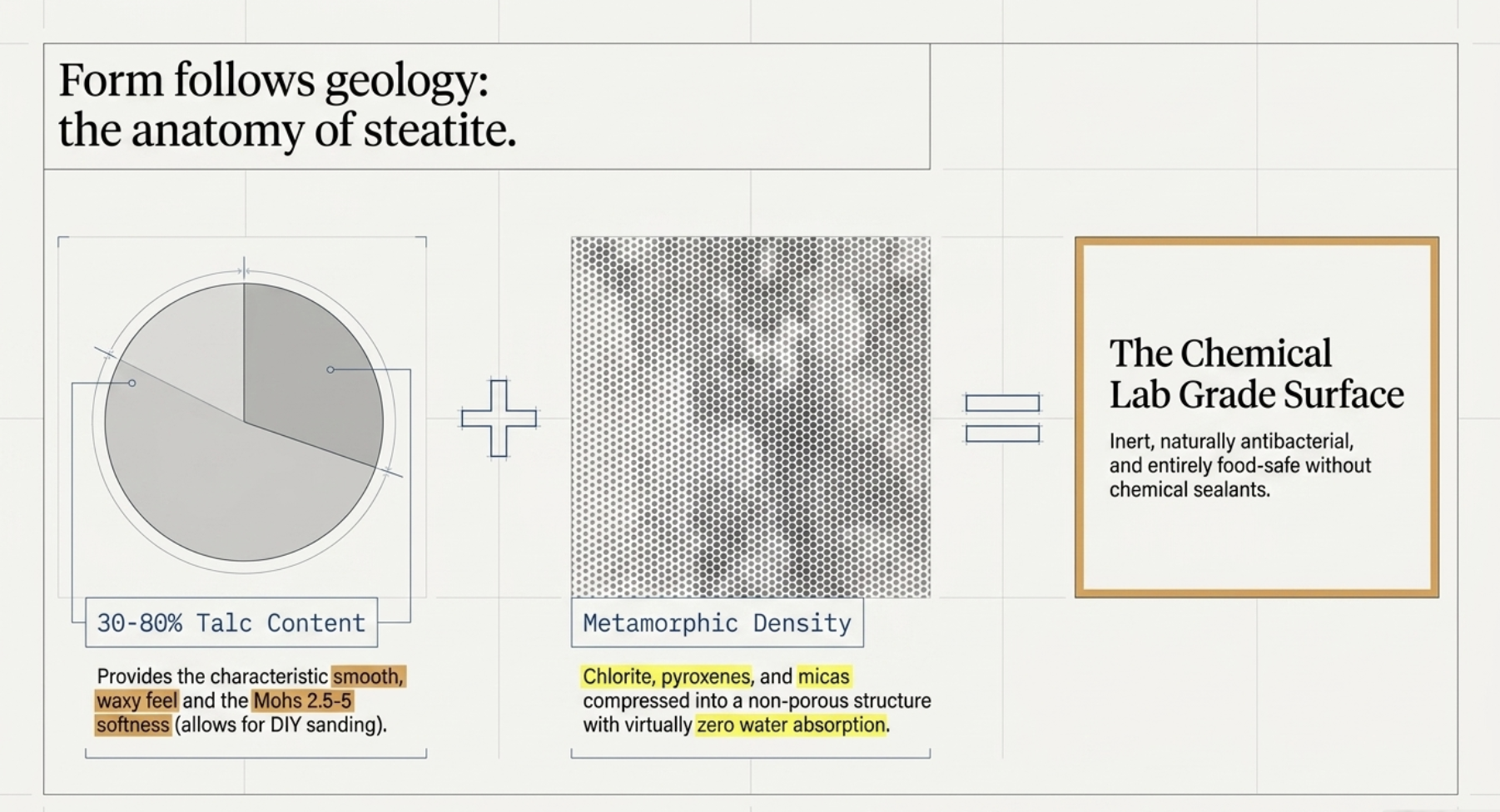
Soapstone kitchen countertops are fabricated from steatite, a natural metamorphic rock composed primarily of talc (30-80%) along with chlorite, pyroxenes, and micas. Countertop-grade soapstone has lower talc content than carving-grade stone, giving it a Mohs hardness of 2.5 to 5 (softer than granite at 6-7 but hard enough for daily kitchen use). The high talc content is what gives the surface its characteristic smooth, slightly waxy texture. According to Theresa Ream, founder of Cypress Cabinets Kitchen Bath & Design, soapstone's lower Mohs hardness should be considered when planning fabrication, edge profiles, and sink cutouts.
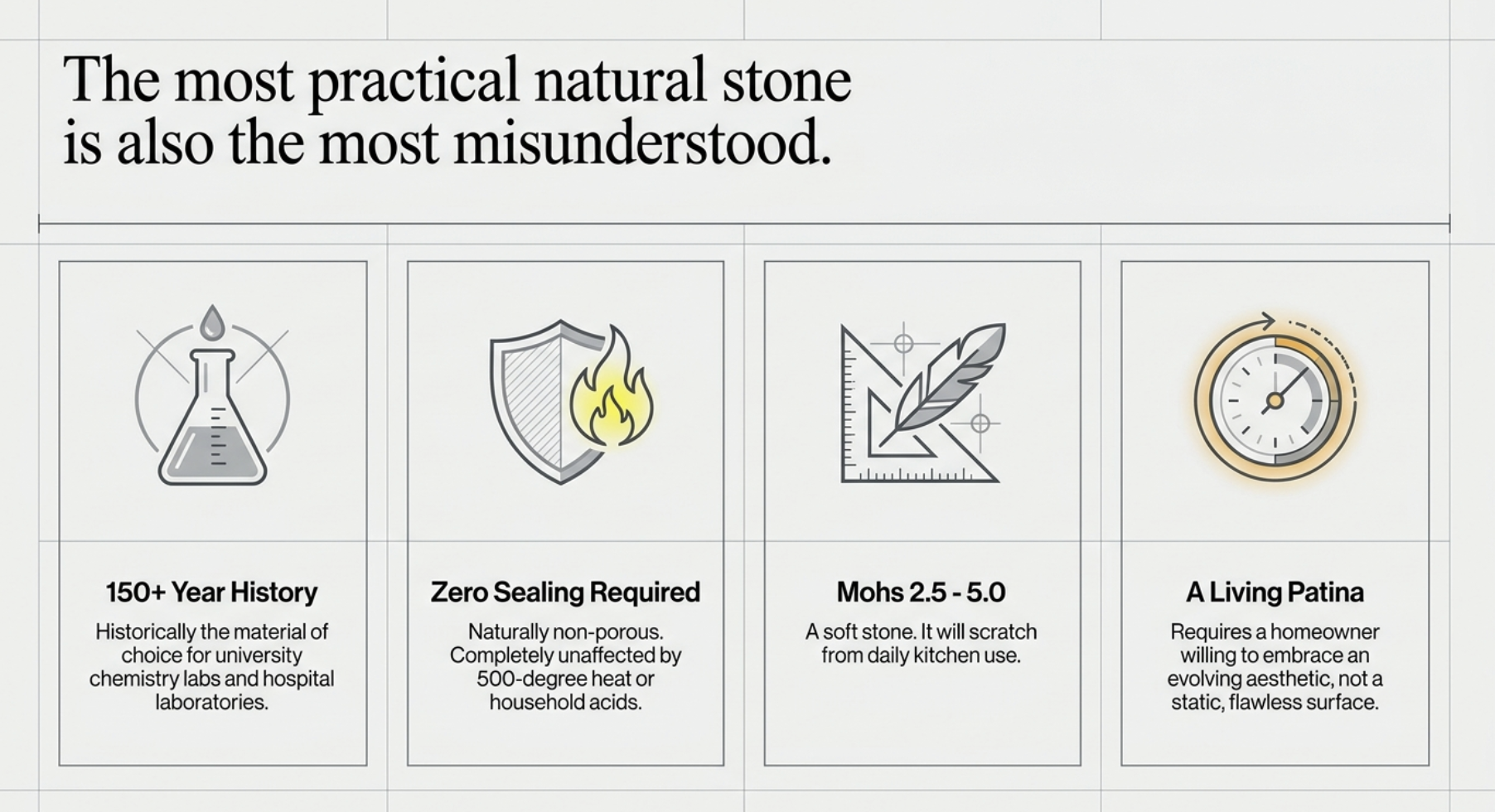
The stone is quarried primarily in Brazil (which supplies the majority of countertop-grade material), with additional sources in Virginia, India, Finland, and Scandinavia. Vermont Soapstone is the best-known domestic supplier. The material has been used for kitchen surfaces and laboratory countertops for over 150 years. Science labs at universities and hospitals relied on soapstone for decades because of its chemical resistance and non-porous composition. The same properties that made it ideal for handling hydrochloric acid in a chemistry lab make it ideal for handling lemon juice in a kitchen.
The color range is limited to shades of grey: light silver, medium grey, dark charcoal, and near-black. Some varieties include subtle green or blue undertones. Soapstone does not come in whites, creams, or warm tones. If the kitchen design calls for a bright countertop, Calacatta marble or engineered quartz will be better options.
How Much Are Soapstone Countertops?
Soapstone countertops cost $70 to $120 per square foot installed, with the national average falling between $80 and $100 per square foot. For a typical 40 square foot kitchen, expect $2,800 to $4,800 total. For a larger kitchen with an island (60 SF), expect $4,200 to $7,200.
Here's where the money goes:
| Cost Component | Low Range | Mid Range | High Range |
|---|---|---|---|
| Slab material (per SF) | $35 | $50 | $70 |
| Fabrication (per SF) | $20 | $30 | $40 |
| Installation (per SF) | $10 | $18 | $25 |
| Total installed (per SF) | $70 | $98 | $120 |
| 40 SF kitchen total | $2,800 | $3,920 | $4,800 |
| 60 SF kitchen total | $4,200 | $5,880 | $7,200 |
Factors that affect where a project falls in the range: stone grade (Brazilian soapstone costs 10-30% less than Indian or Finnish material), slab thickness (3CM is stronger and more expensive than 2CM), edge profile complexity (eased and square edges are typically included in the base price, while ogee adds $20-$30 per linear foot), cutout count (sink, cooktop, faucet holes), and geographic region. The Northeast has historically been the strongest market for soapstone due to New England's quarrying heritage, which means more competitive pricing and more experienced fabricators in that region.
Additional costs to budget for:
| Add-On | Cost Range |
|---|---|
| Edge upgrade (beveled, ogee, bullnose) | $10-$30 per linear foot |
| Soapstone backsplash | $30-$60 per linear foot |
| Integrated carved sink | $800-$2,000 |
| Carved drainboard | $300-$600 |
| Existing countertop removal | $50-$350 |
The total cost of ownership over 20 years is more competitive than the installed price suggests. Soapstone has zero sealing costs (granite requires sealing every 1-2 years, marble every 6-12 months). Zero professional restoration costs. Scratch repair is DIY: a piece of sandpaper and a bottle of mineral oil, totaling about $10 per year.
Soapstone Countertop Pros
Never Needs Sealing
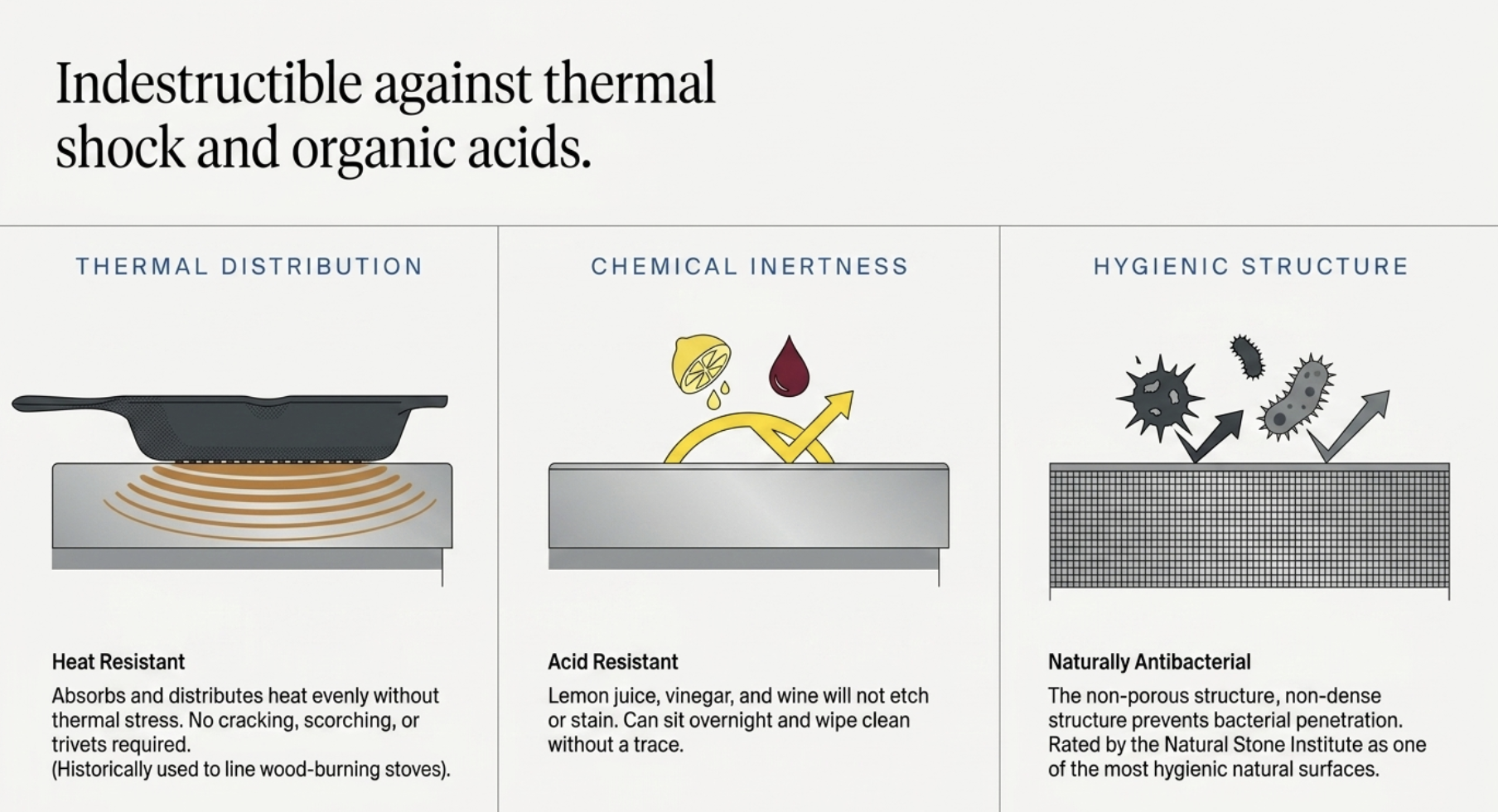
Soapstone countertops are naturally non-porous with virtually zero water absorption. No penetrating sealer is ever required. This eliminates the annual or biannual sealing that granite, marble, and quartzite demand. It also means no chemicals are applied to a food preparation surface. According to the Natural Stone Institute, soapstone's non-porous composition makes it one of the most hygienic natural stone surfaces available.
Heat Resistant
Hot pots, pans, baking sheets, and cast iron can go directly from a 500-degree oven onto a soapstone countertop without a trivet. No cracking, no scorching, no discoloration. The stone absorbs and distributes heat evenly rather than concentrating thermal stress at one point. This is the property that no other countertop material matches. Quartz (engineered) can be damaged by direct heat because the resin binder softens. Granite tolerates heat but can crack from thermal shock. Soapstone is the only countertop stone historically used to line fireplaces and wood-burning stoves.
Acid Resistant
Lemon juice, vinegar, wine, tomato sauce, and coffee do not etch or stain soapstone. This is the critical advantage over marble (which etches from any acid contact) and unsealed granite (which can stain from acidic spills). A lemon wedge can sit on a soapstone countertop overnight and wipe clean in the morning without a trace. Try that on a polished marble surface.
Naturally Antibacterial
The non-porous composition means bacteria cannot penetrate the surface. This is why soapstone was the countertop material of choice in hospital laboratories, university chemistry labs, and commercial kitchens for over 150 years. The surface is inherently food-safe without any applied treatment.
Warm to the Touch
Unlike granite and quartz (which feel cold against bare skin), soapstone absorbs and retains ambient room temperature. The surface feels warm, which is a subtle but noticeable comfort during daily use, particularly in colder months.
DIY Repairable
Scratches can be sanded out with 220-grit sandpaper followed by 400-grit, then a coat of mineral oil. The entire process takes 5 to 10 minutes and requires no professional help. Soapstone is one of the only countertop materials where surface damage is truly owner-serviceable.
Soapstone Countertop Cons
Soft and Scratches Easily
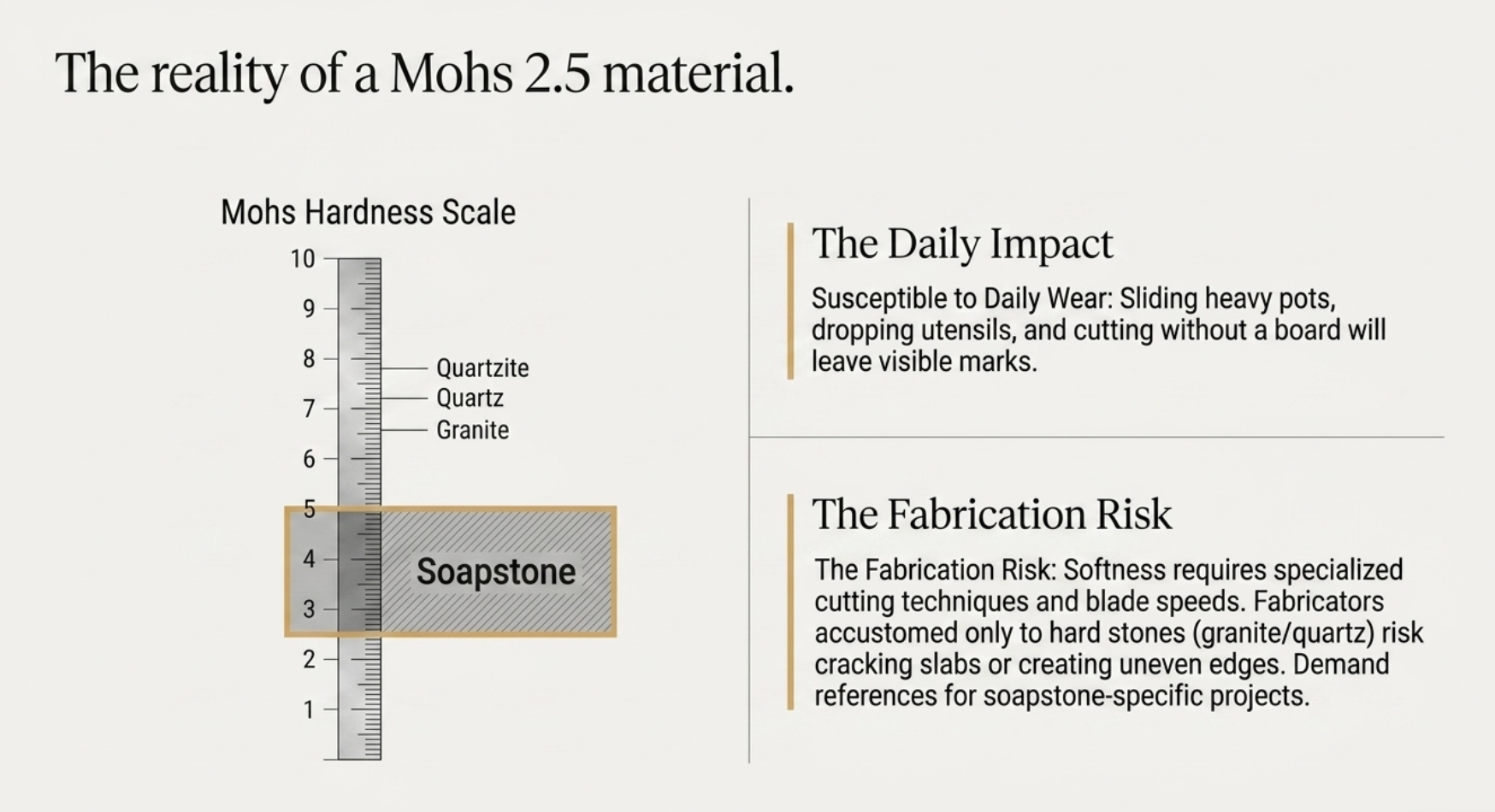
At Mohs 2.5 to 5, soapstone countertops are softer than granite (6-7), quartz (7), and quartzite (7-8). Daily kitchen use produces visible scratches. Cutting directly on the surface without a board will leave marks. Sliding heavy pots, dropping utensils, and even ceramic plates can scratch the surface over time. The scratches are repairable, but the repair cycle is ongoing. Some homeowners sand and oil monthly. Others do it quarterly and accept the marks in between.
Limited Color Range
Soapstone comes in shades of grey only. Light silver-grey, medium grey, dark charcoal, near-black, and occasionally green or blue undertones. No whites, no creams, no warm tones, no dramatic veining. If the kitchen design calls for a bright white countertop or bold colored veining, soapstone is not the material. The palette is quiet and narrow.
Darkens Over Time
Soapstone naturally transitions from lighter grey to darker charcoal over months to years. The darkening is uneven at first: areas that receive more use, more water contact, or more mineral oil darken faster than less-trafficked areas. Mineral oil accelerates and unifies the process. Some homeowners love the developing patina. Others find the inconsistent transition period frustrating. The stone will eventually reach a uniform dark tone, but getting there takes patience.
Smaller Slab Sizes
Soapstone slabs are generally smaller than granite or marble slabs. Kitchens with more than 7 square feet of continuous countertop will likely have visible seams. A skilled fabricator minimizes seam visibility by matching grain direction and color, but seams cannot be eliminated entirely on larger surfaces.
Fewer Experienced Fabricators
Not every stone fabricator has soapstone experience. The stone's softness requires different cutting techniques, blade speeds, and handling than granite or quartz. Fabricators accustomed to harder stones may crack soapstone during cutting or create uneven edges. Ask specifically about soapstone experience (number of projects completed, references) before hiring.
What to Expect: The First Year with Soapstone Countertops
This is what living with a new soapstone kitchen countertop actually looks like, month by month.
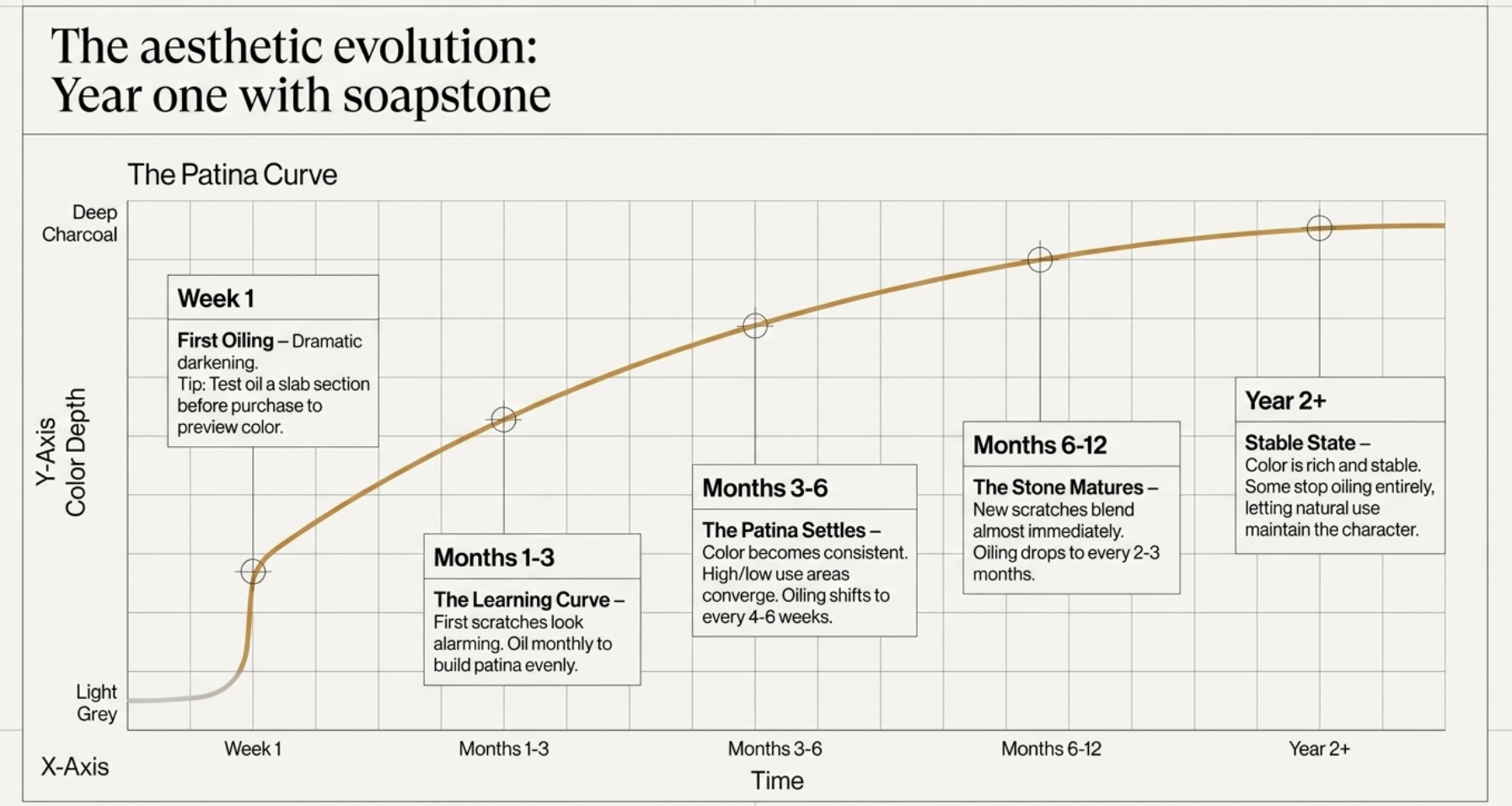
Week 1: First Oiling
After installation, the first coat of food-grade mineral oil is applied. The stone darkens dramatically, shifting from light grey to a deep charcoal. This is the single biggest visual change the countertop will ever undergo. Some homeowners are caught off guard by how much darker the stone gets. The fix: ask the fabricator or stone yard to oil a small section of the slab before purchase so you can preview the final color.
Months 1-3: The Learning Curve
Scratches appear from daily use. The first ones are alarming. The stone looks marked up. This is normal. Sand the entire surface once with 220-grit sandpaper (along the grain, not in circles), apply mineral oil, and everything blends together. Develop the habit of using cutting boards and trivets for cast iron (not because of heat, but because cast iron is rough and heavy). Oil monthly during this period to build the patina evenly.
Months 3-6: The Patina Settles
The stone reaches a more consistent color as oil treatments accumulate. High-use areas and low-use areas start to converge. New scratches are less noticeable against the darker, more uniform background. Oiling moves to every 4 to 6 weeks. The initial alarm about scratching subsides as the homeowner develops a feel for how the stone responds to daily life.
Months 6-12: The Stone Matures
By the end of the first year, the countertop has developed its character. The color is richer and more uniform. New scratches blend into the existing patina almost immediately. Oiling moves to every 2 to 3 months. The maintenance routine feels natural rather than burdensome. Most homeowners report that by month 8 or 9, they stop noticing the scratches entirely.
Year 2 and Beyond
The countertop has reached its mature state. Color is stable. Scratches are minor and blend on contact with oil. Some homeowners stop oiling entirely and let the stone evolve on its own. Others continue quarterly because they enjoy the ritual and the deepened color it produces. The surface looks better with age, not worse. New England homes have soapstone sinks and countertops from the 1800s that are still in daily use.
How to Clean Soapstone Countertops
Daily cleaning is the simplest of any natural stone surface. Warm water and mild dish soap on a soft cloth. That's it. No specialty stone cleaners, no pH-neutral formulas, no avoiding certain products. Soapstone is chemically inert, which means virtually any household cleaner is safe on the surface. Vinegar, all-purpose sprays, and even bleach-based cleaners will not damage soapstone (though mild soap is sufficient and preferred for daily use).
For dried-on food or stubborn residue, a non-abrasive scrub pad works without risk of surface damage. Because soapstone is non-porous, nothing penetrates the surface. Spills do not need to be addressed urgently the way they do on granite or marble. Coffee can sit on a soapstone countertop for hours without staining.
The one cleaning habit that matters: after sanding out scratches, wipe the entire surface with a damp cloth to remove stone dust before applying mineral oil. The oil adheres better to a clean, dust-free surface.
How to Care for Soapstone Countertops
Long-term care goes beyond daily cleaning and involves two maintenance practices: mineral oil application and scratch management.
Mineral oil. Apply food-grade mineral oil with a soft cloth, let it soak for 20 to 30 minutes, then wipe off the excess. Monthly for the first year, then every 3 to 6 months as the stone matures. The oil deepens the stone's color and evens out the patina. It is cosmetic, not protective. Soapstone does not need mineral oil for stain prevention (it's already non-porous). Some homeowners skip oiling entirely and let the stone develop its patina naturally. Both approaches are valid.
Scratch repair. Sand the affected area with 220-grit sandpaper along the grain, follow with 400-grit for smoothness, then apply mineral oil. For a full-surface refresh, sand the entire countertop lightly and oil it. The process takes 5 to 10 minutes. Keep a piece of sandpaper and a bottle of mineral oil under the sink so the tools are always accessible.
What not to do. Do not apply wax-based sealers, topical coatings, or polyurethane. These products sit on the surface, can yellow over time, and are unnecessary for a non-porous stone. Do not use abrasive cleaners for routine cleaning (save abrasives for scratch repair only). Do not cut directly on the surface without a cutting board.
Soapstone Countertops vs Granite vs Quartz
The three materials most commonly compared during kitchen renovation planning. Here is how they stack up on the factors that matter in daily use:
| Feature | Soapstone | Granite | Quartz (Engineered) |
|---|---|---|---|
| Installed cost/SF | $70-$120 | $50-$150 | $50-$130 |
| Sealing required | Never | Every 1-2 years | Never |
| Heat resistance | Excellent (hot pots OK) | Good | Poor (heat damages resin) |
| Acid resistance | Excellent (no etching) | Moderate (can stain if unsealed) | Good |
| Scratch resistance | Low (Mohs 2.5-5) | High (Mohs 6-7) | High (Mohs 7) |
| Color range | Grey tones only | Very wide | Virtually unlimited |
| Maintenance | Oil + sand scratches | Seal periodically | Wipe clean |
| Lifespan | 20-100+ years | 20-50+ years | 15-25 years |
| Best for | Heat/acid resistance, no sealing | Hardness, color variety | Zero maintenance, consistency |
Soapstone vs granite: Soapstone never needs sealing (granite does). Soapstone handles heat and acids better. Granite is harder, more scratch resistant, and comes in far more colors. For a household that cooks daily and hates the idea of sealing, soapstone wins. For a household that wants a hard, colorful, low-scratch surface, granite wins.
Soapstone vs quartz: Soapstone is a natural stone (quartz is engineered). Soapstone is heat resistant (quartz is not: hot pots damage the resin binder). Both are non-porous and never need sealing. Quartz is harder, comes in unlimited colors, and requires zero maintenance. For a household that places hot cookware directly on the counter, soapstone is the only non-marble natural stone option. For a household that wants the hardest possible surface with the most color choices, quartz is the practical pick.
Frequently Asked Questions
How much do soapstone countertops cost?
$70 to $120 per square foot installed, including material, fabrication, and installation. A typical 40 SF kitchen runs $2,800 to $4,800. A 60 SF kitchen with island runs $4,200 to $7,200.
Are soapstone countertops worth it?
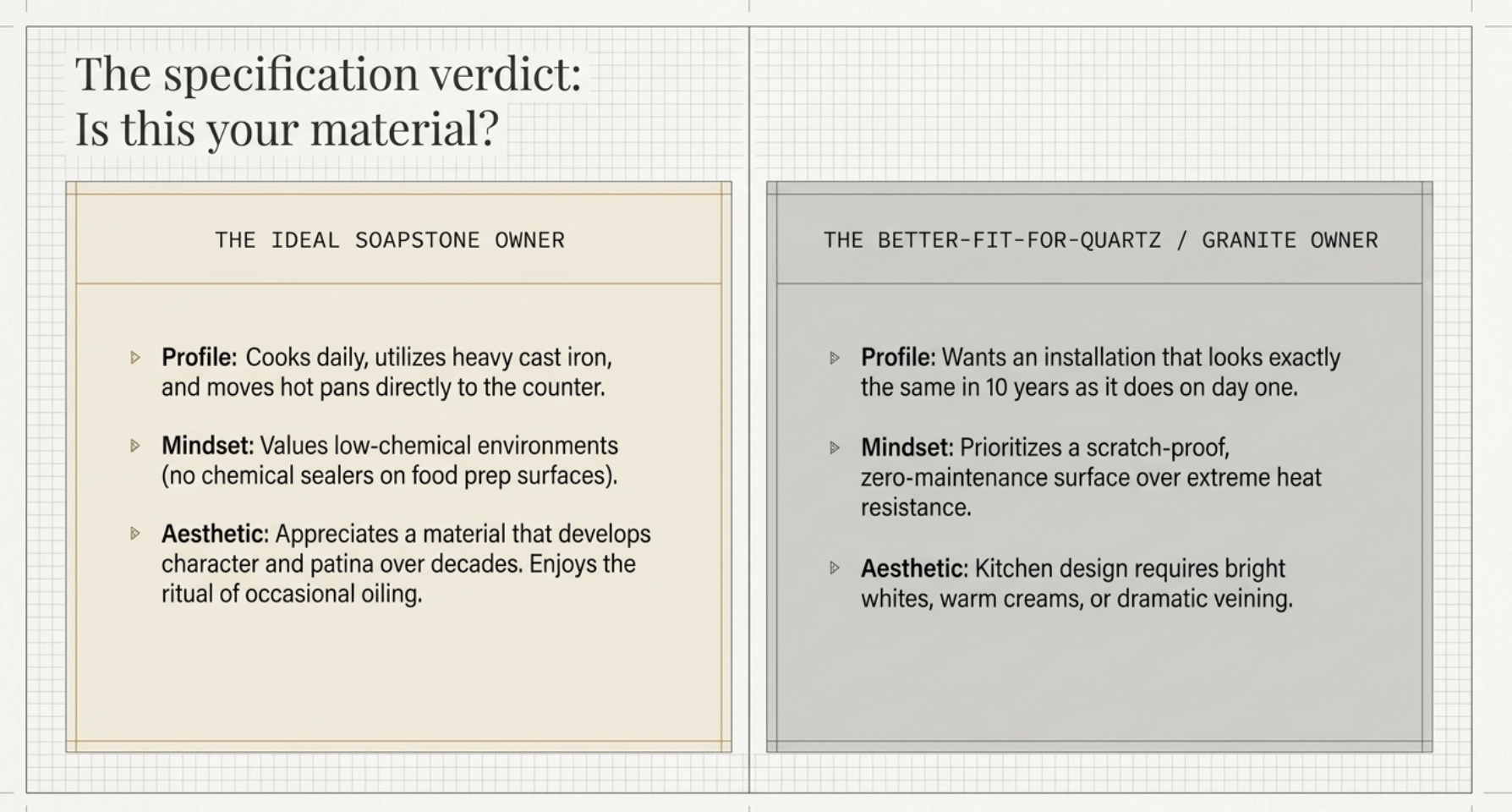
For homeowners who value heat resistance, acid resistance, zero sealing, and a natural stone that develops character over time, yes. For homeowners who want a hard, scratch-proof, bright-colored surface that looks the same in 10 years as it does on installation day, granite or quartz is a better fit.
Do soapstone countertops scratch easily?
Yes. Mohs 2.5-5 means daily kitchen use produces visible scratches. Cutting on the surface, sliding pots, and dropping utensils will mark it. The advantage: scratches are DIY-repairable with 220-grit sandpaper and mineral oil in minutes. No other countertop material offers this level of owner-serviceable repair.
Do soapstone countertops need to be sealed?
No, never. Soapstone is naturally non-porous. Mineral oil is applied optionally for cosmetic purposes (deepening color and evening the patina). It is not a sealant and serves no protective function.
How long do soapstone countertops last?
20 to 100+ years with basic care. The stone is structurally dense and does not degrade from daily use. New England homes have soapstone sinks and countertops from the 1800s still in active daily use. The lifespan question is less about the stone failing and more about whether the homeowner's aesthetic preferences change over decades.
Can you put hot pans on soapstone countertops?
Yes. Directly from the stove, oven, or grill onto the countertop. No trivet needed. No cracking, scorching, or discoloration. Soapstone absorbs and distributes heat evenly. This is the property that historically made it the material of choice for fireplace linings and wood-burning stove surrounds.
Soapstone countertops are the only natural stone surface that combines non-porosity, heat resistance, acid resistance, and zero sealing in a single material. The trade-off is softness: the stone scratches, and the maintenance is sanding and oiling rather than sealing and avoiding. For homeowners who cook daily, who dislike the idea of chemical sealers on food preparation surfaces, and who appreciate a material that develops character over decades of use, soapstone is one of the strongest countertop specifications available.
If you are considering soapstone countertops for a kitchen or bathroom and need guidance on slab selection, fabricator coordination, or how soapstone fits into your overall renovation, start a conversation with us. CooperBuild works with the full range of natural stone and engineered surfaces for custom projects in NYC, the Hamptons, and South Florida. See completed work in our project portfolio, or learn about our custom millwork services.
Considering Soapstone Countertops?
CooperBuild works with natural stone and engineered surfaces for custom kitchen and bathroom projects in NYC, the Hamptons, and South Florida. From slab selection to fabrication and installation, we help you choose the right surface for how you cook and live.
Start a ConversationSubscribe to Our Newsletter
Get the latest insights, trends, and news from the construction industry delivered straight to your inbox.
We respect your privacy. Unsubscribe at any time.