

Leathered Quartzite: What It Is, How It's Made, and How to Specify It
Understanding, selecting, and detailing leathered quartzite for custom projects
Leathered quartzite is a natural stone finish created by running diamond-tipped brushes over a honed quartzite surface, removing softer mineral particles and leaving the harder crystals. The result is a matte, textured surface with subtle peaks and valleys that hides fingerprints, water spots, and smudges better than polished or honed finishes. The stone's hardness (Mohs 7) and durability remain the same regardless of finish. Leathered quartzite requires sealing every 12 to 18 months because the textured surface is slightly more porous than polished. The most popular variety for leathering is Taj Mahal quartzite (warm ivory base, gold veining, quarried in Brazil). Cost is typically 10-15% more than polished due to the additional fabrication processing.
"Leathered" is a finish, not a material. Quartzite is the stone. Leathered is what happens to the surface after cutting. Many homeowners confuse the two, which leads to specification errors and mismatched expectations.
Leathered quartzite has become the most requested alternative to polished in high-end kitchen and bathroom renovations. The reason is practical: the textured surface hides the fingerprints, water spots, and smudges that make polished countertops look dirty within hours of cleaning. Architects and designers are specifying it on kitchen islands, vanity tops, and feature surfaces where daily use meets high visibility.
This guide covers how the leathered finish is created, how it compares to polished and honed, the varieties that work best with the texture (Taj Mahal leading the list), sealing and maintenance, cost, and how to specify it correctly for a custom project. For broader natural stone overviews, see What Is Calacatta? and What Is Soapstone?.
What Is Leathered Quartzite?
Leathered quartzite is a natural quartzite stone with a leathered surface finish. The finish is created by running diamond-tipped abrasive brushes over a honed (matte) quartzite surface. The brushes remove softer mineral particles and leave the harder quartz crystals intact, creating subtle peaks and valleys across the surface. The result is a matte finish with real, tactile texture that catches light differently than polished or honed surfaces.
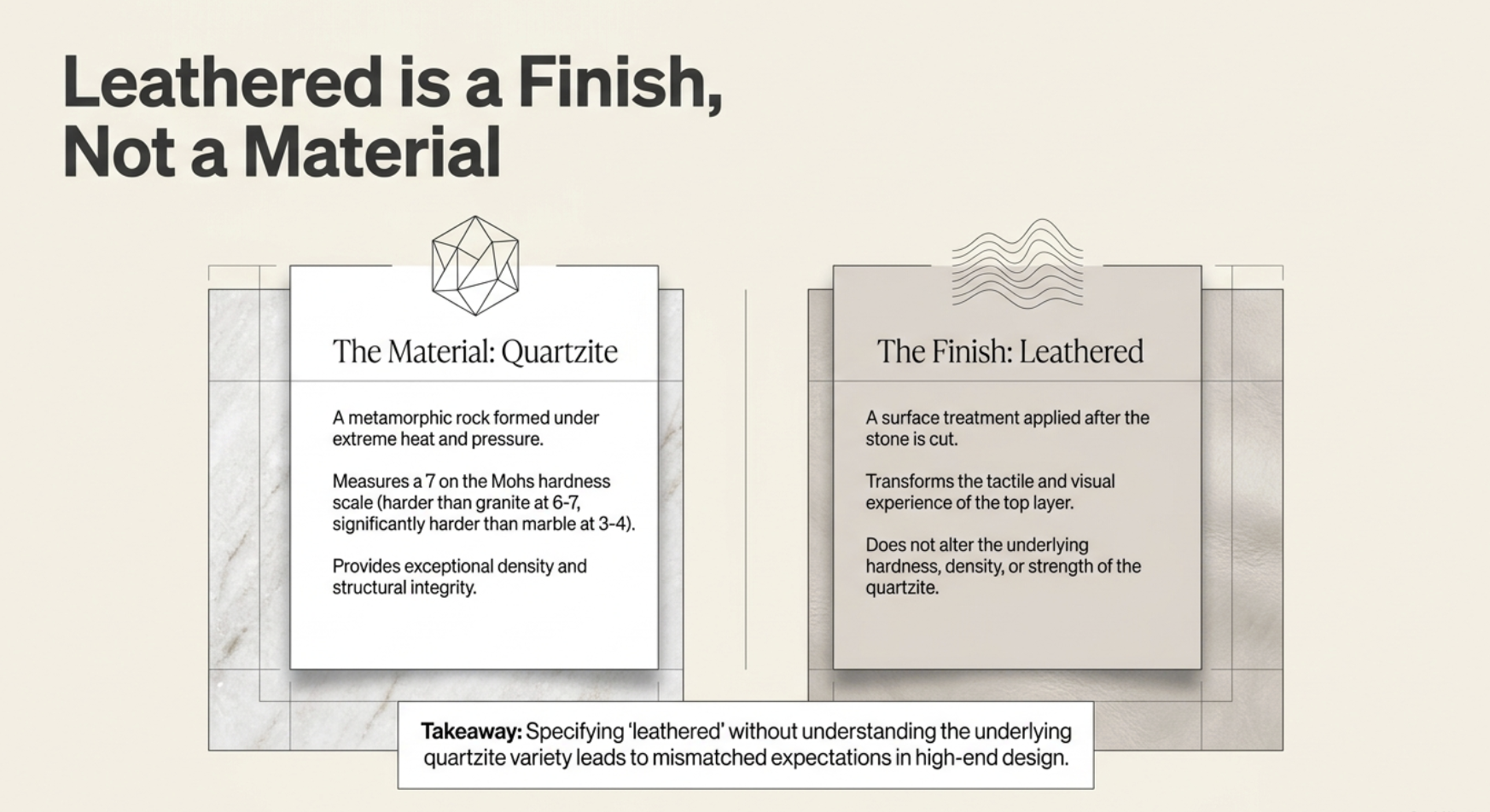
The stone itself does not change. Quartzite is a metamorphic rock formed when sandstone is subjected to extreme heat and pressure, producing a dense, crystalline structure that measures 7 on the Mohs hardness scale. That hardness is harder than granite (6-7) and significantly harder than marble (3-4). The leathering process only affects the top surface layer. Hardness, density, and structural integrity remain identical whether the finish is polished, honed, or leathered.
The name "leathered" comes from the surface feel. The texture is reminiscent of soft, well-worn leather: smooth enough for comfortable daily use but textured enough that the stone's natural grain is tangible under your hand. It is a fundamentally different sensory experience from the glass-smooth surface of polished stone or the flat matte of honed.
How Is the Leathered Finish Made?
The process starts after the quartzite slab is cut to size.
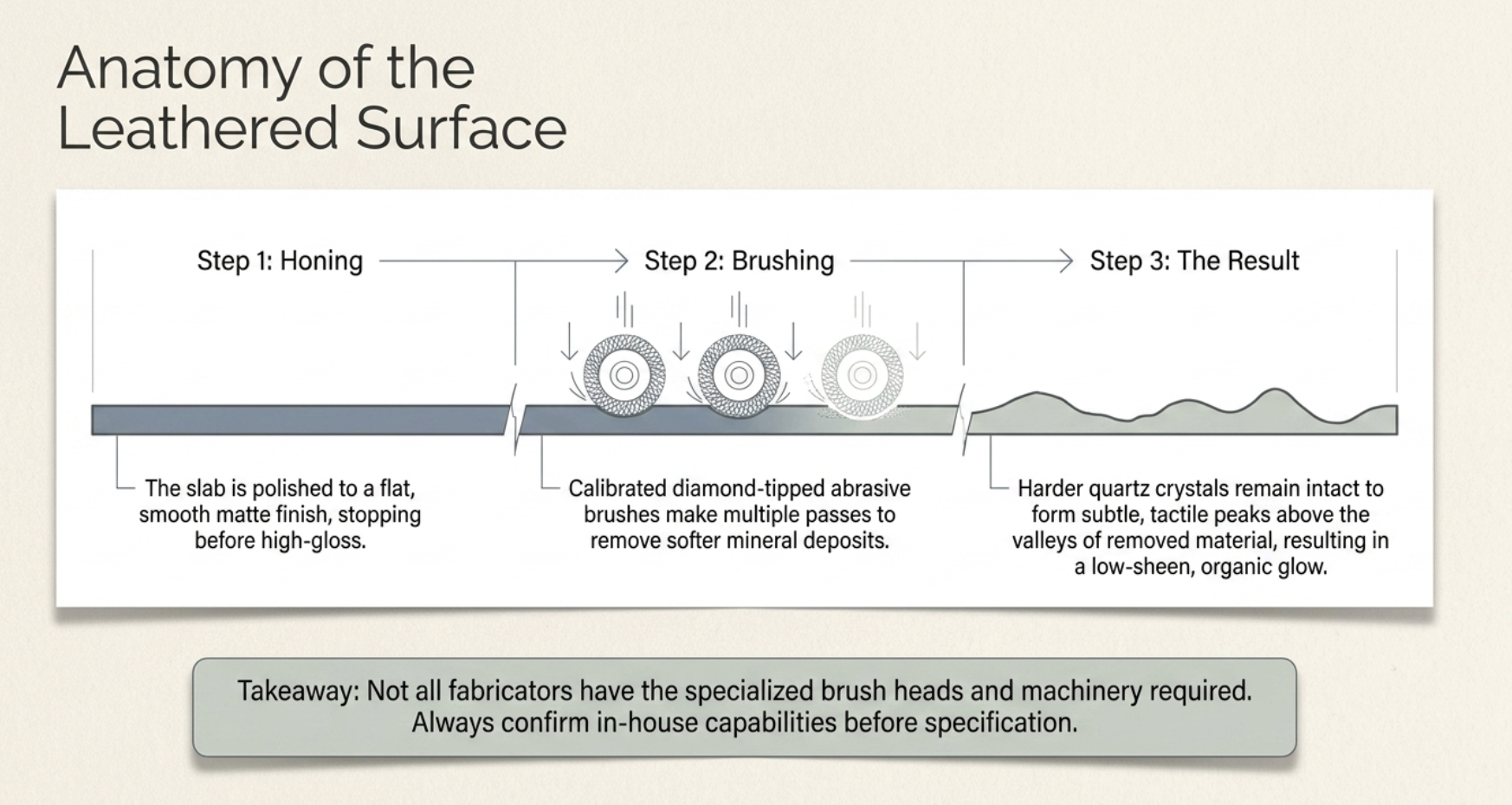
Step 1: Honing. The slab surface is polished to a matte finish, stopping before the high-gloss stage. This creates the flat, smooth base that the leathering brushes will work against.
Step 2: Brushing. Diamond-tipped brush heads are run across the honed surface in multiple passes. The brushes are calibrated to remove softer mineral deposits while preserving harder quartz crystals. Each quartzite variety has a different mineral composition, so the brush pressure, rotation speed, and number of passes vary. Taj Mahal quartzite, with its relatively uniform crystal structure, leathers consistently. More heavily veined or mineralogically varied stones may produce uneven texture.
Step 3: The finished surface. The harder crystals protrude slightly above the softer surrounding material, creating the characteristic peaks and valleys that define the leathered look. The texture is subtle (you can feel it, but it's not rough) and the sheen is low (matte with a soft, organic glow rather than the mirror reflection of polished stone).
Not every fabricator has leathering equipment. The process requires specialized brush heads and machinery that many standard countertop shops do not carry. When specifying leathered quartzite countertops, confirm with the fabricator that they have leathering capability in-house before committing to the finish. Some fabricators outsource the brush process to specialty shops, which adds 1-2 weeks of lead time and increases the cost.
Honed vs Leathered Quartzite: What's the Difference?
Both finishes are matte. Both reduce glare compared to polished. But they are different surfaces that perform differently in daily use.
Honed quartzite is produced by stopping the polishing process before reaching full gloss. The surface is smooth, flat, and matte with no texture. It feels like a sheet of satin paper under your hand. Light diffuses evenly across the surface. Fingerprints and water spots are less visible than on polished but more visible than on leathered. The pores are slightly more open than polished, meaning honed requires more consistent sealing.
Leathered quartzite starts as honed, then undergoes the diamond brush treatment. The surface has visible and tactile texture. Light interacts with the peaks and valleys unevenly, creating depth and movement that honed does not have. Fingerprints and water spots virtually disappear into the texture because the oils and moisture that create visible marks on smooth surfaces disperse across the textured topography. The texture also makes the surface slightly more porous than honed (the valleys can trap liquids if not sealed properly), so sealing is even more important.
| Feature | Polished | Honed | Leathered |
|---|---|---|---|
| Surface feel | Glass-smooth | Satin-smooth, flat | Textured, tactile |
| Sheen | High gloss | No sheen (flat matte) | Low sheen (soft glow) |
| Fingerprint visibility | Very visible | Moderately visible | Nearly invisible |
| Water spot visibility | Very visible | Moderately visible | Nearly invisible |
| Porosity | Lowest (pores closed) | Moderate (pores more open) | Highest (valleys + open pores) |
| Sealing frequency | Every 18-24 months | Every 12-18 months | Every 12-18 months |
| Color saturation | Highest (deepest color) | Moderate (slightly muted) | Moderate (natural, organic) |
| Best for | Formal spaces, low-touch surfaces | Contemporary kitchens, bathrooms | Busy kitchens, islands, high-touch |
| Cost premium | Baseline | Same as polished | +10-15% over polished |
The short version: honed is smooth matte, leathered is textured matte. Both hide marks better than polished. Leathered hides the most but requires the most sealing attention. For a deeper look at how finish selection works on natural marble (where the trade-offs are even more dramatic), see the Calacatta Marble guide.
Taj Mahal Leathered Quartzite
Taj Mahal quartzite is a crystalline quartzite quarried in Ceara, Brazil. It features a warm ivory and cream base with flowing gold and taupe veining that resembles high-end marble but with quartzite's superior hardness and durability. Taj Mahal leathered quartzite is the most searched and most specified variety in the leathered quartzite category, and for good reason.
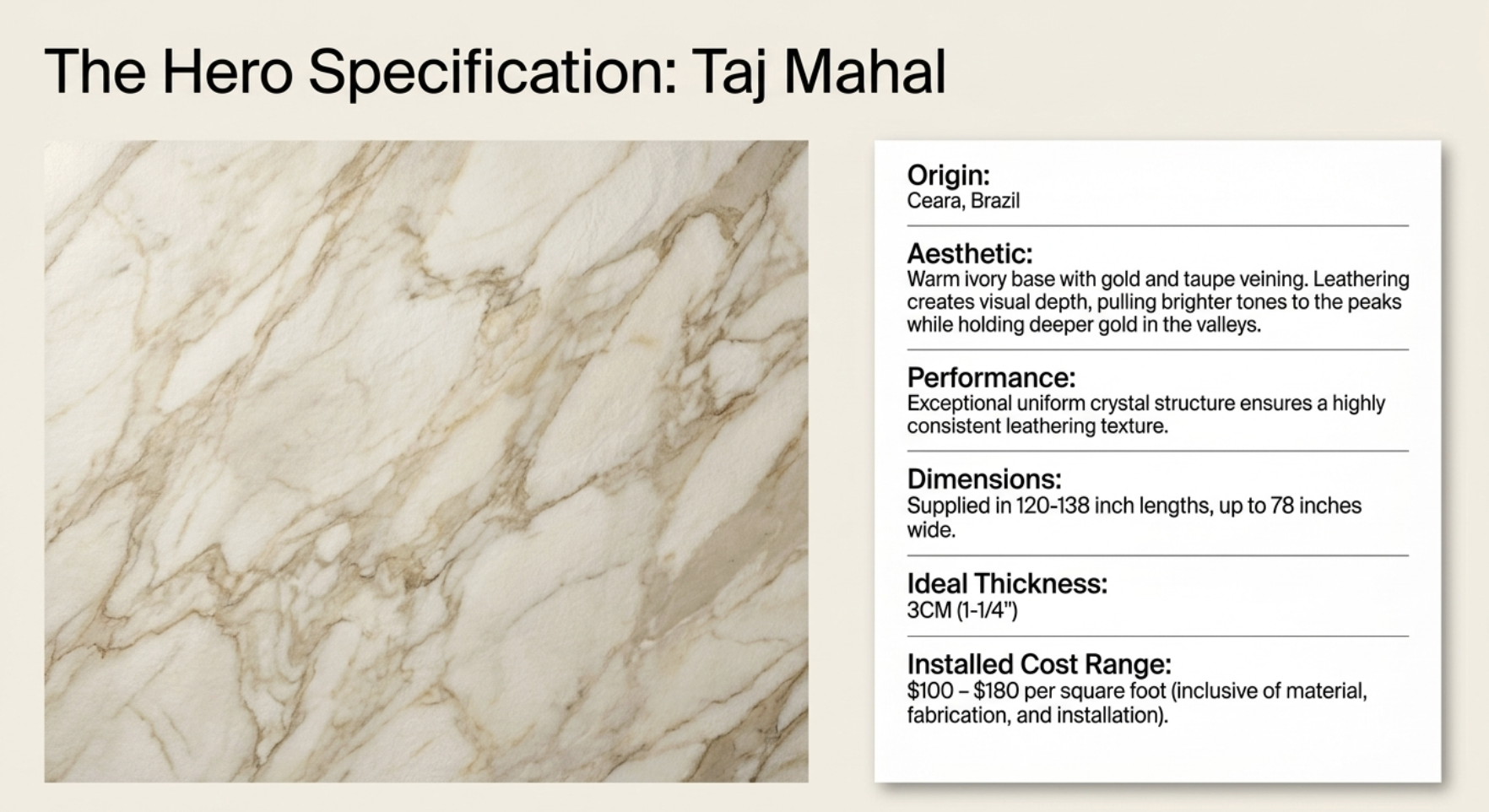
The warm gold veining comes through beautifully in the leathered texture. The peaks catch ambient light and show the stone's brighter tones while the valleys retain the deeper gold and taupe. This interplay creates a surface with more visual depth than polished Taj Mahal, where the uniform gloss flattens the veining into a single plane.
The ivory base stays cleaner-looking with the leathered texture. In a busy kitchen where hands touch the island 50 times a day and glasses leave water rings hourly, polished Taj Mahal shows every mark. Leathered Taj Mahal quartzite absorbs these marks into the texture. The countertop looks clean at 5 PM even if it hasn't been wiped since breakfast.
The finish also softens brightness in sunlit kitchens. Polished white and ivory stones can produce intense glare in south-facing or skylit rooms. The leathered texture diffuses that light, reducing glare without losing the warmth and movement that makes Taj Mahal one of the most popular quartzite varieties on the market.
Taj Mahal quartzite leathered is available in 3CM (1-1/4") thickness in slabs running 120 to 138 inches long and up to 78 inches wide. Standard applications include kitchen islands, kitchen countertops, bathroom vanities, waterfall edges, and backsplashes. Installed cost (material, fabrication, and installation) runs $100 to $180 per square foot, approximately 10-15% more than polished Taj Mahal.
Sealing schedule: every 12 to 18 months. The water drop test is the reliable indicator. Place a few drops of water on the surface. If the stone darkens within a few minutes, the sealer has worn and it's time to reseal.
Other Quartzite Varieties That Look Great Leathered
Taj Mahal dominates the leathered quartzite conversation, but several other varieties produce excellent results with the textured finish.
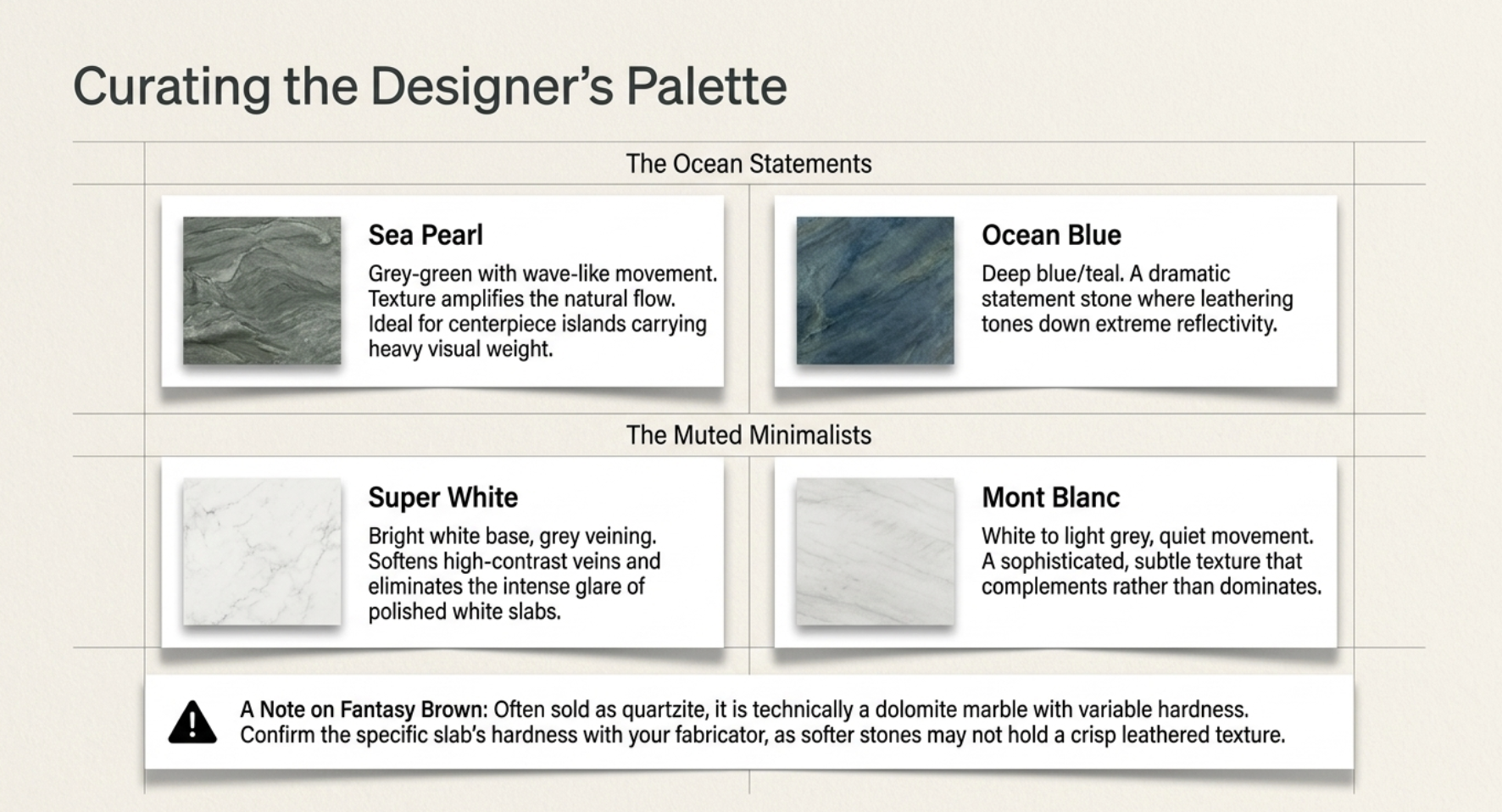
Sea Pearl
Green and grey tones with wave-like movement across the slab. The leathered texture amplifies the natural flow, creating surfaces that read like ocean water frozen in stone. The peaks catch the lighter grey-green tones while the valleys hold the deeper colors. Sea Pearl leathered is an excellent choice for kitchen islands where the stone is the design centerpiece and needs to carry visual weight.
Super White (Calacatta Super White)
Bright white base with grey veining, often sold as a quartzite alternative to Calacatta marble. The leathered finish softens the high-contrast veining and significantly reduces the glare that polished white quartzite produces in bright kitchens. For homeowners who want a white stone countertop that doesn't blind them at 10 AM, Super White leathered is the specification.
Ocean Blue
Deep blue and teal tones with dramatic veining. This is a statement stone regardless of finish. The leathered texture tones down the reflectivity while preserving the striking color depth. Best used as a single focal surface: an island, a bar top, a feature wall where the stone demands attention without the mirror-like intensity of a polished finish.
Mont Blanc
White to light grey with subtle, quiet movement. Mont Blanc is the minimalist's quartzite. Leathering gives it a soft, sophisticated texture that works in kitchens where the stone should complement the design rather than dominate it. The texture adds just enough visual interest to keep the surface from reading as flat.
Fantasy Brown
Brown and grey veining on a white/cream base with flowing, marble-like movement. Technically classified as a dolomite marble by some suppliers rather than true quartzite, which means hardness can be inconsistent across slabs. The leathered finish works well on Fantasy Brown, but confirm the specific slab's hardness with the fabricator before committing. Softer slabs may not hold the texture as crisply as true quartzite varieties.
Not every quartzite variety can be leathered successfully. Softer or more heavily fractured stones may not hold the texture uniformly across the slab surface. Always confirm with the fabricator before specifying leathered on an unfamiliar variety.
Leathered Quartzite Maintenance and Sealing
Daily cleaning is identical to polished or honed quartzite: mild dish soap and warm water on a soft cloth. The textured surface does not trap dirt any more than a smooth surface. This is a common misconception. Food particles and spills sit on the peaks of the texture and wipe off normally. Avoid acidic or ammonia-based cleaners that can degrade the sealer over time.
Sealing is where leathered quartzite requires slightly more attention than polished. The brush process opens up micro-channels in the stone surface, making it marginally more porous. Seal every 12 to 18 months with a penetrating (impregnating) sealer, not a topical coating. Some fabricators recommend the first reseal at 6 months for leathered finishes, then annually or every 18 months thereafter as the stone stabilizes. The water drop test remains the most reliable indicator: if water placed on the surface darkens the stone within a few minutes, it's time to reseal. The Natural Stone Institute provides additional care guidelines for quartzite surfaces.
Stain resistance on sealed leathered quartzite is strong. Wine, coffee, oil, and common household liquids are resisted well with prompt wipe-up. The texture actually helps here: spills bead on the peaks rather than pooling flat across the surface as they do on polished stone, giving more time to notice and wipe.
Etching is not a concern on quartzite the way it is on marble. Quartzite (Mohs 7) does not etch from household acids. Lemon juice, vinegar, and tomato sauce are safe on the surface. Prolonged acid contact can degrade the sealer, so wiping acidic spills promptly is still good practice, but the stone itself is not at risk.
How Much Does Leathered Quartzite Cost?
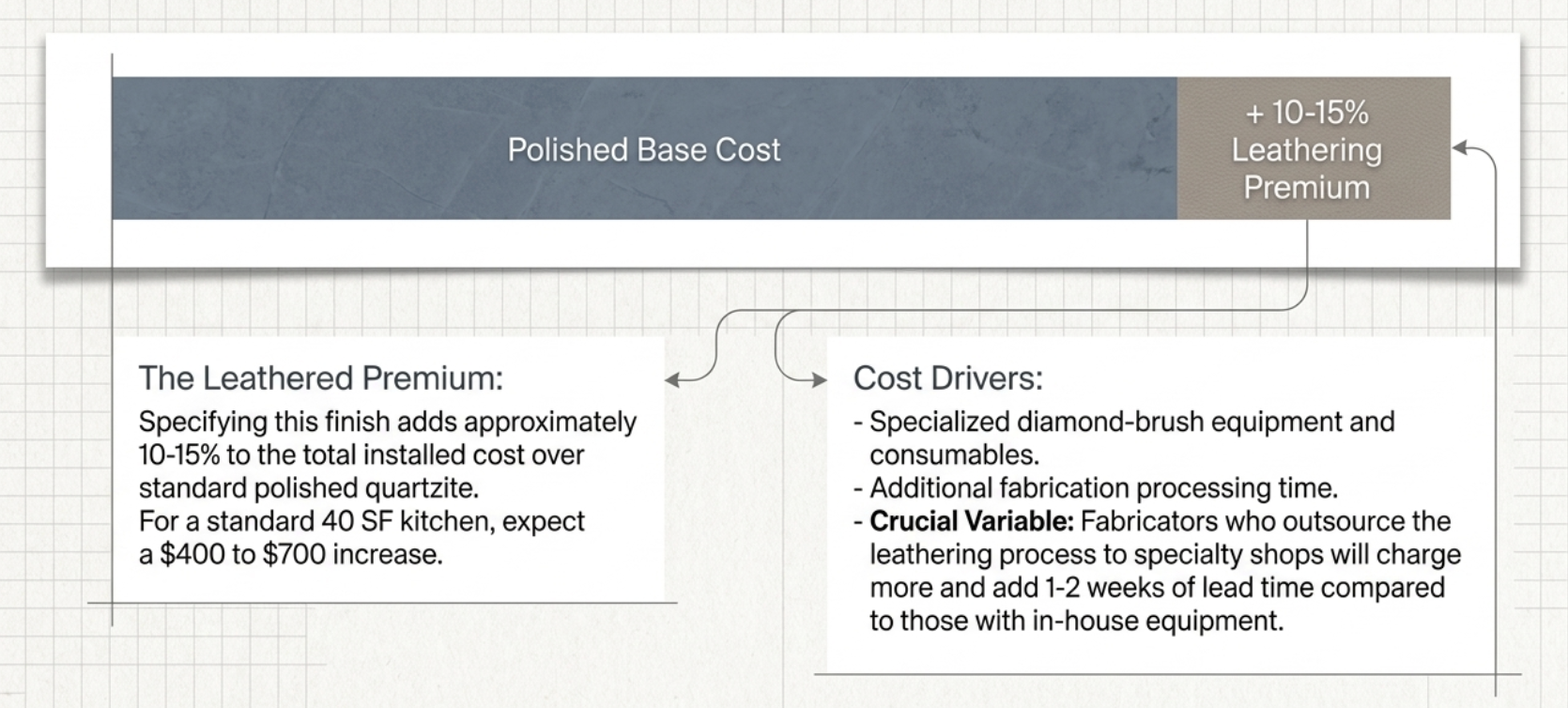
Leathered quartzite costs approximately 10-15% more than the same variety in a polished finish. The premium comes from the additional fabrication step: the diamond brush process adds time, requires specialized equipment, and not every fabricator has the machinery in-house.
| Variety | Polished (Installed/SF) | Leathered (Installed/SF) | Premium |
|---|---|---|---|
| Taj Mahal | $90-$160 | $100-$180 | +10-15% |
| Sea Pearl | $100-$170 | $110-$190 | +10-15% |
| Super White | $100-$180 | $115-$200 | +10-15% |
| Ocean Blue | $120-$200 | $135-$225 | +10-15% |
| Mont Blanc | $90-$150 | $100-$170 | +10-15% |
These are installed ranges (material, fabrication, and installation included). Factors that move the price within each range: slab grade, thickness (2CM vs 3CM), edge profile complexity, cutout count, seam count, and whether the fabricator leathers in-house or outsources the process. Fabricators with leathering equipment on-site charge less than those who send slabs to a specialty shop.
Specifying Leathered Quartzite for Custom Projects
Visit the slab yard in person. The leathered finish reads completely differently in person than in photographs. The texture, sheen, and color depth cannot be accurately evaluated from a screen. Run your hand across the surface. Look at it from multiple angles. Check it under both natural and artificial light. The way light interacts with the peaks and valleys changes dramatically depending on the viewing angle and light source.
Confirm fabricator capability. Ask specifically: do you leather in-house, or do you outsource? If outsourced, how much lead time does the brush process add? Have you leathered this specific quartzite variety before? Get references and photos of completed leathered projects from the fabricator.
Specify at the time of slab selection. The finish decision must be made before fabrication begins. Changing from polished to leathered (or the reverse) after fabrication has started is not possible. The finish is the first thing the fabricator applies after cutting, and it determines every subsequent step.
Specify 3CM thickness for countertops. The additional thickness (1-1/4" versus 3/4" for 2CM) provides better structural integrity, a more substantial visual presence on waterfall edges where the thickness is visible, and a more consistent leathered texture (thicker slabs hold the brush process more uniformly).
CooperBuild's approach: finish selection is part of the stone coordination process during shop drawings. The drawings document the variety, finish, edge profile, seam positions, and slab allocation before the fabricator cuts anything. On projects involving quartzite, the finish is reviewed with the designer and client during the slab selection visit, not decided afterward.
Frequently Asked Questions
What is leathered quartzite?
A natural quartzite stone with a leathered surface finish created by running diamond-tipped brushes over a honed surface. The result is a matte, textured surface with subtle peaks and valleys that hides fingerprints, water spots, and smudges. The stone's hardness (Mohs 7) does not change.
What is the difference between honed and leathered quartzite?
Honed is smooth matte with no texture (the polishing process stopped before reaching gloss). Leathered is textured matte (honed surface plus diamond brush treatment). Both reduce glare compared to polished. Leathered hides fingerprints and water spots better than honed but is slightly more porous and requires consistent sealing.
Is Taj Mahal quartzite good in a leathered finish?
Yes. Taj Mahal is the most popular quartzite variety for leathering. The warm ivory base and gold veining look particularly good with the textured finish, and the leathered surface hides kitchen fingerprints and water spots that accumulate rapidly on polished Taj Mahal.
Does leathered quartzite need to be sealed?
Yes, every 12 to 18 months with a penetrating sealer. The textured surface is slightly more porous than polished because the brush process opens micro-channels in the stone. Use the water drop test to check timing.
Is leathered quartzite harder to clean than polished?
No. Daily cleaning is identical: mild soap, warm water, soft cloth. The texture does not trap dirt or food particles. The misconception that textured surfaces are harder to clean is not supported by daily use.
Is leathered quartzite more expensive than polished?
Yes, approximately 10-15% more. The premium covers the additional diamond brush fabrication step. On a 40 SF kitchen, the difference is typically $400 to $700.
Can any quartzite be leathered?
Most quartzite varieties can be leathered, but results vary by mineral composition. Varieties with uniform crystal structures (Taj Mahal, Sea Pearl, Mont Blanc) leather consistently. Softer or heavily fractured varieties may not hold the texture uniformly. Confirm with the fabricator before specifying.
Does leathered quartzite hide fingerprints?
Yes. This is the primary practical advantage of the finish. The textured surface disperses light and absorbs the oils that create visible fingerprints on polished surfaces. In busy kitchens, leathered quartzite looks cleaner for longer between wipe-downs.
Leathered quartzite is a finish choice, not a material choice. The stone is quartzite (Mohs 7, harder than granite, significantly harder than marble). The finish is leathered (textured matte, hides fingerprints, requires sealing every 12-18 months). Taj Mahal is the most popular variety for leathering, but Sea Pearl, Super White, Ocean Blue, and Mont Blanc all produce excellent results. The specification decisions that matter: confirm the fabricator has leathering capability, select the slab in person, specify the finish at the time of purchase, and plan for sealing on a regular schedule.
If you are specifying leathered quartzite for a kitchen, bathroom, or feature surface and need guidance on variety selection, fabricator coordination, or how the finish integrates with your overall project design, start a conversation with us. CooperBuild is a design build construction company that coordinates stone selection, fabrication, and installation for custom residential projects in NYC, the Hamptons, and South Florida.
See completed work in our project portfolio, or learn about our custom millwork services.
Specifying Leathered Quartzite for Your Project?
CooperBuild coordinates stone selection, fabrication, and installation for custom residential projects in NYC, the Hamptons, and South Florida. From slab yard visits to finish confirmation with your fabricator, we manage the details that make leathered quartzite specification work.
Start a ConversationSubscribe to Our Newsletter
Get the latest insights, trends, and news from the construction industry delivered straight to your inbox.
We respect your privacy. Unsubscribe at any time.