

Calacatta Marble vs Calacatta Quartz: Varieties, Cost, and How to Specify
Understanding Calacatta marble varieties and quartz alternatives for custom projects
Calacatta is a family of Italian white marbles quarried in the Apuan Alps near Carrara, Italy, characterized by a bright white background with bold, dramatic veining in gold, grey, or brown. It is rarer and more expensive than Carrara marble, with premium slabs (Calacatta Gold, Borghini, Viola) ranging from $150 to $300+ per square foot installed. Calacatta quartz is an engineered alternative that replicates the aesthetic without the porosity and maintenance of natural marble. Both are specified for kitchen countertops, vanity tops, backsplashes, and shower surrounds. For custom projects, slab selection should happen in person at the stone yard, with the fabrication template and seam plan reviewed before cutting begins.
"Calacatta" is one of the most searched stone terms in residential renovation. It is also one of the most misunderstood. Homeowners confuse it with Carrara. Designers debate natural marble vs quartz. Slab yards stock a dozen named varieties (Gold, Borghini, Viola, Michelangelo, Turquoise) and each looks completely different from the next.
This guide covers what calacatta marble actually is, where it comes from, the major varieties, the difference between natural marble and calacatta quartz, how it compares to Carrara and Statuario, the real maintenance requirements, and how to approach stone specification on a custom project. The goal is to give architects, designers, and homeowners the information they need to specify the right stone for the right application, before anyone visits a slab yard or signs a fabrication contract.
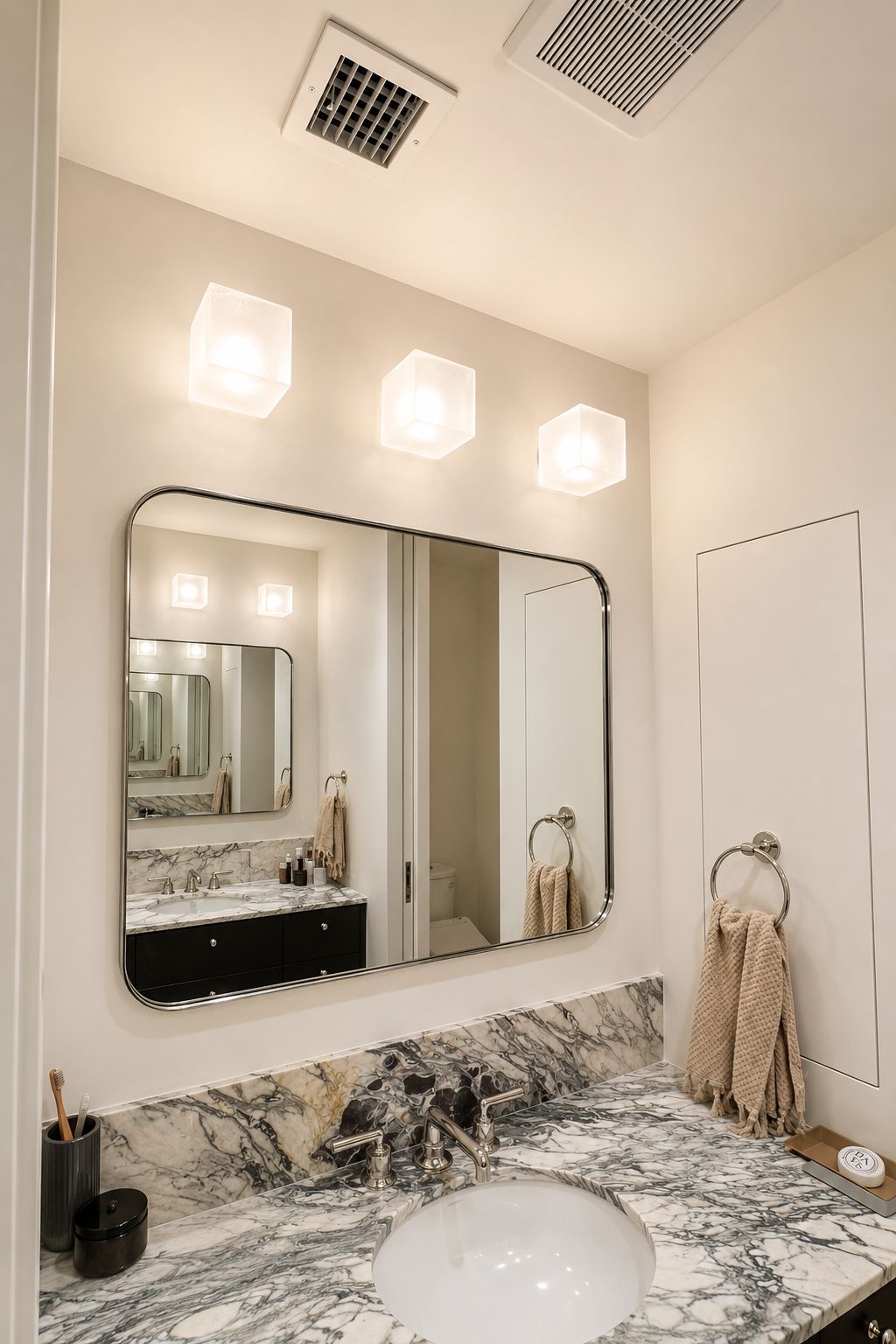
On the Carroll Gardens bath renovation in Brooklyn, CooperBuild specified Calacatta Turquoise Honed 2CM by Bas Stone across six distinct applications (vanity countertops, backsplashes, steam shower bench, shower niche, shower curb, and wall base) from a single lot. That kind of multi-application specification is where the details in this guide matter most.
What Is Calacatta Marble and Where Does It Come From
Origin: The Apuan Alps, Carrara, Italy
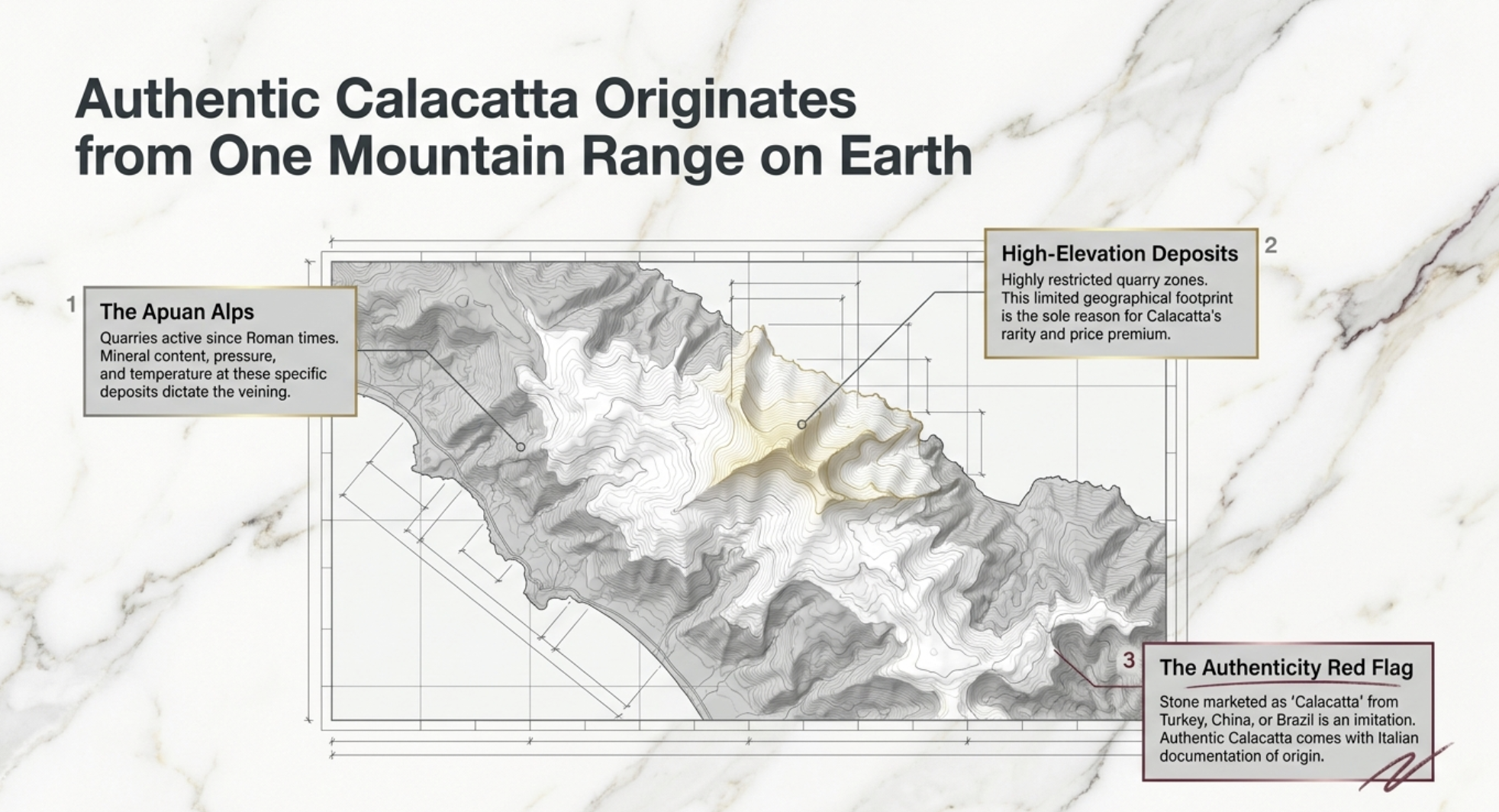
All calacatta marble comes from quarries in the Apuan Alps near Carrara, in the Tuscany region of Italy. The same mountain range produces Carrara marble, but Calacatta is extracted from more limited, specific deposits higher in elevation. These restricted quarry zones are why Calacatta is significantly rarer and more expensive than Carrara. The quarries have been active since Roman times, and the specific geological conditions at each deposit (mineral content, pressure, temperature during formation) determine the veining characteristics of the stone pulled from that location.
Where is calacatta marble from? Exclusively from the Apuan Alps near Carrara, Italy. Stone marketed as "Calacatta" that originates from Turkey, China, or Brazil is not Calacatta. It may look similar, but the geological composition, veining, and long-term performance differ. Authentic Calacatta is Italian and comes with documentation of origin.
What Makes Calacatta Different from Other White Marbles
Three characteristics define Calacatta and separate it from Carrara, Statuario, and other white marbles. First, the background color: Calacatta has a bright, clean white base (Carrara trends grey or blue-grey). Second, the veining: Calacatta's veins are thick, bold, and dramatic with high contrast against the white background (Carrara's veining is softer, more feathery, and lower contrast). Third, the vein colors: Calacatta veining ranges from warm gold and brown to dark grey depending on the variety, while Carrara veining is almost exclusively grey.
This combination of bright white base and bold, colorful veining is what commands the price premium. A slab with a clean white background, well-defined veining, and consistent color throughout will always cost more than one with a muddy background or inconsistent veining.
Calacatta Marble Varieties: Gold, Borghini, Viola, and More
"Calacatta" is not one stone. It is a family of marbles, and each named variety comes from a specific quarry or deposit with distinct visual characteristics.
Calacatta Gold
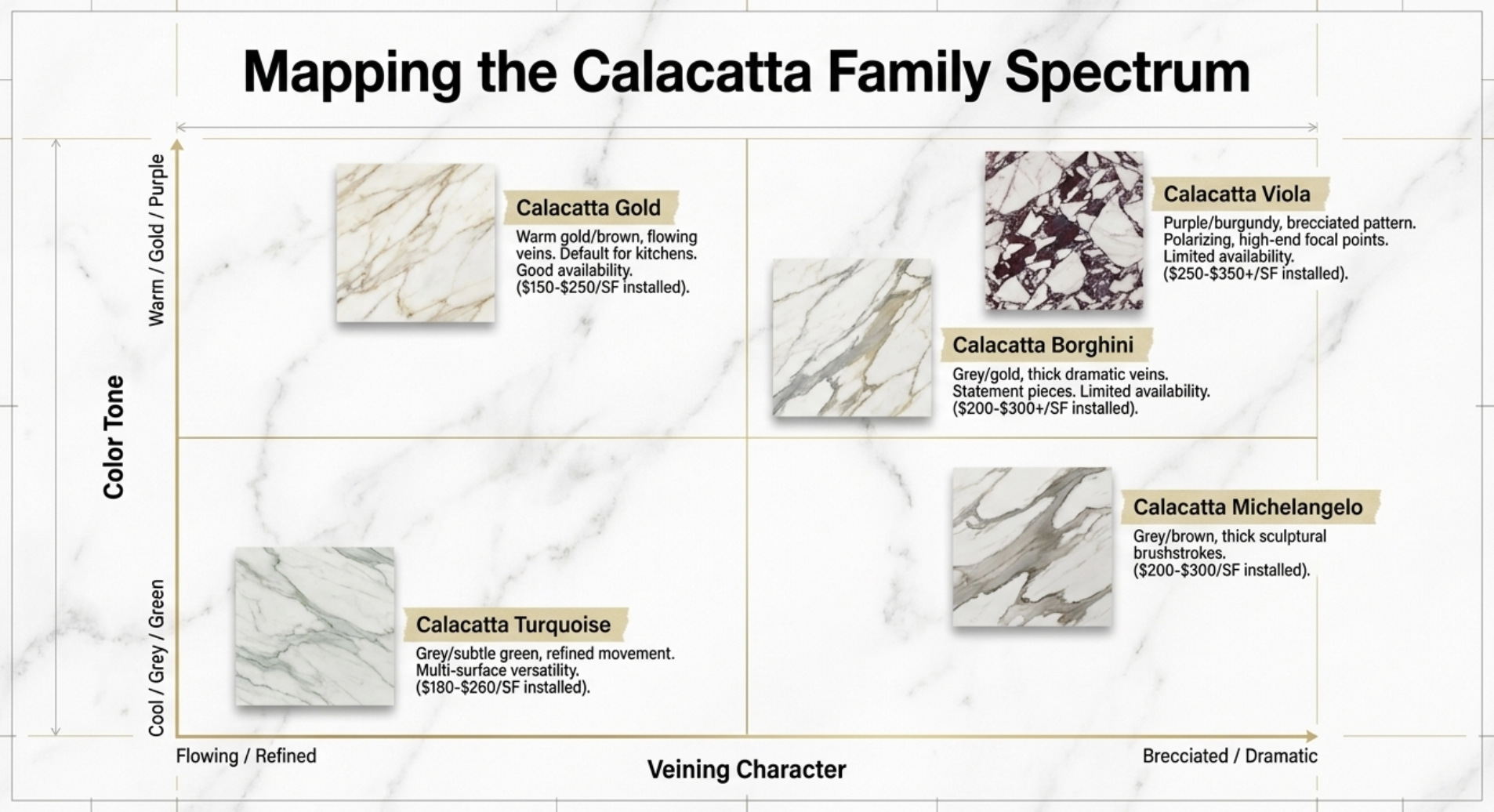
This is the variety most people picture when they hear "Calacatta." Bright white background with warm gold and brown veining. Calacatta Gold is the most available of the Calacatta varieties, which makes it less expensive than Borghini or Viola (though still significantly more than Carrara). It is the default specification for Calacatta kitchen countertops and islands where the designer wants the classic Calacatta look without the absolute top-tier price. Installed cost typically runs $150 to $250 per square foot.
Calacatta Borghini
Similar to Gold but with thicker grey veining and less gold coloration. The veining movement is bolder and more dramatic. Borghini is often specified for statement pieces: a single kitchen island, a fireplace surround, a feature wall where the stone is the focal point. More limited availability than Gold. Installed cost: $200 to $300+ per square foot.
Calacatta Viola
Distinctive purple, burgundy, and violet veining on a white background. The pattern is brecciated (broken, mosaic-like), giving it an entirely different character from the flowing veins of Gold or Borghini. Calacatta Viola has gained significant prominence in high-end design in recent years. It is highly distinctive and polarizing: designers either specify it deliberately or avoid it entirely. Installed cost: $250 to $350+ per square foot.
Other Notable Varieties
Calacatta Michelangelo features thick, sculptural veining that resembles brushstrokes. Calacatta Vagli has grey-green veining. Calacatta Oro carries heavy gold veining. Calacatta Turquoise is the variety CooperBuild specified on the Carroll Gardens project: honed 2CM by Bas Stone (LOT 240428 BM, Slab #24), used for dual vanity countertops, vanity backsplashes, the steam shower bench, shower niche, shower curb, and wall base. Each quarry produces a named variety, and availability changes constantly. A specific variety in stock today may not be available in six months.
Varieties at a Glance
| Variety | Veining Color | Veining Character | Availability | Price Range (Installed/SF) | Best Application |
|---|---|---|---|---|---|
| Calacatta Gold | Gold, brown | Flowing, medium-bold | Good | $150 to $250 | Kitchen countertops, islands |
| Calacatta Borghini | Grey, some gold | Thick, dramatic | Limited | $200 to $300+ | Statement pieces, feature walls |
| Calacatta Viola | Purple, burgundy | Brecciated, mosaic-like | Limited | $250 to $350+ | Focal point installations |
| Calacatta Michelangelo | Grey, brown | Thick, sculptural | Moderate | $200 to $300 | Countertops, wall cladding |
| Calacatta Turquoise | Grey, subtle green | Moderate, refined | Moderate | $180 to $260 | Vanities, shower surrounds, multi-surface |
Calacatta Marble vs Calacatta Quartz
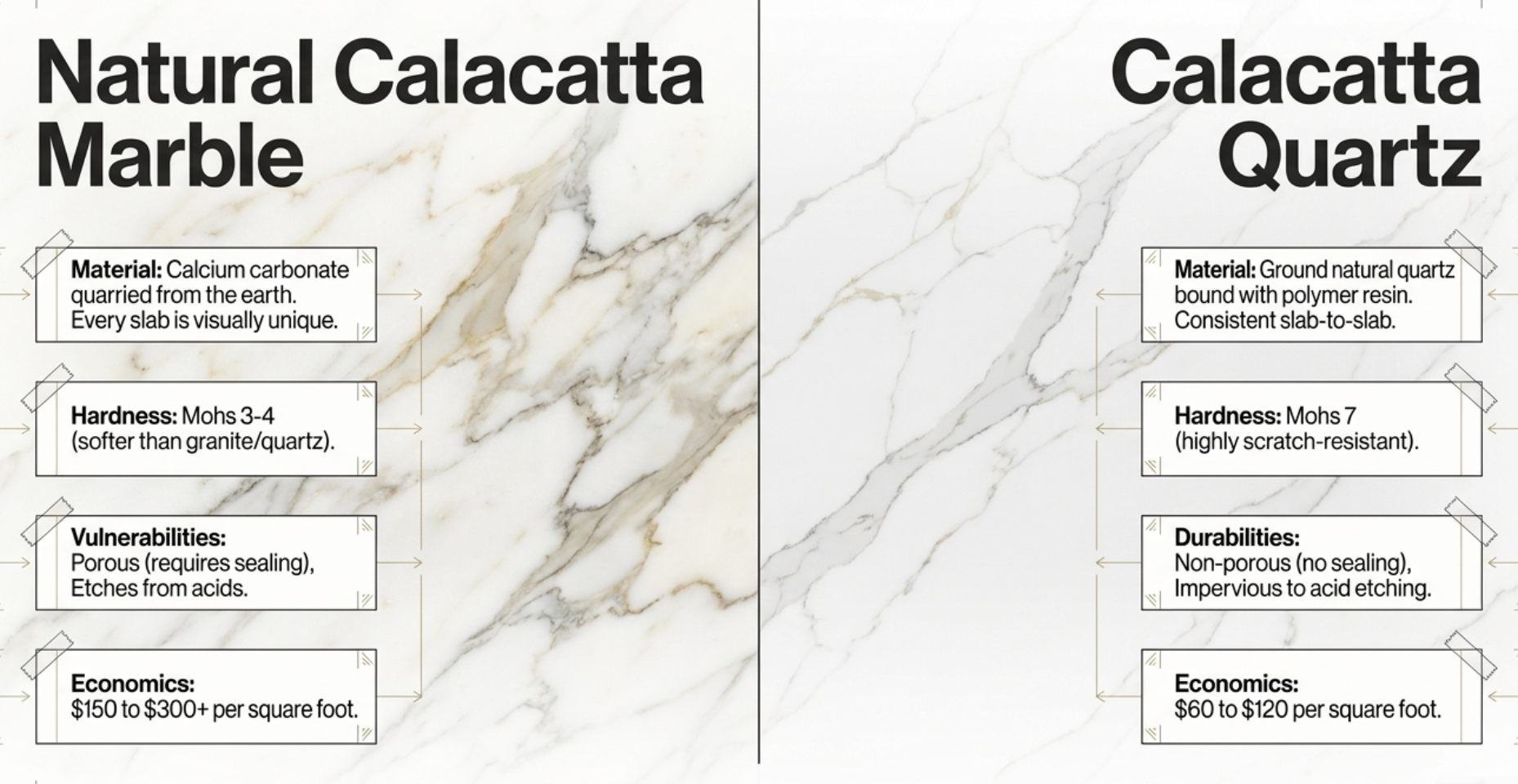
Natural Calacatta Marble
Natural calacatta marble is quarried stone. It is porous, meaning liquids can penetrate the surface if not sealed. It requires sealing every 6 to 12 months with a penetrating (impregnating) sealer. It etches from contact with acids (lemon juice, wine, vinegar, tomato sauce). This etching is a chemical reaction that dulls the polished surface. It is not a stain and cannot be prevented by sealing.
Every slab is unique. The veining pattern, color intensity, and background tone vary from slab to slab, even within the same lot. This natural variation is part of the material's value. Mohs hardness is 3 to 4, meaning it is softer than granite, quartzite, and quartz. Natural Calacatta must be fabricated by a specialist stone shop.
Calacatta Quartz (Engineered)
Calacatta quartz is an engineered surface: ground natural quartz bound with polymer resin, with Calacatta-pattern veining either printed or embedded during manufacturing. Major products include Caesarstone Calacatta Maximus (5031), Silestone Calacatta Gold, MSI Calacatta Classique, and Cambria Brittanicca.
What is calacatta quartz? It is a manufactured surface designed to replicate the Calacatta marble aesthetic. It is non-porous (no sealing required), does not etch from acids, and is consistent from slab to slab. Mohs hardness is 7, making it significantly harder and more scratch-resistant than natural marble. Installed cost is lower: $60 to $120 per square foot compared to $150 to $300+ for natural.
When to Spec Natural vs Quartz
Specify natural Calacatta marble when: the project requires authentic natural stone, the slab will serve as a focal point where unique veining matters, the designer wants a material that cannot be replicated, and the client accepts the maintenance requirements.
Specify Calacatta quartz when: durability and zero maintenance are priorities, budget is a factor, the application sees heavy daily use (a family kitchen with young children), or visual consistency across a large surface area is important. Quartz is also the better option for commercial applications where maintenance protocols may not be followed consistently.
Natural vs Quartz Comparison
| Feature | Natural Calacatta Marble | Calacatta Quartz |
|---|---|---|
| Material | Quarried natural stone | Engineered (quartz + resin) |
| Porosity | Porous (requires sealing) | Non-porous (no sealing) |
| Etch resistance | No (acids dull the surface) | Yes |
| Hardness (Mohs) | 3-4 | 7 |
| Slab uniqueness | Every slab unique | Consistent slab to slab |
| Price (installed/SF) | $150 to $300+ | $60 to $120 |
| Maintenance | Seal every 6-12 months, pH-neutral cleaners | Wipe clean, no special care |
| Best for | Focal points, statement pieces, authenticity | High-use kitchens, commercial, budget-conscious |
Calacatta vs Carrara vs Statuario
These are the three Italian white marbles that architects and designers encounter most frequently. All come from the Carrara region of Tuscany. All are calcium carbonate with similar hardness and maintenance requirements. The differences are visual and economic.
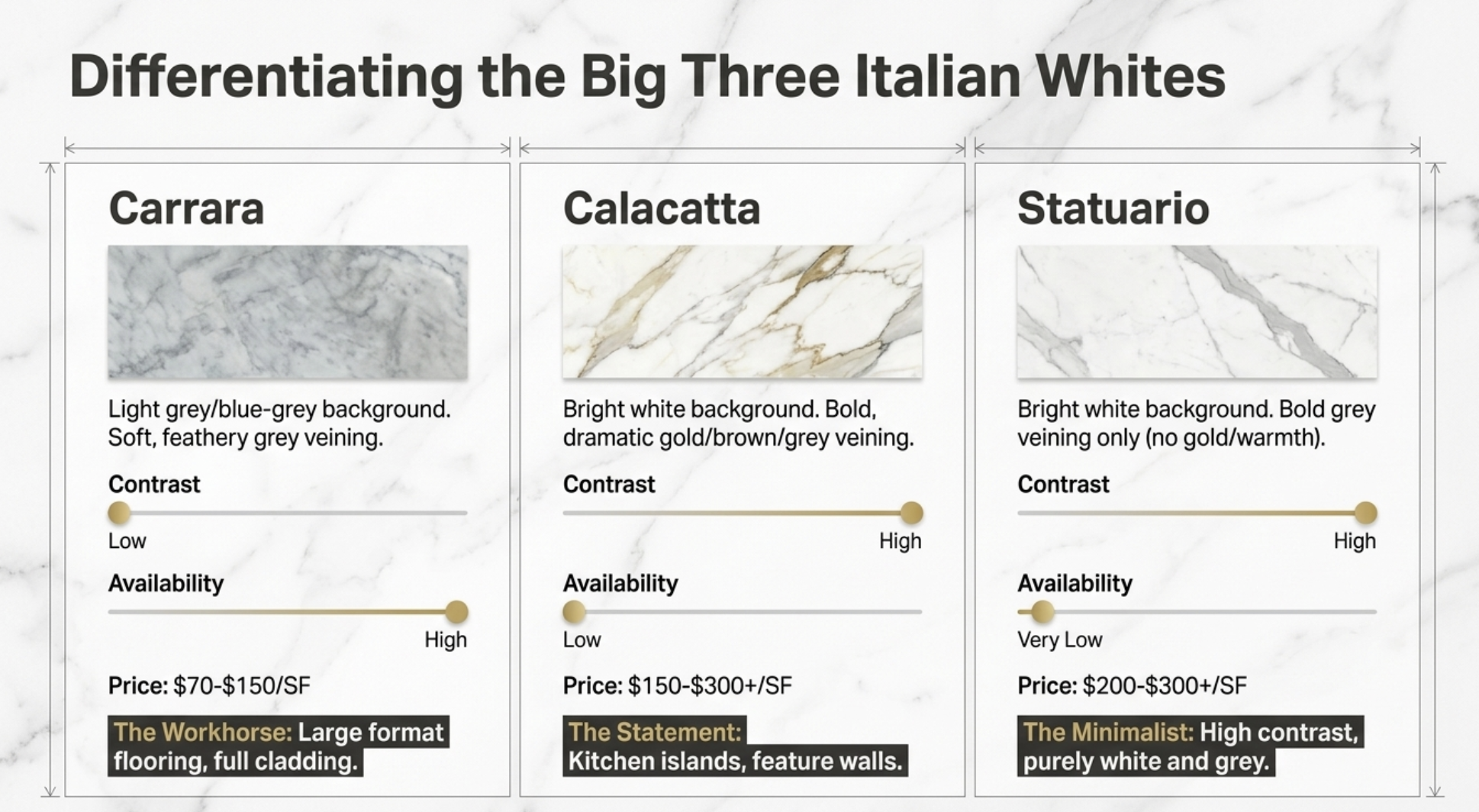
Carrara has a light grey to blue-grey background with soft, feathery grey veining. It is the most available Italian white marble and the most affordable ($70 to $150/SF installed). Carrara is the workhorse: large-format flooring, full bathroom cladding, kitchen countertops where a softer, less dramatic stone is appropriate.
Calacatta has a bright white background with bold, dramatic veining in gold, brown, or grey. It is rarer and more expensive ($150 to $300+/SF). Calacatta is the statement stone: a kitchen island, a shower feature wall, an entry floor where the stone demands attention.
Statuario has a bright white background similar to Calacatta but with darker grey veining and less color variation (no gold or brown tones). It is very limited in availability and priced similarly to Calacatta ($200 to $300+/SF). Statuario is the minimalist's choice: high contrast, no warmth, purely white and grey. For more context on how these marbles compare, Remodelista's marble comparison provides a good visual overview, and Marble.com's stone reference covers additional detail.
| Feature | Carrara | Calacatta | Statuario |
|---|---|---|---|
| Background | Light grey to blue-grey | Bright white | Bright white |
| Veining | Soft, feathery, grey | Bold, dramatic, gold/brown/grey | Bold, grey only (no gold) |
| Contrast | Low to moderate | High | High |
| Availability | Abundant | Limited | Very limited |
| Price (installed/SF) | $70 to $150 | $150 to $300+ | $200 to $300+ |
| Best for | Large surfaces, flooring, full baths | Statement pieces, focal points | Minimalist high-contrast applications |
Maintaining Calacatta Marble in Kitchens and Bathrooms
Sealing
Natural Calacatta marble requires sealing every 6 to 12 months with a penetrating sealer. The sealer fills the stone's pores and slows liquid absorption, giving time to wipe up spills before they stain. Sealing does not make marble impervious. It buys time. A sealed Calacatta surface will still stain if red wine sits on it overnight. It will not stain if the wine is wiped up within a few minutes.
Etching
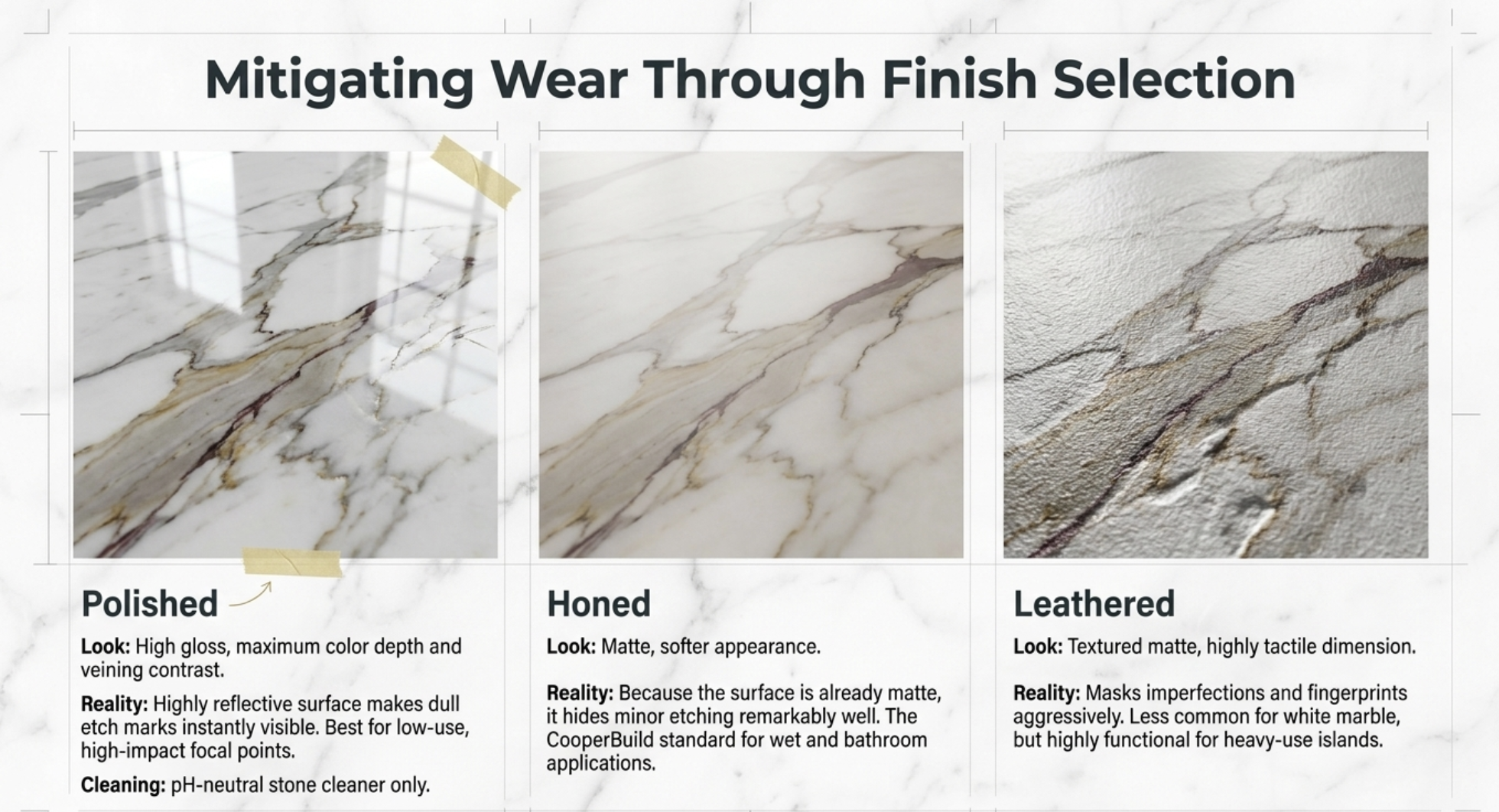
Marble is calcium carbonate. Contact with acidic substances (lemon, wine, vinegar, tomato sauce, certain cleaning products) causes a chemical reaction that etches the surface, leaving a dull spot. Etching is not staining. Sealing does not prevent etching (it prevents staining). Etching shows more on polished finishes than honed. Calacatta in a honed finish (like the 2CM honed specification used on the Carroll Gardens project) hides minor etching significantly better than polished.
Daily Care
Clean with a pH-neutral stone cleaner and a soft cloth. No acidic cleaners, no bleach, no abrasive pads. Use cutting boards on kitchen countertops. Use trivets under hot cookware. Wipe spills immediately, especially anything acidic.
For bathrooms, the low-acid environment makes Calacatta an excellent surface. Vanity tops, shower walls, niches, and benches see far less acid exposure than kitchen countertops. This is why many designers spec natural Calacatta for bathrooms but Calacatta quartz for kitchens in the same project.
The Patina Question
Over years of use, natural marble develops a patina: a subtle accumulation of micro-scratches, minor etch marks, and surface dulling that blend together into a softened finish. Some designers and homeowners consider this part of the material's character, similar to how leather ages. Others want a pristine surface that looks new indefinitely. If patina is unacceptable, specify quartz. If patina is embraced, natural marble ages in a way that engineered surfaces cannot replicate.
Specifying Calacatta for Custom Projects
Slab Selection at the Stone Yard
Never specify Calacatta from a catalog photo or a 4x4 sample. Every slab is different. The designer or owner should visit the stone yard, view full slabs standing upright under consistent lighting, compare veining direction and color across multiple slabs, and approve specific slabs before fabrication begins. Most yards hold slabs for 48 to 72 hours after selection.
For large applications (a full kitchen or a bathroom with countertop, backsplash, and shower surround), book-matched slabs (consecutive cuts from the same block) create symmetrical veining across seams. Book-matching must be requested at the time of slab selection. Not all blocks are available for book-matching.
Fabrication and Seam Planning
The fabricator creates an on-site template showing exact slab dimensions, cutout locations (sinks, cooktops, faucet holes), and seam positions. Seam placement matters on Calacatta because the bold veining makes poorly aligned seams more visible than on a uniform surface like Carrara. A skilled fabricator matches veining direction across seams so the pattern reads as continuous. Review the seam plan before cutting begins.
Finish Selection: Polished vs Honed vs Leathered
Polished: high gloss, maximum veining contrast and color depth. Shows etching most visibly. Best for low-use applications where appearance is the priority. Honed: matte finish, softer appearance, hides minor etching. CooperBuild's standard for bathroom applications (Carroll Gardens used honed 2CM throughout). Leathered: textured matte, masks imperfections well, adds tactile dimension. Less common for Calacatta but works on islands and surfaces where fingerprints are a concern.
How CooperBuild Approaches Stone Specification
Stone selection is part of the design coordination process on every project involving natural stone or engineered surfaces. The designer selects the variety and finish. We coordinate with the stone yard and fabricator. The shop drawings show stone placement with seam locations, edge profiles, and waterproofing details (for wet applications). The fabricator templates on site before cutting.
On the Carroll Gardens project, Calacatta Turquoise Honed 2CM by Bas Stone (LOT 240428 BM, Slab #24) was specified for six applications: dual vanity countertops, vanity backsplashes, the steam shower bench, shower niche, shower curb, and wall base. Six applications from one lot required careful slab allocation so the color and veining read consistently across all surfaces. The shop drawings documented every stone piece with dimensions, edge treatment, and seam positions before fabrication began.
That's how stone specification works on a custom project. The material is selected, documented, and coordinated before it reaches the jobsite. See additional examples in our project portfolio, or learn more about our custom millwork services (which frequently involve stone countertop coordination).
Calacatta is not one stone. It is a family of Italian marbles, each with different veining, availability, and cost. The specification decisions that matter: natural marble vs quartz (based on maintenance tolerance and budget), which variety matches the design intent, polished vs honed finish, and slab selection at the stone yard before fabrication. These decisions belong in the design coordination phase, not on the jobsite.
If you are specifying Calacatta marble or quartz for a project and need guidance on varieties, finish, or fabricator coordination, start a conversation with us. CooperBuild coordinates stone selection, fabrication, and installation for custom residential and commercial projects in NYC, the Hamptons, and South Florida.
Sources & Additional Reading
Planning a Custom Project with Natural Stone or Quartz?
CooperBuild coordinates stone selection, fabrication, and installation for custom residential and commercial projects in NYC, the Hamptons, and South Florida. From slab selection to seam planning, we manage the details that make stone specification work.
Start a ConversationSubscribe to Our Newsletter
Get the latest insights, trends, and news from the construction industry delivered straight to your inbox.
We respect your privacy. Unsubscribe at any time.