

Types of Paint Finishes: How to Choose the Right Sheen for Every Surface
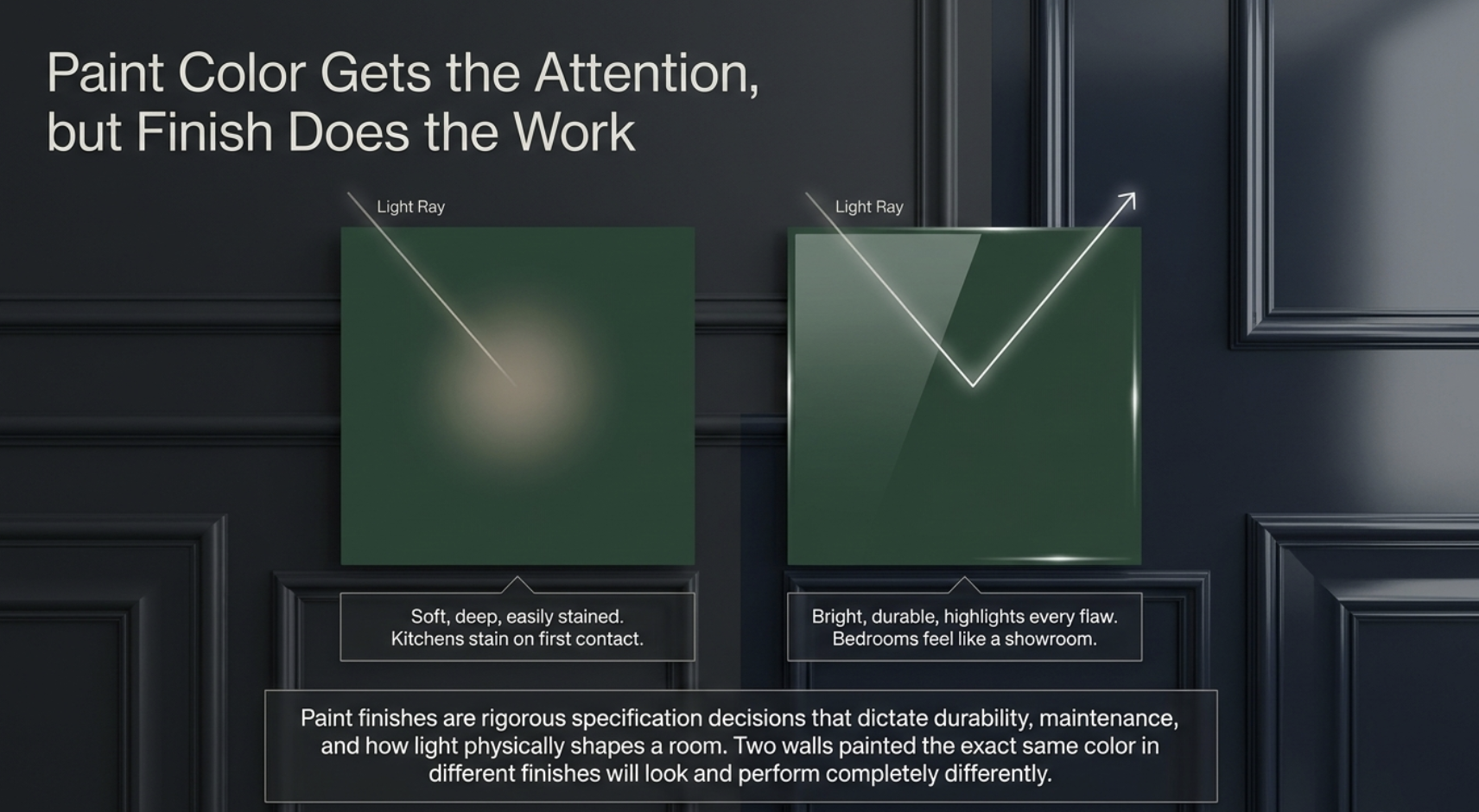
Paint color gets the attention, but finish does the work: the same color in two sheens looks and performs differently
Paint finish (also called sheen) determines how much light a dried paint surface reflects. The six standard finishes, from least to most reflective: flat, matte, eggshell, satin, semi-gloss, and high-gloss. Lower sheens hide wall imperfections but are harder to clean. Higher sheens are more durable and washable but reveal every flaw in the substrate. The rule of thumb: flat or matte for ceilings and formal rooms, eggshell for most living spaces, satin for kitchens and bathrooms, semi-gloss for trim and doors, and high-gloss for cabinets and architectural features. The finish affects how the color reads in different light, how the surface wears over time, and how easily it can be cleaned.
The paint color gets all the attention. The paint finish does all the work. Two walls painted the same color in different finishes will look like two different colors depending on the light, and they will perform completely differently in daily use. A flat-finished kitchen wall stains on first contact. A semi-gloss bedroom wall reflects light so aggressively it feels like sleeping inside a showroom.
Paint finishes are specification decisions that affect aesthetics, durability, and maintenance. This guide covers every standard finish level (flat through high-gloss), what each one does, where each one performs best, and the room-by-room recommendations that professional painters in NYC use on luxury residential projects. For the broader overview of paint types (latex, acrylic, alkyd, enamel, primer), see our guide to types of paint for interior and exterior surfaces.
What Is Paint Finish (Sheen)?
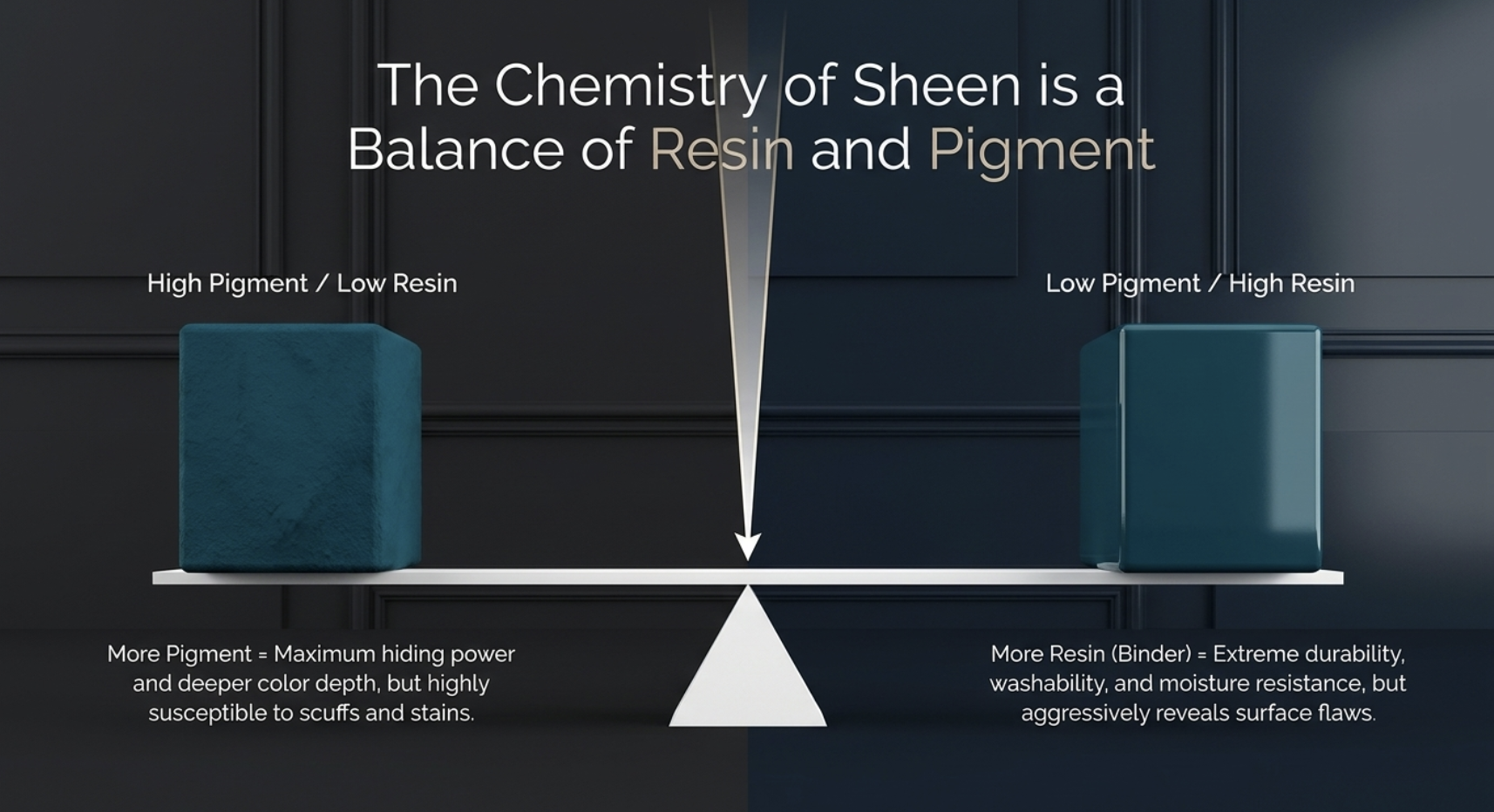
Paint finish refers to the degree of light reflectivity in the dried paint film. The more reflective the finish, the shinier the surface appears. This reflectivity is determined by the ratio of binder (resin) to pigment in the paint formula. Higher-sheen paints contain more resin and less pigment per unit volume. Lower-sheen paints contain more pigment and less resin.
This ratio has practical consequences. Resin is what makes paint durable, washable, and moisture-resistant. Pigment is what gives paint its hiding power and color depth. So higher-sheen paints are more durable but show surface imperfections. Lower-sheen paints hide imperfections but are less durable and harder to clean.
Every paint brand uses slightly different terminology and may subdivide the sheen spectrum differently, but the six universally recognized levels are flat, matte, eggshell, satin, semi-gloss, and high-gloss. Each serves a specific purpose.
Flat Finish
Flat finish (also called dead flat) is a completely non-reflective surface. It absorbs light rather than reflecting it, which gives walls a smooth, velvety appearance and makes colors look deeper and richer than in any other sheen. Flat paint contains the highest pigment-to-resin ratio, which means it hides surface imperfections (bumps, patches, uneven textures, roller marks) better than any other finish.
The trade-off is durability. Flat paint is the most susceptible to scuffing, staining, and damage from cleaning. Wiping a flat-painted wall with a damp cloth can leave visible marks or remove paint entirely. This is why flat is reserved for surfaces that receive little to no physical contact.
Premium flat paints (Benjamin Moore Regal Select Flat, Sherwin-Williams Emerald Flat) have improved scuff resistance compared to basic flat paints, but they still cannot match the washability of eggshell or satin.
Where to Use Flat Finish
Ceilings. The default ceiling finish. Flat eliminates light reflection on the ceiling plane, which prevents the distracting glare that higher sheens produce under overhead lighting. It also hides the imperfections (patches, texture changes, hairline cracks) that are common in older plaster ceilings found in pre-war NYC apartments.
Formal living rooms and dining rooms. In rooms where the walls are display surfaces (for art, for color, for architectural detail) rather than high-contact surfaces, flat produces the most refined, gallery-like appearance.
Adult bedrooms. Low-traffic bedrooms where the walls are not touched, bumped, or cleaned frequently.
Textured or imperfect walls. Any wall with visible patches, uneven plaster, or textured finishes benefits from flat, which absorbs light and minimizes the shadows that reveal surface flaws.
Matte Finish
Matte finish sits just above flat on the sheen spectrum. It has a barely perceptible angular sheen (visible only when light hits the surface at a low angle) while still appearing non-reflective from most viewing positions. The practical advantage over flat: matte is significantly more washable. Modern premium matte paints can be wiped with a damp cloth without leaving marks or removing paint.
This washability improvement makes matte the preferred alternative to flat in rooms where imperfection-hiding is important but some degree of cleanability is needed. Matte is the finish that architects and designers increasingly specify for living spaces in high-end residential projects because it delivers the visual depth of flat with enough durability for real life.
For the full breakdown on when to choose matte over flat or eggshell, see Matte Paint: Choosing the Right Finish for Interior Walls.
Where to Use Matte Finish
Living rooms and family rooms. Matte handles the occasional scuff from furniture or hands better than flat while maintaining the low-reflectivity appearance.
Dining rooms. Matte walls behind a dining table provide a rich, quiet backdrop for art and lighting without competing for attention.
Bedrooms (all ages). Matte works in both adult bedrooms and children's rooms because it balances visual softness with reasonable durability.
Exterior siding. Matte or low-sheen finishes are common on exterior siding because they minimize the visual impact of surface imperfections on wood, stucco, and fiber cement.
Eggshell Finish
Eggshell finish has a soft, low luster similar to the surface of an eggshell (which is where the name comes from). It reflects more light than matte but significantly less than satin. Eggshell is the most versatile interior wall finish because it balances three competing priorities: it hides imperfections reasonably well, it is durable enough for daily living, and it cleans up without damage.
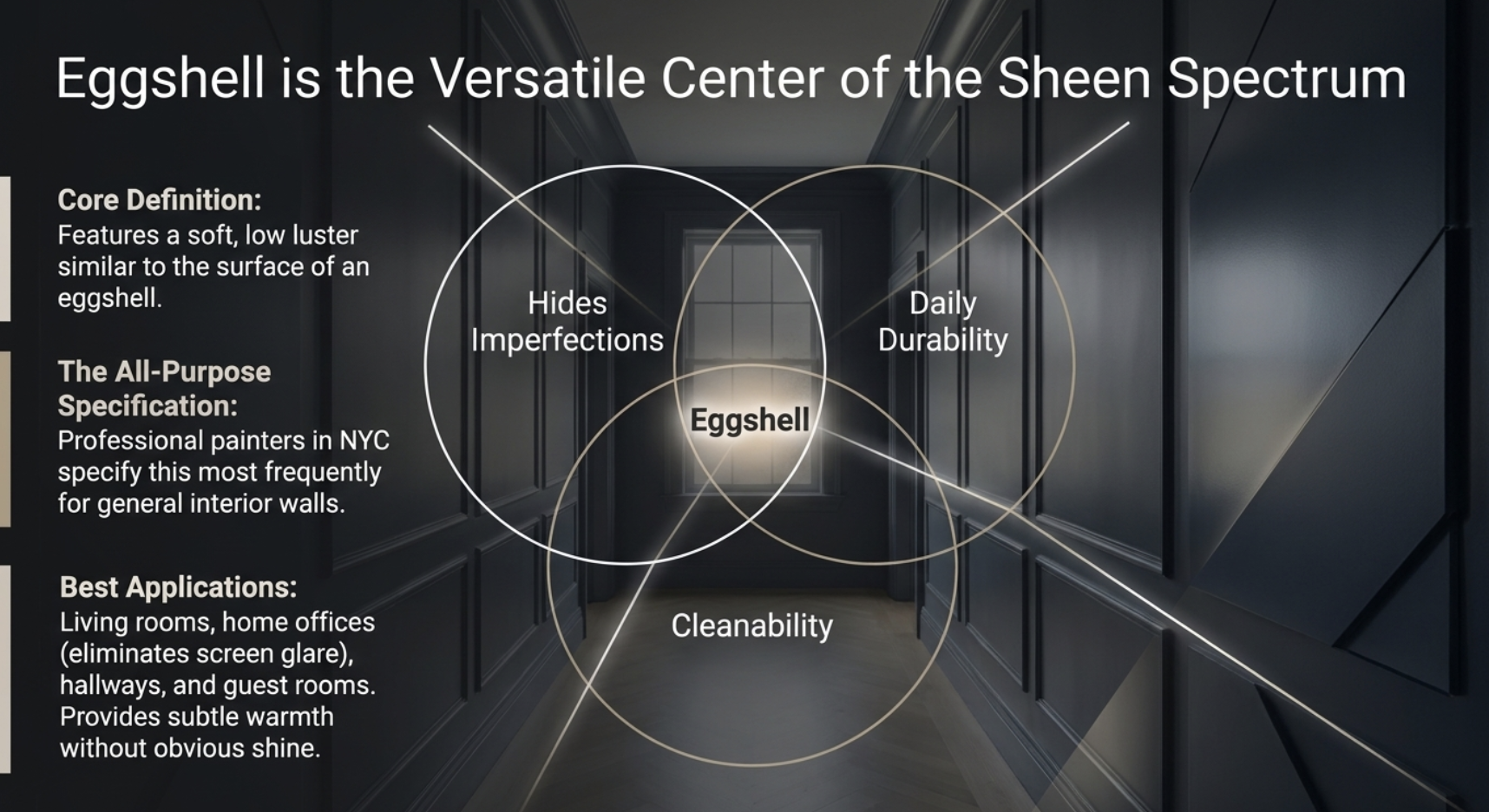
Eggshell is the finish that professional painters in NYC specify most frequently for general interior walls. It works in virtually every room and on virtually every wall surface. When a designer or homeowner is unsure which finish to choose, eggshell is the safe answer.
For the complete guide to eggshell, including how it compares to satin and matte, see What is Eggshell Paint and When Should You Use It?.
Where to Use Eggshell Finish
Living rooms, dining rooms, and bedrooms. The all-purpose wall finish. Eggshell provides a subtle warmth without obvious shine.
Home offices. Professional, clean appearance without the reflectivity that causes glare on computer screens.
Hallways and entryways. Durable enough for moderate traffic while maintaining a refined appearance.
Guest rooms and secondary spaces. Any room where a balanced, universally appropriate finish is needed.
Satin Finish
Satin finish has a noticeable soft sheen, more reflective than eggshell but less shiny than semi-gloss. It is the first finish on the spectrum that reads as visibly "shiny" in most lighting conditions. Satin is significantly more washable and moisture-resistant than eggshell, making it the standard specification for rooms that encounter water, grease, steam, or frequent cleaning.
The trade-off: satin reveals surface imperfections more than eggshell or matte. Bumps, patches, and roller marks that disappear under eggshell become visible under satin because the sheen reflects light at angles that highlight surface irregularities. This means surface preparation matters more with satin. Walls need to be properly skim-coated, sanded, and primed before satin paint is applied, particularly in older buildings with imperfect plaster.
Where to Use Satin Finish
Kitchens. The standard kitchen wall finish. Satin resists grease splatter, steam, and moisture from cooking. It wipes clean with a damp cloth. For kitchen renovations where the walls will be exposed to daily cooking activity, satin is the minimum sheen level.
Bathrooms. Moisture resistance makes satin the standard for bathroom walls. It handles steam from showers, splashes around the vanity, and the humidity that builds in enclosed bathroom spaces. Pair this with proper bathroom ventilation.
Laundry rooms and mudrooms. High-moisture, high-contact rooms where walls need regular cleaning.
Children's bedrooms and playrooms. Fingerprints, crayon marks, and scuffs wipe off satin more easily than off eggshell or matte.
High-traffic hallways. Hallways in multi-person households (families, roommates, co-ops with shared corridors) benefit from satin's scuff resistance.
Exterior trim and siding. Satin is a popular exterior finish that provides moderate sheen with good moisture and UV resistance.
Semi-Gloss Finish
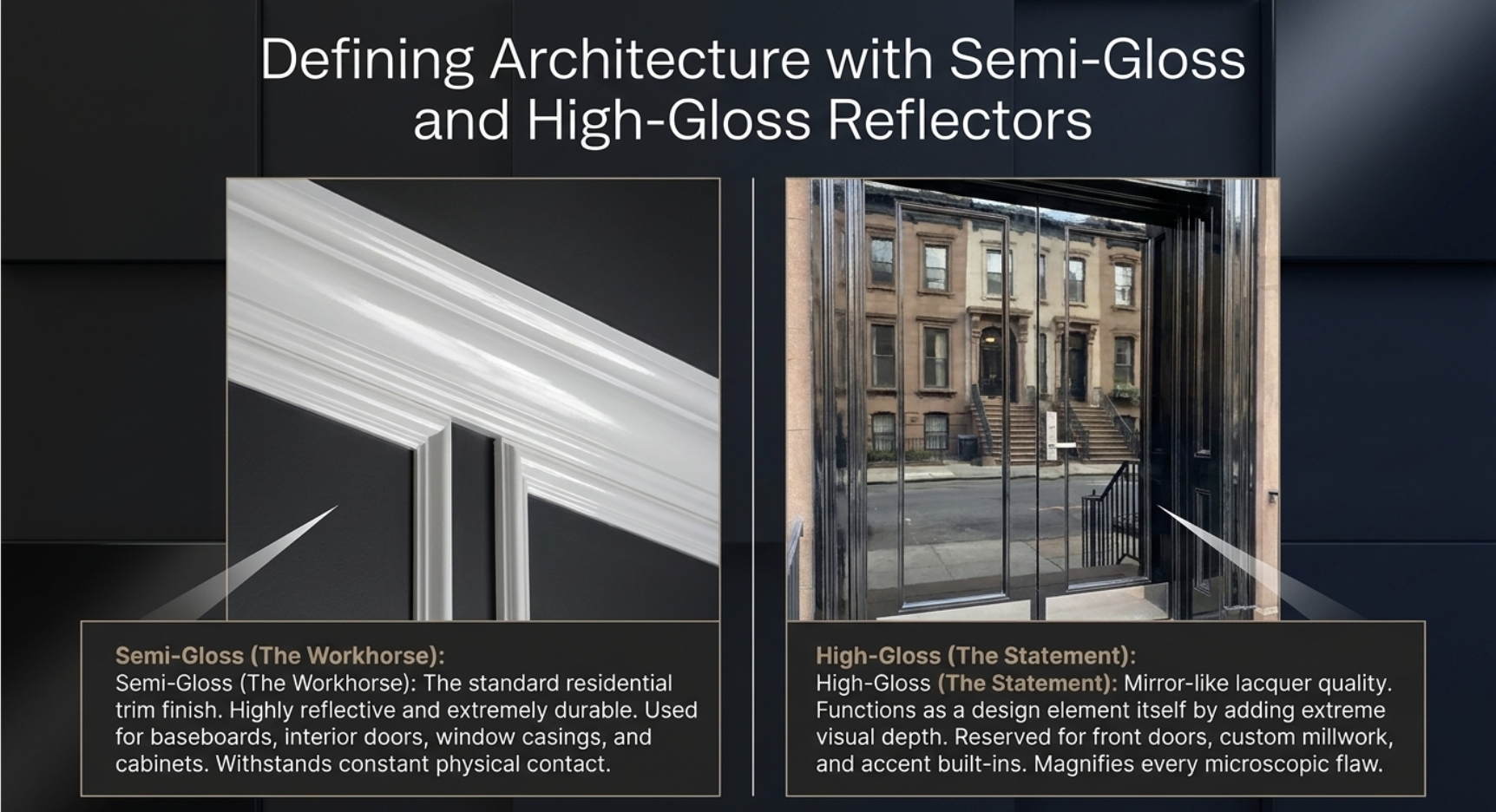
Semi-gloss finish is highly reflective, producing a noticeable shine that catches and reflects light from every angle. It is the most durable standard wall/trim finish, with excellent resistance to moisture, stains, scuffing, and repeated cleaning. Semi-gloss is the workhorse finish for every surface in a home that takes daily physical contact.
Semi-gloss reveals surface imperfections aggressively. Every bump, nail pop, patch, and sanding mark shows clearly under the reflective surface. This is why semi-gloss is rarely used on large wall areas (where imperfections are most visible over wide surfaces) and is instead reserved for trim, doors, and millwork, where the surfaces are small, properly prepared, and usually made from wood or MDF rather than plaster.
Where to Use Semi-Gloss Finish
Interior trim, baseboards, and crown molding. The standard trim finish in residential construction. Semi-gloss on trim creates a visual contrast with eggshell or satin walls, defining the architectural lines of the room. This contrast between wall sheen and trim sheen is one of the most fundamental interior design conventions. See our guide to custom wood trim.
Doors (interior and exterior). Semi-gloss withstands the constant contact that doors receive (handle areas, kick plates, edges) while maintaining a clean, professional appearance.
Window casings and sills. The moisture resistance of semi-gloss handles condensation on window surfaces.
Kitchen and bathroom cabinets. Semi-gloss provides a washable, grease-resistant surface on cabinet faces and frames. Applied by an expert painter in New York City over a bonding primer, semi-gloss enamel on cabinets can rival a factory-sprayed finish.
Bathroom walls (high-moisture). In bathrooms with poor ventilation or no exhaust fan, semi-gloss on walls provides maximum moisture protection.
Utility rooms, storage rooms, and garage interiors. Surfaces that need to be scrubbed.
High-Gloss Finish
High-gloss finish is the most reflective paint surface available. It produces a mirror-like, lacquer-quality shine that is extremely hard, extremely durable, and extremely unforgiving of surface preparation flaws. High-gloss reflects so much light that it functions almost as a design element itself: the reflectivity adds visual depth and drama to surfaces.
The preparation requirements for high-gloss are the most demanding of any finish. The surface must be perfectly smooth because the reflective sheen magnifies every imperfection, including grain patterns in wood, microscopic brush marks, dust particles in the paint film, and uneven primer coats. Professional application typically involves spray equipment and multiple thin coats with sanding between coats.
High-gloss is a statement finish. It is not the default for anything. It is specified deliberately, on specific surfaces, for specific visual impact.
Where to Use High-Gloss Finish
Front doors. The front door is the most impactful single paint application in residential construction. A high-gloss front door on a NYC brownstone signals quality from the sidewalk. The reflective surface catches light and draws the eye, making the door the focal point of the facade.
Kitchen cabinets (lacquer look). High-gloss on properly prepared and sprayed cabinet doors produces a finish that reads as lacquer at a fraction of the cost of actual lacquer. This specification is common in modern and contemporary kitchen designs.
Architectural features and custom millwork. Crown molding, wainscoting, mantels, and decorative trim that the designer wants to highlight as a focal point. High-gloss on a fireplace mantel, for example, draws attention to the millwork detail. See our custom millwork services.
Accent furniture and built-ins. A high-gloss bookshelf or media unit creates a modern, gallery-like statement.
Stair railings and banisters. The hard cure and extreme durability of high-gloss handles the constant hand contact that railings receive.
Room-by-Room Finish Guide
The right finish depends on the room's function, the amount of physical contact the walls receive, the moisture exposure, and the aesthetic goal. Here is what professional painters specify for luxury residential projects in NYC:
| Room / Surface | Recommended Finish | Why |
|---|---|---|
| Ceilings | Flat | Hides imperfections, eliminates glare |
| Living room walls | Eggshell or matte | Balanced durability and refined appearance |
| Dining room walls | Matte or eggshell | Rich, quiet backdrop for art and lighting |
| Bedroom walls (adult) | Flat, matte, or eggshell | Calm, non-reflective atmosphere |
| Bedroom walls (children) | Satin or eggshell | Washable, handles fingerprints and scuffs |
| Kitchen walls | Satin | Moisture, grease, and steam resistance |
| Bathroom walls | Satin or semi-gloss | Maximum moisture resistance |
| Hallways and entryways | Eggshell or satin | Scuff resistance for high-traffic areas |
| Home office | Eggshell | Professional look, no screen glare |
| Interior trim and baseboards | Semi-gloss | Durability, visual contrast with walls |
| Doors (interior) | Semi-gloss | Withstands daily contact |
| Front door (exterior) | High-gloss or semi-gloss | Statement finish, weather resistance |
| Kitchen cabinets | Semi-gloss or high-gloss | Hard, washable, grease-resistant surface |
| Crown molding and millwork | Semi-gloss or high-gloss | Highlights architectural detail |
| Exterior siding | Flat, matte, or satin | Hides imperfections, UV resistance |
| Exterior trim | Semi-gloss or satin | Weather resistance, visual definition |
How Finish Affects Color
The same paint color looks different in different finishes. This is not an illusion. It is a physical property of how light interacts with the paint surface.
Lower sheens (flat, matte) make colors look deeper and warmer. The non-reflective surface absorbs light, which saturates the pigment and deepens the perceived color. A navy blue in flat looks richer and darker than the same navy blue in semi-gloss.
Higher sheens (semi-gloss, high-gloss) make colors look lighter and cooler. The reflective surface bounces light back to the eye before it can be fully absorbed by the pigment, which washes out the color slightly and adds a cool, bright quality. A warm grey in high-gloss may read as a cooler, lighter grey in certain lighting.
This is why paint samples should always be evaluated in the actual sheen that will be used in the room, under the room's actual lighting conditions. A paint chip (which is typically printed in a single sheen) does not predict how the color will look flat on the ceiling versus semi-gloss on the trim.
Mixing Finishes in the Same Room
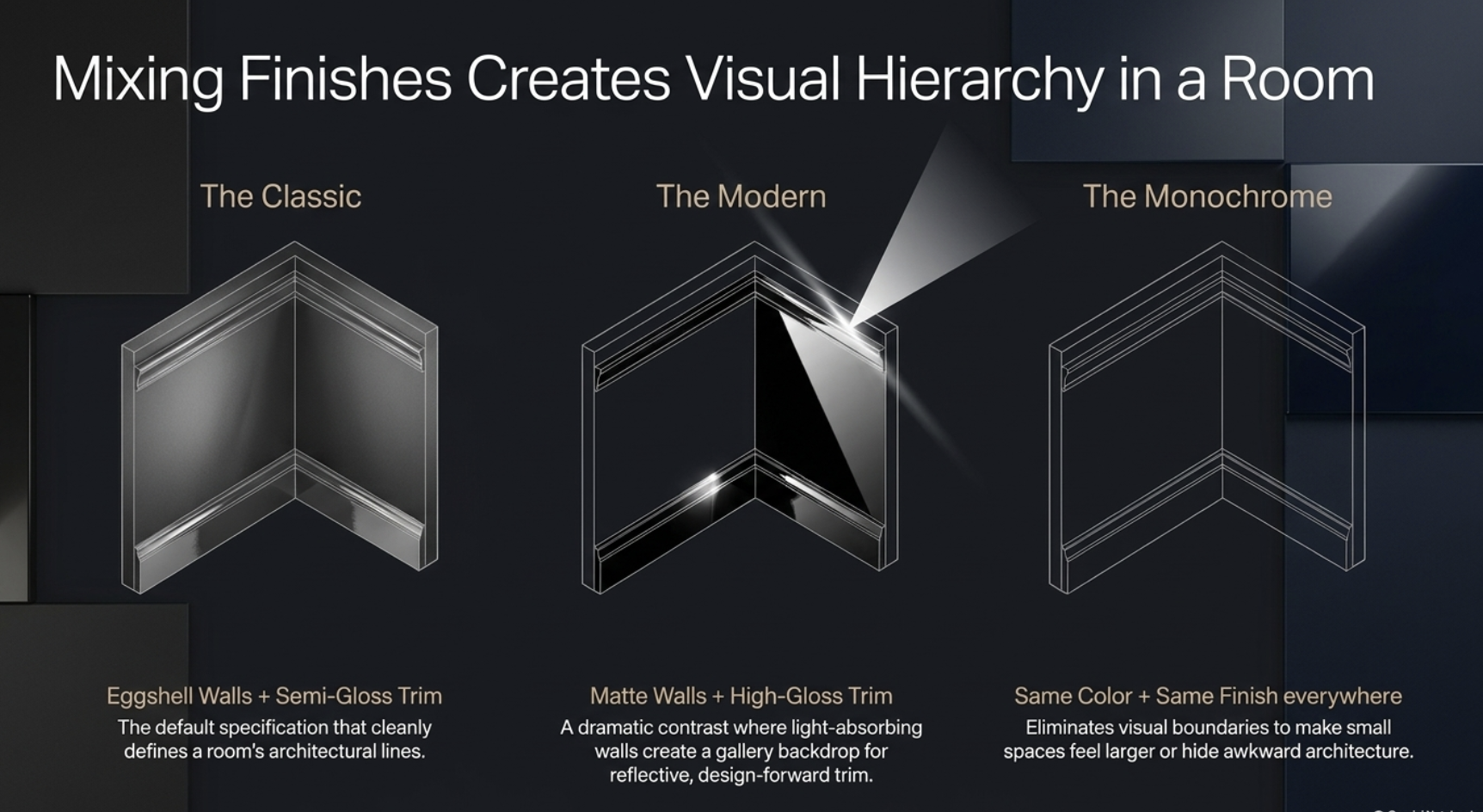
The standard residential paint specification uses multiple finishes in every room. This is intentional, not a compromise. The contrast between sheens creates visual hierarchy: the walls recede, the trim advances, and the architectural details are highlighted.
The classic combination: eggshell walls with semi-gloss trim. The eggshell provides a soft, refined wall surface. The semi-gloss on trim, baseboards, crown molding, and door casings creates a crisp border that defines the room's architecture. This is the default specification on the vast majority of NYC residential projects.
The modern combination: matte walls with high-gloss trim. This creates a more dramatic contrast. The matte walls absorb light and create a gallery-like backdrop. The high-gloss trim reflects light and reads as a design element. This combination works best in contemporary interiors with clean lines and simple millwork profiles.
The monochrome approach: same color, same finish on walls and trim. This eliminates the visual boundary between wall and trim, creating a seamless, enveloping effect. Some designers specify this in small rooms (powder rooms, closets) to make the space feel larger, or in rooms where architectural detail should recede rather than be highlighted.
Finish and Surface Preparation
Higher sheens demand better surface preparation. This is non-negotiable.
A flat or matte finish is forgiving. Minor imperfections in the substrate (small bumps, uneven patches, light roller texture) disappear under the non-reflective surface. This is why flat and matte work so well on older plaster walls in pre-war NYC apartments, where the walls have decades of repairs and imperfections.
Satin and semi-gloss are less forgiving. Surface defects that are invisible under eggshell become visible under satin because the light reflection creates shadows along imperfections. Walls painted in satin need to be skim-coated, sanded smooth, and properly primed.
High-gloss is the least forgiving. Every flaw is magnified. High-gloss on trim, doors, and cabinets requires sanding between coats, dust-free application environments, and often spray equipment for a flawless finish. This is skilled work. An expert painter in New York City with experience in high-gloss application is essential for achieving the lacquer-quality finish that high-gloss promises.
Frequently Asked Questions
What paint finish is best for kitchens?
Satin for walls. Semi-gloss or high-gloss for cabinets. The satin walls resist moisture, grease, and steam from cooking and wipe clean easily. The higher sheen on cabinets provides a harder, more washable surface that handles daily contact and grease exposure.
What paint finish is best for bathrooms?
Satin or semi-gloss for walls. Semi-gloss for trim and vanity cabinets. Moisture resistance is the primary consideration. In bathrooms with no exhaust fan or poor ventilation, semi-gloss on all surfaces provides maximum protection against humidity-related paint failure.
What paint finish is best for ceilings?
Flat. It eliminates light reflection, hides imperfections in older plaster or drywall, and provides the smoothest visual plane overhead. Some manufacturers produce specific "ceiling flat" formulas with higher viscosity to reduce dripping during application.
What paint finish is best for cabinets?
Semi-gloss or high-gloss enamel over a bonding primer. The hard cure resists chipping, scuffing, and grease. High-gloss produces a lacquer-like finish but requires excellent surface preparation and skilled application. Semi-gloss is more forgiving and equally practical.
What paint finish is best for living rooms?
Eggshell or matte for walls. Semi-gloss for trim. Eggshell balances imperfection-hiding with durability. Matte provides a richer, deeper color appearance with slightly less durability. The choice depends on whether the room prioritizes visual depth (matte) or practical durability (eggshell).
What paint finish hides wall imperfections?
Flat and matte finishes hide imperfections best because they absorb light rather than reflecting it. The non-reflective surface minimizes the shadows that reveal bumps, patches, and texture variations. The more imperfect the wall, the lower the sheen should be.
Can you mix different paint finishes in the same room?
Yes, and professional painters almost always do. The standard is eggshell or satin on walls with semi-gloss on trim, baseboards, crown molding, and doors. The contrast between sheens creates visual hierarchy and highlights architectural detail.
Does paint finish affect durability?
Yes. Higher sheens contain more resin relative to pigment, which makes the cured film harder, more moisture-resistant, and more washable. Flat paint is the least durable. High-gloss is the most durable. This is why high-contact surfaces (trim, doors, cabinets) are always painted in higher sheens than walls.
The finish is half the specification. The color determines what a room looks like. The finish determines how it performs. Flat for ceilings and formal walls. Eggshell for most living spaces. Satin for kitchens and bathrooms. Semi-gloss for trim and doors. High-gloss for statements and focal points. The right finish on the right surface, applied with proper preparation, is what separates a renovation that looks good on day one from one that looks good on year ten.
If you are planning a renovation and need guidance on paint finish specification for interior or exterior surfaces, start a conversation with us. CooperBuild is a New York City general contractor whose painting team coordinates paint selection, surface preparation, and application as part of every renovation project. See completed work in our project portfolio.
- Category: Expert Advice / Painting
- Topic: Types of Paint Finishes and Sheen Selection
- Author: CooperBuild Team
- Published: November 2026
- Related:
- • Types of Paint for Interior and Exterior Surfaces
- • What is Eggshell Paint and When Should You Use It?
- • Matte Paint: Choosing the Right Finish for Interior Walls
Choosing Sheen for a Renovation?
CooperBuild specifies paint finish room by room for custom residential projects in NYC, the Hamptons, and South Florida. From flat ceilings to high-gloss millwork, we match sheen to the surface and prepare the substrate before the first coat.
Start a ConversationSubscribe to Our Newsletter
Get the latest insights, trends, and news from the construction industry delivered straight to your inbox.
We respect your privacy. Unsubscribe at any time.