

Hard Maple vs Soft Maple: A Custom Millwork Guide for Architects and Designers
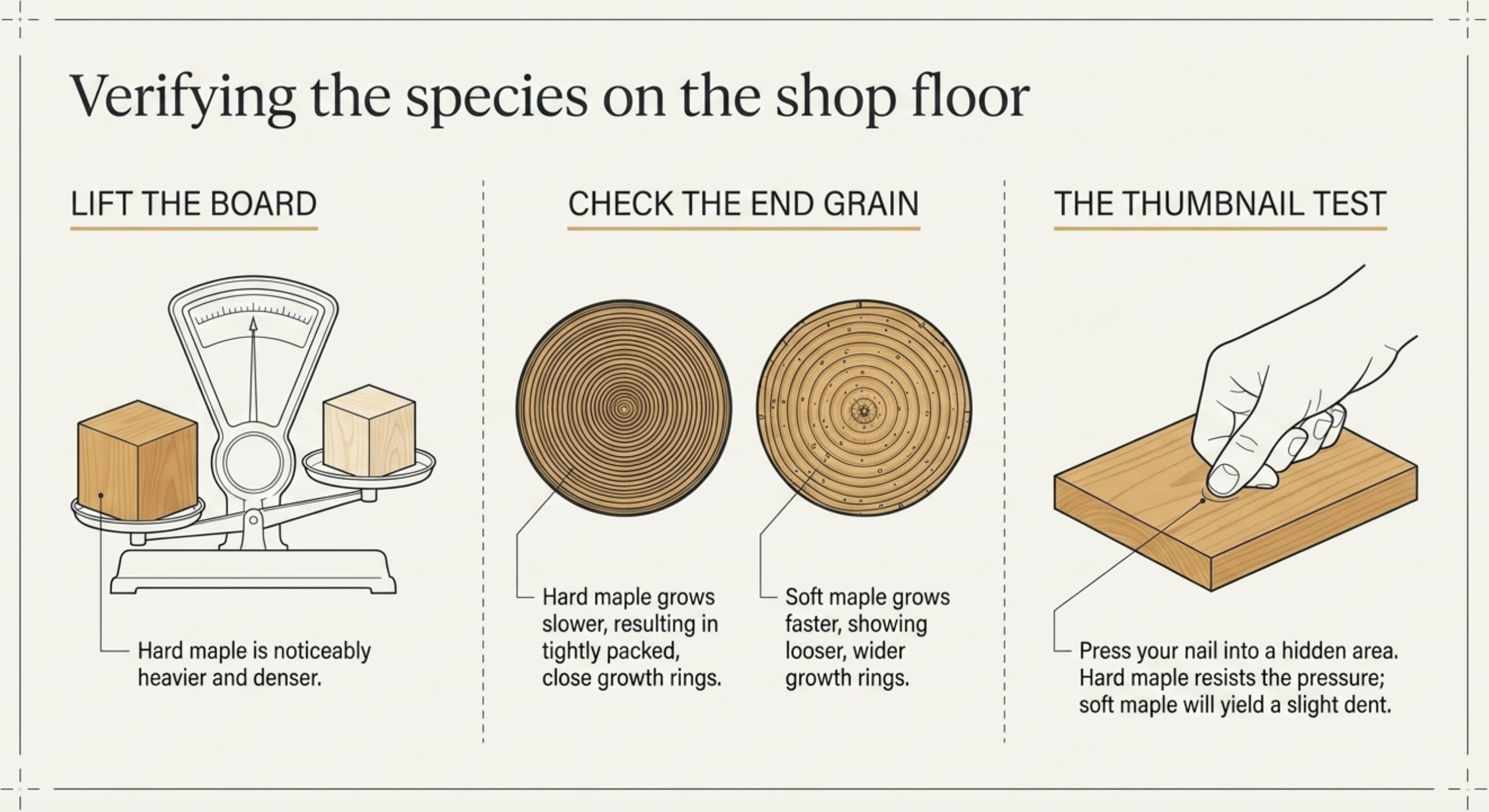
Understanding the differences between hard maple and soft maple for custom millwork projects
When an architect or designer specs maple millwork for a NYC project, the first question that needs an answer isn't about color or finish. It's about species. Hard maple and soft maple are different materials with different properties, and the choice between them affects how the piece takes stain, how it holds up under daily use, how it machines in the shop, and what it costs.
For custom maple cabinetry, built-ins, paneling, and doors, this decision happens early in the specification process. Getting it right avoids costly finish sample rounds, stain failures, and the kind of disappointment that shows up six months after installation when a kitchen island starts showing dents it shouldn't. Getting it wrong means re-specifying, re-fabricating, or living with a result that doesn't match the design intent.
This guide covers the hard maple vs soft maple decision from the perspective of a team that fabricates maple millwork daily in our Yonkers workshop. For a broader overview of all maple species (including curly, spalted, birdseye, and rustic), see our complete guide to types of maple wood.
Hard Maple (Sugar Maple) for Millwork
Hard maple wood, also called Sugar Maple or Rock Maple, comes from Acer saccharum. Its Janka hardness rating is 1,450 lbf, making it one of the hardest domestic woods used in furniture and millwork production. Only hickory (1,820) is meaningfully harder among common North American species.
The color is creamy white to light amber with a fine, straight, very uniform grain. This uniformity is why hard maple is the default for painted cabinetry: the tight grain pattern virtually disappears under paint, leaving a smooth surface with no visible grain telegraph. Under a clear coat, the clean, pale wood reads as modern and minimal.
How it machines. Hard maple is hard on blades. Our shop runs carbide tooling at slower feed rates when cutting it. But the payoff is clean cuts with minimal tear-out. Edges come off the jointer and planer smooth enough that sanding is about refinement, not correction. The density that makes it tough to cut also makes it hold detail well, which matters for molding profiles, panel edge details, and routed elements.
Finishing. Clear coat, lacquer, and paint all perform well on hard maple. Staining is where it gets tricky (more on that in the staining section below). For light, natural, or painted finishes, hard maple is hard to beat.
What CooperBuild uses it for. Kitchen cabinets (especially painted), butcher block counters, bathroom vanities, high-traffic built-ins, wall paneling in commercial and gallery spaces, and custom interior doors. Anywhere the millwork needs to take daily impact and still look right years later. See examples in our project portfolio.
Soft Maple for Millwork
Soft maple wood is a group name for several species: Red Maple (Acer rubrum), Silver Maple (Acer saccharinum), Bigleaf Maple (Acer macrophyllum), and Box Elder (Acer negundo). The soft maple Janka rating ranges from 700 to 950 lbf depending on species.
The word "soft" is the most misleading term in the lumber industry. Soft maple is still a hardwood. It's harder than cherry (950 lbf), birch (910), and poplar (540). It's harder than every softwood species used in construction. The "soft" only means it's softer than hard maple, which is an exceptionally dense wood. For most millwork applications, soft maple is plenty hard.
The color ranges from cream to pinkish brown with more natural variation than hard maple. You'll see warmer tones, subtle color shifts across a single board, and occasionally some mineral streaking. The maple wood grain is similar to hard maple but slightly less uniform, with more character.
How it machines. Easier to cut, sand, and shape than hard maple. Less wear on tooling. Our shop can run faster feed rates. The tradeoff is a slight tendency toward tear-out on figured grain, which requires more attention during planing.
Finishing. This is soft maple's biggest advantage for millwork: it takes maple wood stain more evenly than hard maple. The slightly more porous surface absorbs color consistently, producing a clean, uniform tone across the entire piece. Paint works well too. Soft maple is the species you want when the design calls for a stained finish and color consistency is critical.
What CooperBuild uses it for. Stained kitchen cabinetry, bedroom built-ins, walk-in closet systems, decorative shelving, and custom furniture-grade pieces where stain color matters more than maximum hardness. For maple built-ins in NYC apartments where the finish is stained to match a designer's palette, soft maple is often the better spec.
Hard Maple vs Soft Maple: Side-by-Side Comparison
| Feature | Hard Maple | Soft Maple |
|---|---|---|
| Species | Sugar Maple (Acer saccharum) | Red Maple, Silver Maple, Bigleaf, Box Elder |
| Janka hardness | 1,450 lbf | 700 to 950 lbf |
| Color | Creamy white to light amber | Cream to pinkish brown, more variation |
| Grain | Fine, straight, very uniform | Similar but less uniform, more character |
| Stainability | Blotchy without conditioner on dark stains | Absorbs stain evenly, consistent color |
| Paintability | Excellent (grain disappears under paint) | Good (slightly more grain visibility) |
| Machinability | Requires carbide tooling, slower feeds | Easier to machine, faster feed rates |
| Cost | Higher (approx. $6 to $10/BF) | 20 to 40% less (approx. $4 to $7/BF) |
| Weight | ~44 lbs/cu ft | ~38 lbs/cu ft |
| Best millwork use | Painted cabinets, vanities, doors, high-traffic | Stained cabinets, closets, built-ins, shelving |
Board foot pricing is approximate and varies by grade, supplier, and market conditions. For current pricing benchmarks, the USDA Forest Products Laboratory publishes domestic hardwood data. Species-specific mechanical properties are documented at The Wood Database.
The key takeaway: hard maple vs soft maple is not a quality question. It's an application question. Soft maple is not a downgrade. It's a different specification for a different job.
The Staining Question
This is the section that matters most to designers speccing custom maple cabinetry for a renovation project.
Hard maple and stain is the single most common finishing problem in custom millwork. The dense, closed grain of hard maple resists stain penetration. When a designer specs a medium walnut or espresso stain on hard maple, the result is often blotchy: lighter areas where the grain is tightest reject the stain, darker areas where the grain is slightly more open absorb too much. The surface looks muddy and uneven. No amount of wiping technique fixes it after the fact.
The standard workaround is a pre-stain wood conditioner, which partially seals the surface so stain absorbs more evenly. It helps, but on hard maple with very dark stains, the result is often still not what the designer envisioned. This is why sample rounds exist.
Our approach at CooperBuild: we produce stain and finish samples on the actual species, on the actual substrate thickness, and evaluate them under the project's specific lighting conditions (not showroom lighting, not workshop fluorescents). For the Waverly Place West Village renovation, the oxblood lacquer kitchen went through multiple sample rounds in our Yonkers shop because the color sat on a narrow band where a slight shift in either direction would have changed the entire read of the room. That's the level of attention custom millwork requires.
Soft maple absorbs stain more evenly. For any millwork piece where a consistent stained finish is the design intent, soft maple is often the better specification. The slightly more porous surface accepts color uniformly. Medium to dark stains that would blotch on hard maple lay down clean on soft maple.
The exception: if the piece needs maximum durability AND a dark stain (a kitchen island, a commercial reception desk), hard maple with a dye-based finish rather than a penetrating stain can achieve color consistency without the blotching problem. Dyes are dissolved in solvent or water and penetrate the wood fiber differently than pigmented stains. They don't sit in the pores the same way. It's more labor-intensive but it works.
Does soft maple stain better than hard maple? In almost every case, yes. For stained millwork, soft maple gives a cleaner, more predictable result with less risk.
Which Maple for Which Millwork Application
This is the table we reference internally when specifying maple millwork for a project:
| Millwork Type | CooperBuild Recommendation | Why |
|---|---|---|
| Kitchen cabinets (painted) | Hard maple | Smooth grain disappears under paint, maximum durability for daily kitchen use |
| Kitchen cabinets (stained) | Soft maple | Absorbs stain evenly, consistent color across all cabinet faces |
| Bathroom vanities | Hard maple | Moisture-adjacent environment, needs maximum hardness and density |
| Built-in shelving | Either (depends on finish) | Painted = hard maple; stained = soft maple |
| Walk-in closet systems | Soft maple | Lower daily wear, stains beautifully, cost-effective for large runs |
| Wall paneling | Hard maple | Uniform grain reads clean at scale across large surfaces |
| Custom interior doors | Hard maple | Takes impact from daily use, heavy closure, and hardware mounting |
| Furniture-grade pieces | Depends on use | Dining table = hard maple; dresser or nightstand = soft maple |
| Commercial reception desk | Hard maple | High traffic, impact resistance, heavy daily use |
Is soft maple good for cabinets? Yes, particularly for stained cabinets. It's the better choice when the designer wants a specific stain color and consistency across 30+ cabinet faces. Which maple is better for kitchen cabinets? If painted, hard maple. If stained, soft maple. If you need both paint and stain finishes in the same kitchen (painted perimeter with a stained island, for example), we use both species in the same project.
Cost Difference and When It Matters
Hard maple typically costs 20% to 40% more than soft maple per board foot. On a full kitchen with 30+ linear feet of cabinetry, upper and lower boxes, drawer fronts, and end panels, that material cost difference adds up.
But cost should follow function, not the other way around. Specifying soft maple for a kitchen island top to save money is a mistake. A soft maple surface at 950 Janka will dent under normal kitchen use in ways that a hard maple surface at 1,450 Janka won't. Specifying hard maple for a painted closet interior where nobody will ever see the grain, and where the shelves hold sweaters and shoes, is a waste of the premium.
Is hard maple worth the extra cost? For high-traffic, high-impact surfaces, absolutely. For everything else, soft maple delivers equal or better results (especially on stained finishes) at a lower cost.
The right answer for most NYC renovation projects is both species in the same scope: hard maple where durability and hardness matter, soft maple where stainability and cost efficiency matter. We spec this combination regularly.
How CooperBuild Handles the Maple Specification Process
The species decision happens during the millwork specification phase, before shop drawings and before fabrication. Here's how the process works with our custom millwork services:
The designer selects the species based on the intended finish and application (using the matrix above as a starting point). We produce stain and finish samples on the actual species in our Yonkers workshop. Those samples go to the project site or the designer's office for evaluation under the actual lighting conditions. Not showroom light. Not phone photos. Actual conditions, because a stain that looks warm under incandescent reads completely different under the LED panels in a modern kitchen.
Shop drawings go through review rounds with the designer before we cut a single board. The drawings specify species, finish, hardware, and every dimension. For the Waverly Place project, the four custom interior doors had their own shop drawing package: 1-3/4" solid core hard maple panels with low profile bolection moulding, Grandeur Fifth Avenue plates with Georgetown levers in polished brass, and Baldwin 1040 NRP hinges in vintage brass. The window trim used Dykes Lumber #243 casing with bullseye rosette corner blocks at every window. That level of documentation is standard.
Finished pieces are sprayed in a controlled booth, wrapped individually for transport, and installed on site by the same team that built them. For the powder blue high-gloss lacquer closet at Waverly Place, every panel was installed with cotton gloves. No bare hands touched a finished surface.
That's what separates custom millwork from cabinetry ordered from a catalog. The material choice (hard maple vs soft maple) is the first decision, but it's followed by the finish specification, the sample approval, the shop drawing review, and the fabrication and installation process that makes sure what was specified is what gets built.
If you're specifying maple millwork for an upcoming project, start a conversation with us. We can produce samples and shop drawings for your scope.
- Category: Expert Advice / Wood Species & Millwork
- Topic: Hard Maple vs Soft Maple for Custom Millwork
- Author: CooperBuild Team
- Published: June 2026
- Sources:
- • USDA Forest Products Laboratory
- • The Wood Database: Sugar Maple
- • Janka Hardness Test (Wikipedia)
Specifying Maple Millwork for Your Project?
We fabricate custom maple cabinetry, built-ins, and millwork in our Yonkers workshop. Whether you need hard maple for painted cabinets or soft maple for stained built-ins, our team can help you spec the right species and produce finish samples for your project.
Discuss Your Millwork ProjectSubscribe to Our Newsletter
Get the latest insights, trends, and news from the construction industry delivered straight to your inbox.
We respect your privacy. Unsubscribe at any time.