

Types of Maple Wood: A Complete Guide for Custom Millwork & Cabinetry
Understanding maple wood types for custom millwork projects
There are over 120 species of maple trees worldwide, but only a handful are used to make custom millwork and cabinetry. If you're specifying wood for a kitchen renovation or custom built-ins, you've probably seen "maple" listed without much explanation of which type. That matters, because the types of maple wood differ significantly in hardness, color, maple wood grain pattern, price, and what they're best suited for.
This guide breaks down each type, explains the differences in plain terms, and helps you choose the right maple for your millwork project. Whether you're building kitchen cabinets, specifying wood for built-in shelving, or selecting material for architectural millwork, the type of maple you pick will affect how the finished piece looks, feels, and holds up over the years.
Hard Maple (Sugar Maple)
Hard maple wood comes from the Sugar Maple tree (Acer saccharum), also called Rock Maple. It's the gold standard for custom millwork when you need strength and durability. According to the Janka hardness scale, hard maple rates at 1,450 lbf, making it one of the hardest domestic woods used in cabinetry and millwork.
The color is creamy white to light amber, with a fine, straight, uniform grain. This clean look is why hard maple is the default choice for modern and contemporary millwork designs. The pale tone also makes it a blank canvas for staining, though hard maple's density means it can be uneven with darker stains if not conditioned properly.
Best for: Kitchen cabinets, kitchen islands, butcher block countertops, hardwood flooring, built-in shelving, and any millwork that takes daily use. Hard maple resists dents and scratches better than nearly every other furniture wood except hickory.
Hard maple is widely available and moderately priced for a premium hardwood. Expect to pay more than soft maple or oak, but less than walnut or cherry. For detailed species data, The Wood Database maintains comprehensive mechanical properties for Sugar Maple.
Soft Maple
Soft maple wood is a group name for several maple species: Red Maple (Acer rubrum), Silver Maple (Acer saccharinum), Bigleaf Maple (Acer macrophyllum), and Box Elder (Acer negundo). The word "soft" is misleading. Soft maple has a Janka rating of 700 to 950 lbf depending on species, which makes it softer than hard maple but still harder than cherry (950), poplar (540), and most softwoods.
The color ranges from light cream to pinkish brown, with more variation and warmth than hard maple. The grain is similar but slightly less uniform, often with more character and color shifts across a single board. This natural variation is a feature, not a flaw. It gives soft maple millwork a warmth that hard maple sometimes lacks.
Best for: Painted cabinets, bedroom built-ins, bookshelves, doors, crown molding, and any millwork where extreme hardness isn't critical. Soft maple takes stain beautifully because its slightly more porous surface absorbs color more evenly than hard maple. It's also the go-to when we want to replicate the look of cherry or mahogany at a lower cost.
Soft maple costs 20% to 40% less than hard maple. It's an excellent value for millwork that won't see heavy daily wear.
Hard Maple vs Soft Maple: Direct Comparison
The question of hard maple vs soft maple comes up constantly, so here's a side-by-side:
| Feature | Hard Maple | Soft Maple |
|---|---|---|
| Species | Sugar Maple (Acer saccharum) | Red, Silver, Bigleaf, Box Elder |
| Janka hardness | 1,450 lbf | 700–950 lbf |
| Color | Creamy white to light amber | Light cream to pinkish brown |
| Grain | Fine, straight, very uniform | Similar but more variation |
| Stainability | Can be blotchy without conditioner | Takes stain more evenly |
| Workability | Harder to machine, dulls blades faster | Easier to cut, sand, and shape |
| Weight | Heavier (44 lbs/cu ft) | Lighter (38 lbs/cu ft) |
| Price | Higher | 20–40% less |
| Best for | Dining tables, flooring, butcher blocks | Painted furniture, bedroom pieces, cabinets |
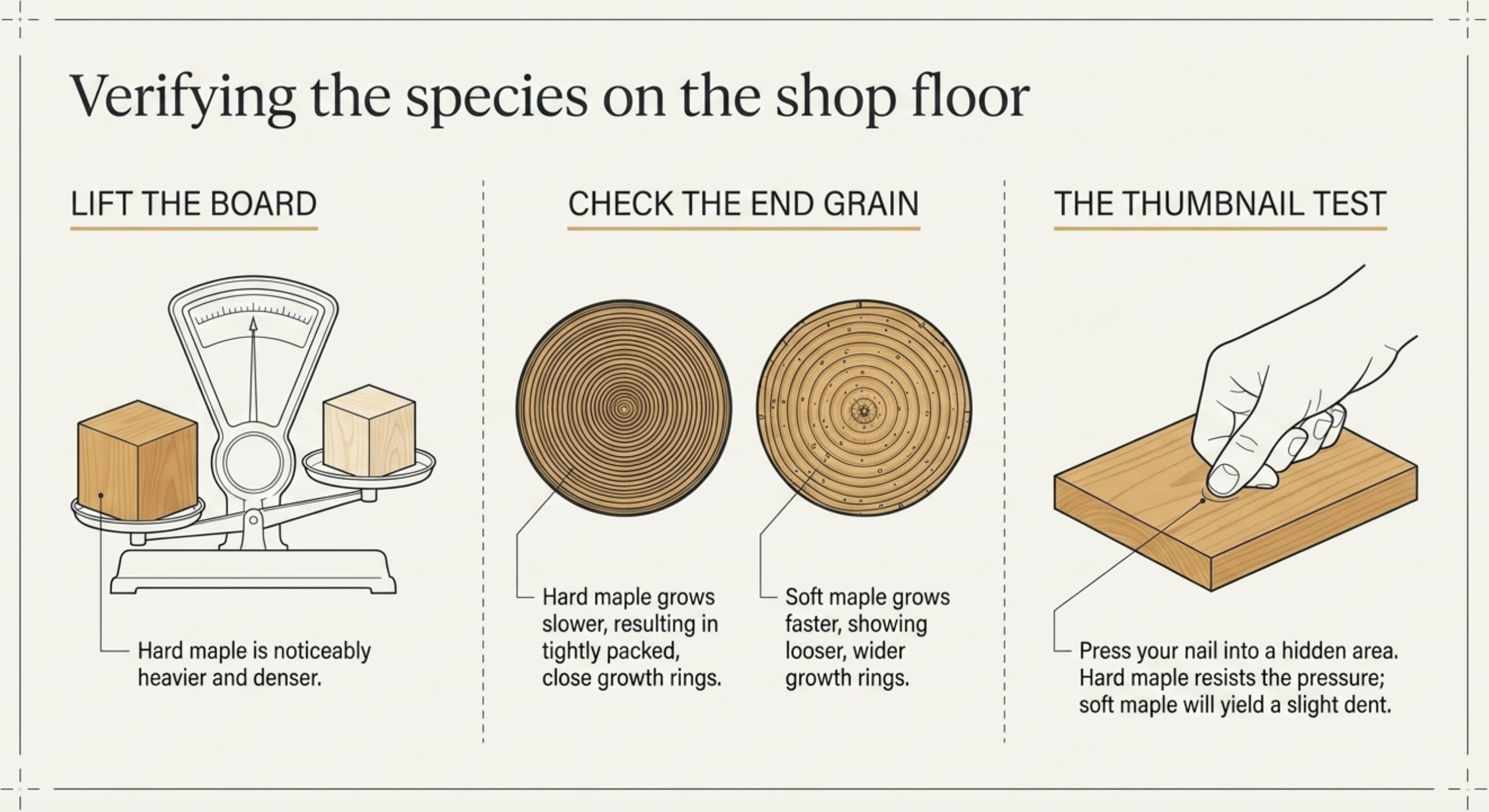
How to tell the difference when shopping: Hard maple is noticeably heavier. If you can see the end grain, hard maple has tighter, closer growth rings (it grows slower). The simplest test: press your thumbnail into a hidden area. If it barely leaves a mark, it's hard maple. If it dents slightly, it's soft.
The key point most people miss: soft maple is not a downgrade. It's a different tool for a different job. A painted cabinet doesn't need 1,450 lbf of hardness. A built-in bookshelf doesn't need to resist the same abuse as a kitchen countertop. Choosing soft maple where it makes sense saves money without sacrificing quality.
Figured and Specialty Maple Types
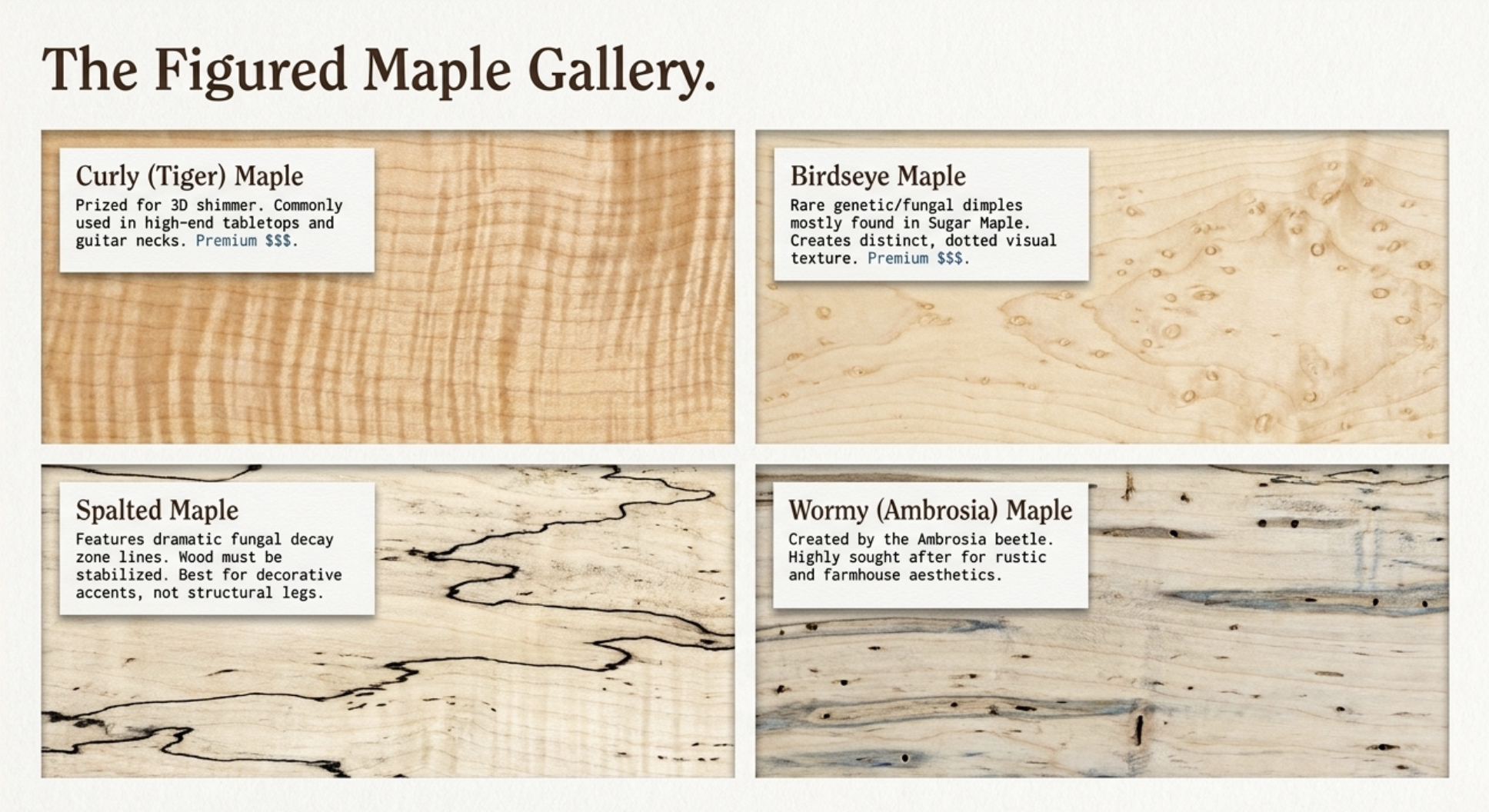
Beyond the hard/soft distinction, maple produces some of the most visually striking grain patterns found in any wood species.
Curly Maple (Tiger Maple, Fiddleback)
Curly maple wood has a wavy grain that creates a rippled, three-dimensional shimmer effect when light hits the surface. The waves run perpendicular to the grain direction, producing alternating light and dark stripes that seem to move as you shift your viewing angle. The effect is called "chatoyance," the same optical phenomenon that makes a cat's eye gemstone shimmer.
Curly maple appears in both hard and soft maple species. It's prized for high-end tabletops, jewelry boxes, and accent millwork. Expect to pay a significant premium over standard maple for figured boards with strong curl.
Birdseye Maple
Birdseye maple features small, circular dimple-like patterns scattered across the grain surface, resembling the eyes of a bird. The cause is still debated among wood scientists. Leading theories include localized fungal infection, genetic mutation, and environmental stress during growth. Whatever the cause, it's rare. Only a small percentage of Sugar Maple trees develop the pattern.
Birdseye is most commonly found in hard maple. It's used for decorative veneer, tabletops, dashboards, and high-end millwork accents. A solid birdseye maple cabinet front or built-in panel is one of the most visually distinctive details you can specify.
Spalted Maple
Spalted maple features bold dark lines and irregular patterns caused by fungal colonization during the early stages of wood decay. The fungal zone lines create dramatic black streaks against the pale maple background. Each piece is unique because the fungal growth pattern is never repeated.
The tradeoff: spalting weakens the wood. If the fungal process goes too far, the wood becomes punky and structurally compromised. Well-spalted maple that's been harvested at the right stage and stabilized with resin or finish is safe for millwork use, but it's best suited for decorative panels and accent details rather than structural components.
Wormy Maple (Ambrosia Maple)
Wormy maple gets its character from the Ambrosia beetle, which bores small tunnels into the living tree and introduces a fungus that creates distinctive gray, brown, and blue streaks radiating from each hole. The result is a rustic, heavily figured wood that's become popular in farmhouse and cottage-style millwork.
Rustic Maple
Rustic maple isn't a separate species. It's a grading term for boards that include natural imperfections: knots, bark inclusions, mineral streaks, and color variation. These are the boards that would be rejected in a premium "select" grade but are deliberately chosen for millwork where character and a handmade feel are the goal.
Complete Maple Types Reference
| Type | Janka (lbf) | Color | Grain Pattern | Best For | Relative Price |
|---|---|---|---|---|---|
| Hard Maple | 1,450 | Creamy white to amber | Fine, straight, uniform | Tables, cabinets, flooring | $$$ |
| Soft Maple | 700–950 | Cream to pinkish brown | Moderate variation | Painted furniture, bedroom pieces | $$ |
| Curly Maple | 1,450* | Light with shimmer bands | Wavy, 3D ripple effect | Accent furniture, instruments | $$$$ |
| Birdseye Maple | 1,450* | Light with circular dots | Scattered eye pattern | Tabletops, decorative panels | $$$$ |
| Spalted Maple | Varies | White with dark lines | Irregular fungal streaks | Decorative pieces, wall art | $$–$$$$ |
| Wormy (Ambrosia) | 700–950* | Streaked gray/brown/blue | Tunnel marks + streaks | Rustic furniture, farmhouse | $$ |
| Rustic Maple | 700–1,450 | Variable | Knots, mineral streaks | Cottage/farmhouse furniture | $ |
*Figured grain occurs in both hard and soft maple species. Janka rating depends on the base species.
Maple vs Other Woods for Millwork
Is maple good for custom millwork compared to other popular hardwoods? Here's how it stacks up.
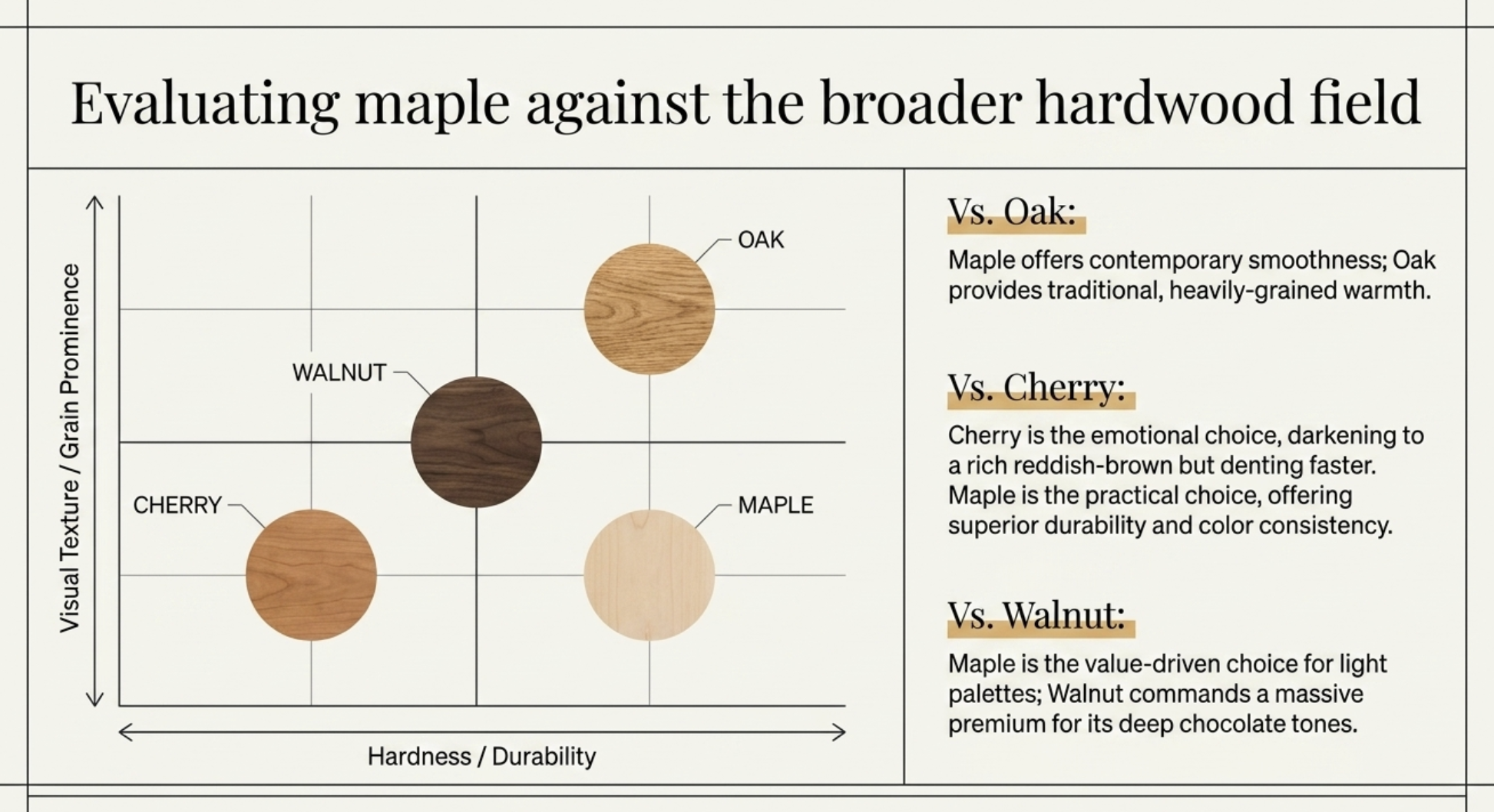
Maple vs Oak. Hard maple (1,450 Janka) is harder than white oak (1,290) and red oak (1,220). Maple has a smoother, less visible grain, while oak's prominent grain pattern gives it more visual texture and a traditional feel. If you want clean and contemporary, choose maple. If you want warm and rustic, choose oak.
Maple vs Cherry. Cherry (950 Janka) is softer than hard maple and will show wear faster on high-use pieces. Cherry's advantage is its color: it starts with a warm pinkish tone and darkens to a rich reddish-brown over years. Maple stays lighter and more consistent. Cherry is the emotional choice. Maple is the practical one.
Maple vs Walnut. Walnut (1,010 Janka) is softer than hard maple, significantly darker (chocolate brown), and more expensive. Walnut is the premium choice for people who want a dark, rich wood. Maple is the better value if you prioritize durability and don't mind a lighter palette.
Is maple harder than oak? Yes. Hard maple at 1,450 lbf is approximately 12% harder than white oak (1,290) and 19% harder than red oak (1,220). For flooring and kitchen countertops, that difference translates to fewer dents and scratches over the life of the installation.
Which Maple for Which Application
Kitchen cabinets. Hard maple is the industry standard for painted cabinets. Its fine, closed grain means the wood surface stays smooth under paint with no visible grain telegraph. For stained cabinets, soft maple works well and costs less. If you're specifying maple wood for cabinets in a renovation, match the maple type to the finish: paint = hard, stain = soft.
Kitchen islands and countertops. Hard maple for any surface that will take daily use. The 1,450 Janka rating means it handles plates, glasses, cutting boards, and daily life without showing every bump.
Built-in shelving and bookcases. Either type works. Hard maple if you want a natural, unstained look. Soft maple if you're painting or staining to match existing millwork.
Flooring. Hard maple only. Soft maple dents too easily underfoot, especially in high-traffic areas. There's a reason NBA basketball courts are made of hard maple: nothing else takes that kind of punishment and still looks good.
Architectural millwork. Crown molding, baseboards, door casings: soft maple is excellent for these applications, especially when painted. The cost savings over hard maple lets you allocate budget to other details.
How to Care for Maple Millwork
Does maple wood stain well? Soft maple takes stain more evenly than hard maple. Hard maple's dense, closed grain can cause blotchiness with darker stains unless you apply a pre-stain wood conditioner first. For light or natural finishes, hard maple's uniformity is actually an advantage.
Maple millwork develops a warm amber or honey tone over years as it oxidizes. This natural aging is part of the wood's character, but if you want to slow it down, keep millwork out of direct sunlight.
For routine care: dust regularly, use coasters on countertops, clean spills promptly, and avoid silicone-based polishes (they build up and make refinishing difficult later). A quality maple millwork installation that's properly cared for will last 30 years or more. How long does maple millwork last? With reasonable care, multiple generations. Maple is one of the most durable domestic woods available for cabinetry and millwork.
If the finish wears or the piece gets scratched, maple refinishes well. Sand it back, reapply stain or clear coat, and the wood underneath is as good as the day it was milled.
What to Specify for Your Project
Solid wood vs veneer. Solid maple shows consistent grain through the edge and the face. Veneer shows a thin layer of figured wood glued to a substrate (usually plywood or MDF). Veneer isn't bad, especially with figured types like birdseye or curly where solid boards would be prohibitively expensive, but you should know what you're specifying.
Ask which species. If the specification just says "maple," ask. Hard maple and soft maple are different products at different price points. A reputable millwork shop will tell you exactly which species they're using.
Check for kiln-dried lumber. Properly kiln-dried maple has a moisture content around 6% to 8%. This prevents warping, cracking, and joint failure after installation. If the fabricator can't confirm the wood was kiln-dried, that's a red flag.
Grain and color consistency. If you're specifying multiple millwork elements for the same space (cabinets, built-ins, and trim), ask whether they'll be cut from the same batch of lumber. Maple's color can vary between batches, and mismatched pieces are hard to fix after installation.
Budget by type. Hard maple costs more than soft maple. Figured maple (curly, birdseye, spalted) costs significantly more than plain. Knowing which type you need for your application lets you spend your budget where it matters and save where it doesn't.
For more on custom millwork options, see our custom millwork services. Ready to discuss a project? Get in touch with our team.
- Category: Expert Advice / Materials & Wood Types
- Topic: Types of Maple Wood for Custom Millwork
- Author: CooperBuild Team
- Published: May 2026
- References:
- • USDA Forest Products Laboratory
- • The Wood Database: Sugar Maple
- • Janka Hardness Test (Wikipedia)
Planning a Custom Millwork Project?
We fabricate custom cabinetry, built-ins, and architectural millwork in our Yonkers workshop. Whether you're specifying maple for kitchen cabinets or built-in shelving, our team can help you choose the right type and grade for your project.
Discuss Your ProjectSubscribe to Our Newsletter
Get the latest insights, trends, and news from the construction industry delivered straight to your inbox.
We respect your privacy. Unsubscribe at any time.