

Ductless Mini-Split Systems: A Guide for High-End Residential Renovations
Ductless mini-splits for high-end residential renovations: how they work, cost, brands, and when to specify something else
Ductless mini-split systems deliver room-by-room heating and cooling through compact wall-mounted, ceiling-cassette, or concealed-duct indoor units connected to an outdoor compressor via a thin refrigerant line. No ductwork required. The leading residential brands are Mitsubishi Electric (M-Series), Daikin (Aurora, Quaternity), and Fujitsu (Halcyon, Airstage). Installed cost in NYC ranges from $4,500 to $7,000 for a single zone and $11,000 to $15,000 for a typical four-head brownstone floor. Modern cold-climate models (Mitsubishi Hyper-Heat, Fujitsu XLTH+) produce useful heat down to -13°F to -15°F, making them viable as primary heating systems. Mini-splits are the most popular HVAC retrofit for NYC brownstones, pre-war co-ops, and townhouses because they install quickly, cost less than ducted alternatives, and provide per-room temperature control.
Ductless mini-split systems are the most installed HVAC retrofit in NYC residential renovation. The reason is straightforward: they add heating and cooling to buildings that have no ductwork, no available ceiling space, and no tolerance for major construction. A wall-mounted indoor unit, a thin refrigerant line through the wall, and an outdoor compressor. That is the entire installation. No trunk lines. No soffits. No dropped ceilings.
For high-end residential projects, the specification gets more nuanced. The visible indoor unit becomes a design consideration. The outdoor condenser placement triggers DOB permits and potentially Landmarks Preservation Commission (LPC) review. The brand and model selection affects heating performance, dehumidification, noise levels, and warranty coverage. And the question of whether a mini-split is the right system (versus a high-velocity mini-duct system or a VRF system) depends on the building, the budget, and the owner's tolerance for visible hardware.
This guide covers how ductless mini-splits work, the top brands for luxury residential, cost, the honest advantages and disadvantages, lifespan, installation specifics for NYC buildings, and when to specify a different system instead.
How Ductless Mini-Split Systems Work
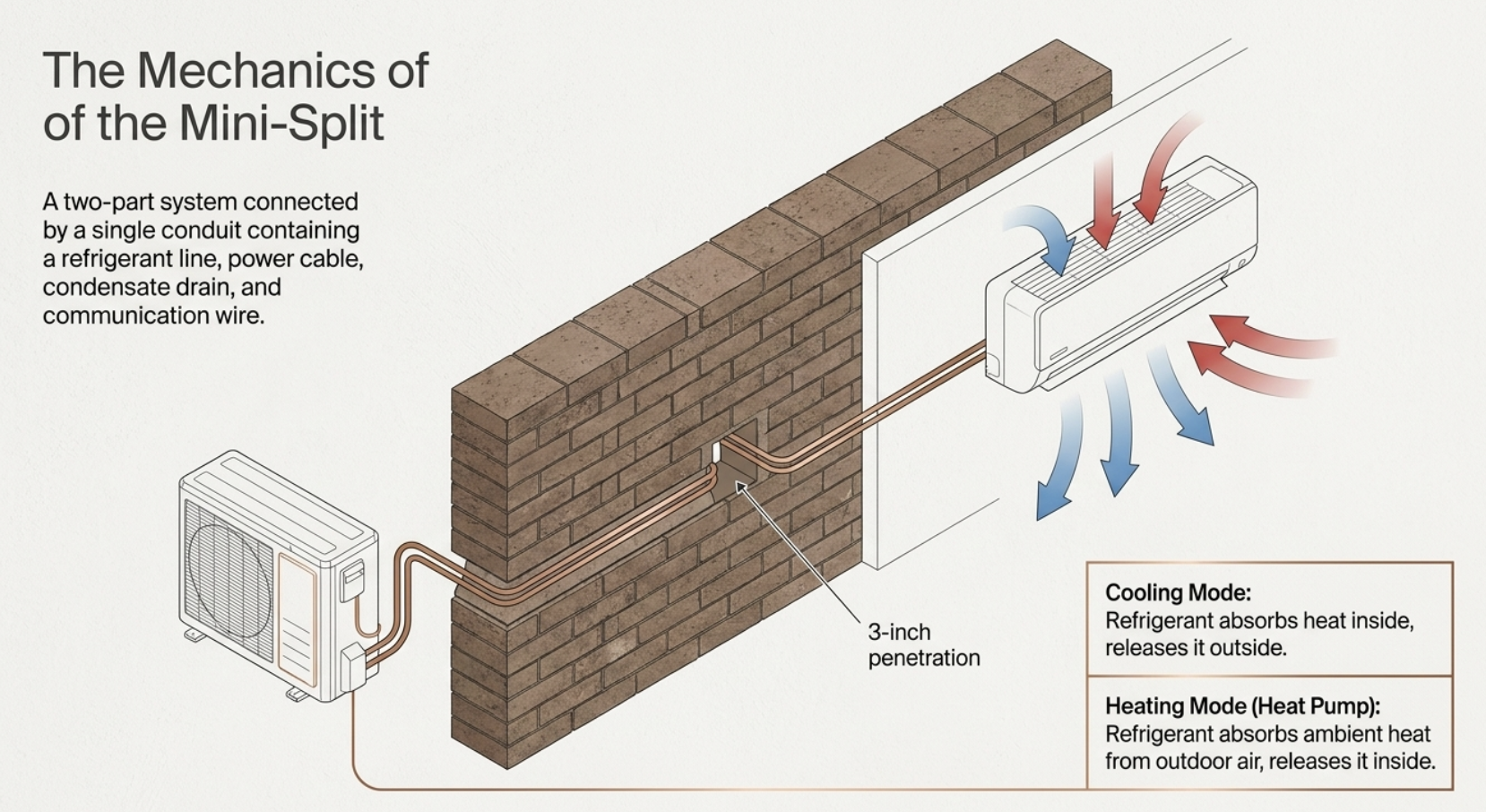
A ductless mini-split system has two core components: an outdoor compressor/condenser unit and one or more indoor air handlers. The two are connected by a conduit containing a refrigerant line, a power cable, a condensate drain, and a communication wire. The conduit passes through a 3-inch hole in the exterior wall.
The indoor unit pulls warm room air across a cold evaporator coil (in cooling mode) or a hot coil (in heating mode via heat pump), then returns the conditioned air to the room. The refrigerant cycles between the indoor and outdoor units, absorbing heat inside and releasing it outside (cooling) or absorbing heat from outdoor air and releasing it inside (heating).
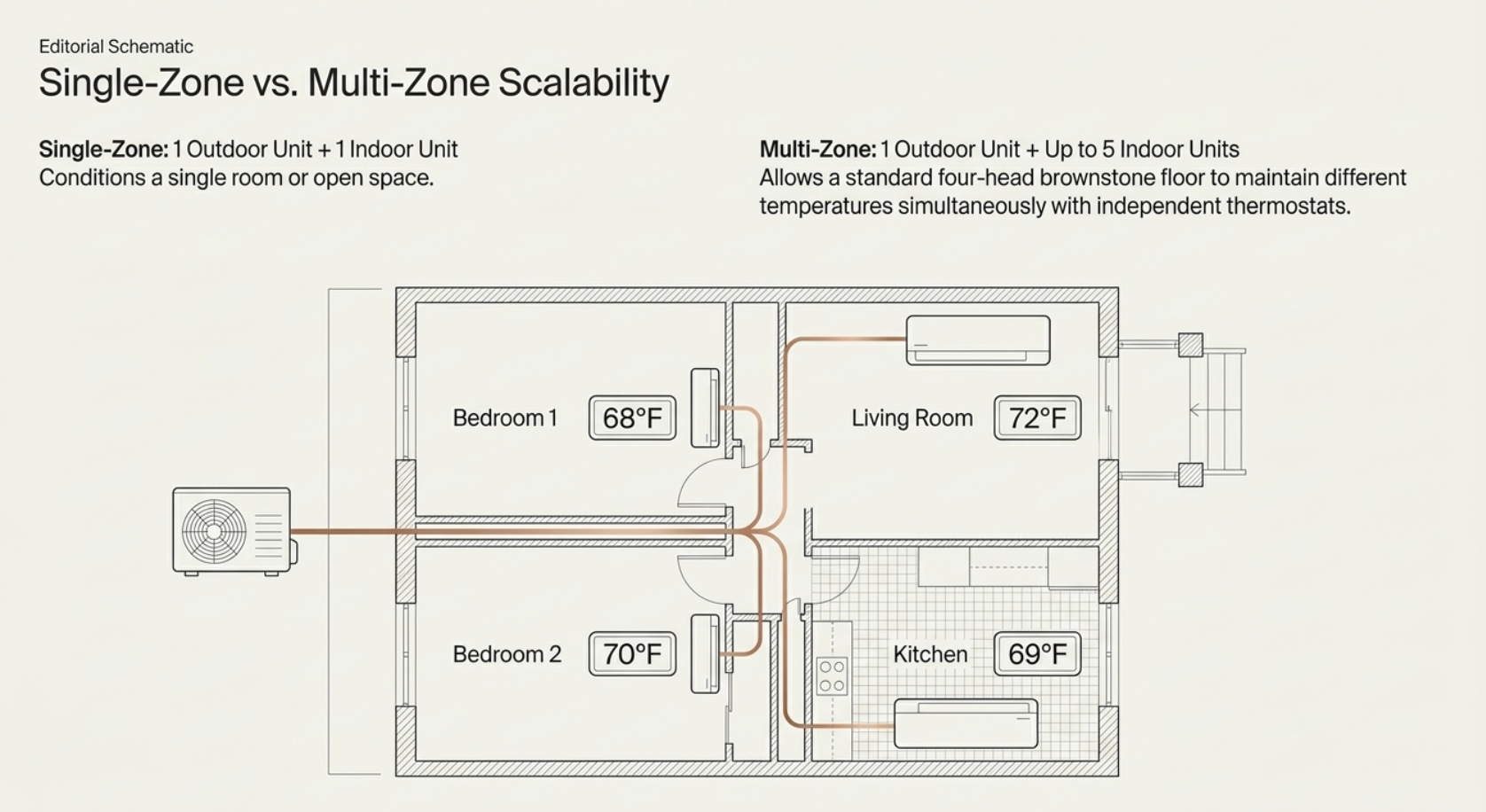
Single-zone systems have one outdoor unit connected to one indoor unit. They condition a single room or open space. Multi-zone systems have one outdoor unit connected to two to five indoor units, each independently controlled. A four-head multi-zone system on a brownstone floor allows each bedroom, the living room, and the kitchen to maintain different temperatures simultaneously.
The indoor units come in several form factors. Wall-mounted units are the most common and least expensive, mounted high on the wall near the ceiling. Ceiling cassettes recess into the ceiling for a lower visual profile. Floor-mounted units sit near the baseboard, useful for rooms with limited wall space. Concealed-duct units hide behind a ceiling or soffit and distribute air through short duct runs, combining mini-split efficiency with the invisible distribution of a ducted system.
Top Brands for Luxury Residential Projects
The brand matters in high-end renovation. Warranty coverage, cold-climate heating performance, noise levels, indoor unit aesthetics, and local service availability all vary.
Mitsubishi Electric M-Series
Mitsubishi Electric is the dominant brand in NYC residential ductless installation. The M-Series includes wall-mounted (MSZ), ceiling-cassette (PLA), floor-mounted (MFZ), and concealed-duct (PEAD) indoor units. The Hyper-Heat (H2i) line is the cold-climate benchmark: 100% rated heating capacity at 5°F and useful heat production down to -13°F. The MSZ-FS Deluxe wall unit is the premium residential model with a flat-panel design, advanced filtration, and Wi-Fi control. Mitsubishi offers a 12-year compressor warranty (registered) and has the deepest service network in the NYC metro area.
Daikin
Daikin is the world's largest HVAC manufacturer and a strong alternative to Mitsubishi. The Aurora line is the flagship residential ductless platform. The Quaternity model adds built-in dehumidification and a plasma streamer air purifier, which is a notable advantage in NYC's humid summers. Daikin's refrigerant transition to R-32 is ahead of Mitsubishi's R-454B rollout. The brand is strong in multi-zone and VRF applications, making it a natural choice for projects that may scale to VRF systems in the future.
Fujitsu
Fujitsu's Halcyon and Airstage lines are known for quiet operation and cold-climate performance. The XLTH+ heat pump line is rated to -15°F, the lowest operating temperature of any residential mini-split, making it the strongest cold-climate specification available. Fujitsu units tend to price 10-20% below Mitsubishi for comparable specifications. The service network in NYC is smaller than Mitsubishi or Daikin, which can affect response times for warranty claims and repairs.
| Feature | Mitsubishi M-Series | Daikin Aurora/Quaternity | Fujitsu Halcyon/XLTH+ |
|---|---|---|---|
| Cold-climate heating | -13°F (Hyper-Heat) | -4°F to -13°F | -15°F (XLTH+) |
| SEER2 range | Up to 30+ | 19.5-21 | Up to 33 |
| Indoor unit styles | Wall, ceiling, floor, concealed | Wall, ceiling, concealed | Wall, ceiling, floor, concealed |
| Compressor warranty | 12 years (registered) | 12 years (registered) | 12 years (registered) |
| NYC service network | Largest | Strong | Moderate |
| Starting price (single-zone, installed) | $5,500-$8,000 | $4,500-$6,000 | $5,000-$7,000 |
| Best for | Brownstone retrofits, premium spec | Air quality, VRF pathway | Cold-climate heating, quiet operation |
How Much Do Ductless Mini-Split Systems Cost?
Ductless mini-split systems cost less to install than ducted alternatives, which is one reason they dominate the NYC retrofit market.
| Configuration | NYC Installed Range |
|---|---|
| Single-zone (1 indoor unit) | $4,500-$7,000 |
| Two-zone (2 indoor units) | $7,000-$10,000 |
| Three-zone (3 indoor units) | $9,000-$13,000 |
| Four-zone (4 indoor units, typical brownstone floor) | $11,000-$15,000 |
| Five-zone (5 indoor units) | $13,000-$18,000 |
These ranges include equipment, labor, refrigerant line installation, electrical connections, and basic DOB permit filing. They assume standard wall-mounted indoor units. Ceiling cassettes add $500-$1,000 per unit. Concealed-duct units add $1,000-$2,000 per unit. Premium brands (Mitsubishi MSZ-FS Deluxe) carry a 10-20% surcharge over standard models.
Additional costs to anticipate: co-op board alteration agreement fees ($500-$2,000), LPC review fees (if in a historic district), condenser bracket or pad ($200-$600), line-set cover ($150-$400 per run), and electrical panel upgrade if needed ($2,000-$5,000).
NYSERDA and Con Edison offer Clean Heat rebates for qualifying heat pump installations in NYC, which can offset $1,000-$3,000+ of the installed cost depending on system efficiency and configuration. Verify current rebate availability before finalizing the specification.
Are Ductless Mini-Splits Worth It?
Yes, for most NYC residential renovations. Here is the specific case.
They install faster than any ducted alternative. A single-zone mini-split installs in 4-8 hours. A four-zone brownstone floor installs in 2-3 days. A comparable high-velocity mini-duct system takes 5-10 days for the same floor. Less time on site means less disruption, less labor cost, and faster occupancy.
They cost less than ducted systems. A four-zone mini-split floor ($11,000-$15,000) costs roughly half what a high-velocity mini-duct system costs for the same floor ($15,000-$30,000). For homeowners where budget is a primary constraint, this gap is decisive.
They provide per-room temperature control. Each indoor unit operates independently with its own thermostat. The bedroom can be 68°F while the living room is 72°F. Ducted systems condition the entire zone to one temperature unless expensive damper systems are added.
They double as heat pumps. Modern mini-splits are heat pumps that provide both heating and cooling from the same unit. Cold-climate models (Mitsubishi Hyper-Heat, Fujitsu XLTH+) produce useful heat down to -13°F to -15°F, which covers the vast majority of NYC winter conditions. This means one system replaces both air conditioning and supplemental heating. For bathrooms, many projects still pair this with electric radiant floor heating.
They qualify for rebates. ENERGY STAR-certified heat pump mini-splits qualify for NYSERDA Clean Heat rebates and potentially federal tax credits, reducing the net installed cost.
What Are the Disadvantages of Mini-Split Systems?
Visible indoor units. This is the number one objection in high-end residential. A white or beige plastic wall unit mounted near the ceiling is architecturally visible. In brownstones with original plaster walls, crown moldings, and carefully designed interiors, the mini-split head can feel like an afterthought. Ceiling cassettes and concealed-duct units reduce the visual impact but cost more and require ceiling depth that may not be available.
Multiple exterior line penetrations. Each indoor unit requires its own refrigerant line running to the outdoor condenser. A four-floor brownstone with 3-4 heads per floor means 12-16 line penetrations through the building envelope. In landmarked buildings, this creates LPC review complications. Line-set covers help aesthetically but add cost and still require exterior mounting.
Condenser placement constraints. The outdoor unit must go somewhere: rear yard, roof, balcony, or through-wall. In Manhattan, where rear yards are small and rooftop access is shared, condenser placement is often the hardest part of the project. Multi-zone systems reduce the number of condensers (one per floor rather than one per room), but each condenser still needs 24 inches of clearance on all sides for airflow.
Limited dehumidification. Mini-splits dehumidify less effectively than ducted systems because the indoor coil operates at variable speed to match the cooling load. When the cooling load is light (a mild, humid day), the system may not run long enough or hard enough to remove significant moisture. High-velocity mini-duct systems (particularly Unico) provide up to 30% more moisture removal, which matters in NYC's humid climate. Bathroom moisture is a separate issue; see bathroom ventilation.
No centralized filtration. Each indoor unit has its own small, washable filter. The filtration grade is lower than what a centralized ducted system can achieve with MERV-13 or HEPA-grade media filters. For homeowners with allergies or air quality concerns, this is a meaningful limitation.
Noise (indoor unit). Wall-mounted mini-splits operate at 19-32 dB depending on fan speed, which is quiet but not silent. In a bedroom at night, the sound of the fan and the occasional click of the compressor cycling can be audible. Concealed-duct units move the air handler out of the room, which eliminates the in-room noise entirely.
What Is the Lifespan of a Mini-Split?
Ductless mini-split systems have a typical lifespan of 15 to 20 years with proper maintenance. The compressor (the most expensive component) is warranted for 12 years by all three major brands (Mitsubishi, Daikin, Fujitsu) when registered. Some compressors last 20-25 years in practice, though efficiency degrades gradually after year 15.
Factors that affect lifespan:
Installation quality. Proper refrigerant charge, correct line-set sizing, and sealed connections are critical. Undercharged or overcharged refrigerant shortens compressor life by 30-50%. This is why hiring an experienced installer matters more than saving $500 on the equipment.
Maintenance. Indoor filters should be cleaned every 2-4 weeks during heavy-use seasons. The outdoor coil should be cleaned annually. Condensate drains should be flushed annually to prevent clogs (which cause water damage and mold). Neglecting maintenance is the number one cause of premature failure.
Usage patterns. Systems that run 24/7 in extreme conditions (continuous cooling in a sun-exposed penthouse, continuous heating through a NYC winter) will reach end-of-life sooner than systems used seasonally or moderately.
Environment. Coastal and rooftop installations expose the outdoor unit to salt air and extreme weather, which corrodes the condenser coil faster. Corrosion-resistant coatings (standard on Mitsubishi and Daikin premium models) help but do not eliminate the issue.
A well-installed, well-maintained mini-split from Mitsubishi, Daikin, or Fujitsu will reliably serve a NYC apartment or brownstone for 15-20 years before the compressor or major components require replacement.
Installation Considerations for NYC Buildings
DOB Permits
New condenser installations, refrigerant line runs, and associated electrical work require NYC Department of Buildings permits. The work must be performed by a licensed HVAC contractor. Permit filing adds 2-4 weeks to the project timeline. Expedited filing is available but adds cost. For a broader look at code compliance, see Navigating NYC Building Codes.
LPC Review
In historic districts (Greenwich Village, Park Slope, Brooklyn Heights, Upper West Side, Harlem, and others), any visible exterior equipment requires LPC review. This includes roof-mounted condensers, rear-yard condensers visible from the street or adjacent properties, and line-set covers on exterior walls. Review adds 4-12 weeks. Mini-duct systems have an advantage here because they require fewer exterior penetrations per floor.
Co-op and Condo Boards
Board approval is required for most HVAC installations in multi-unit buildings. The alteration agreement process reviews mechanical plans, noise impact, condenser location, and any structural modifications. Allow 4-8 weeks for board review. Our alteration agreement guide covers that process in more detail.
Electrical Capacity
Each outdoor condenser requires a dedicated 20-30 amp circuit at 208-230V. Pre-war buildings with original electrical panels may not have available capacity. Verify with an electrician before committing to a system. Panel upgrades ($2,000-$5,000) are common in pre-war brownstones adding multi-zone mini-splits.
Condenser Placement
The outdoor unit needs 24 inches of clearance on all sides for airflow. In NYC, the most common placements are rear yards (ground-level pad or wall bracket), rooftops (requires structural verification for weight), and through-wall sleeves (limited to smaller single-zone units). Noise ordinances apply: NYC limits outdoor equipment noise to 42 dB at the property line during nighttime hours.
When to Specify Something Other Than a Mini-Split
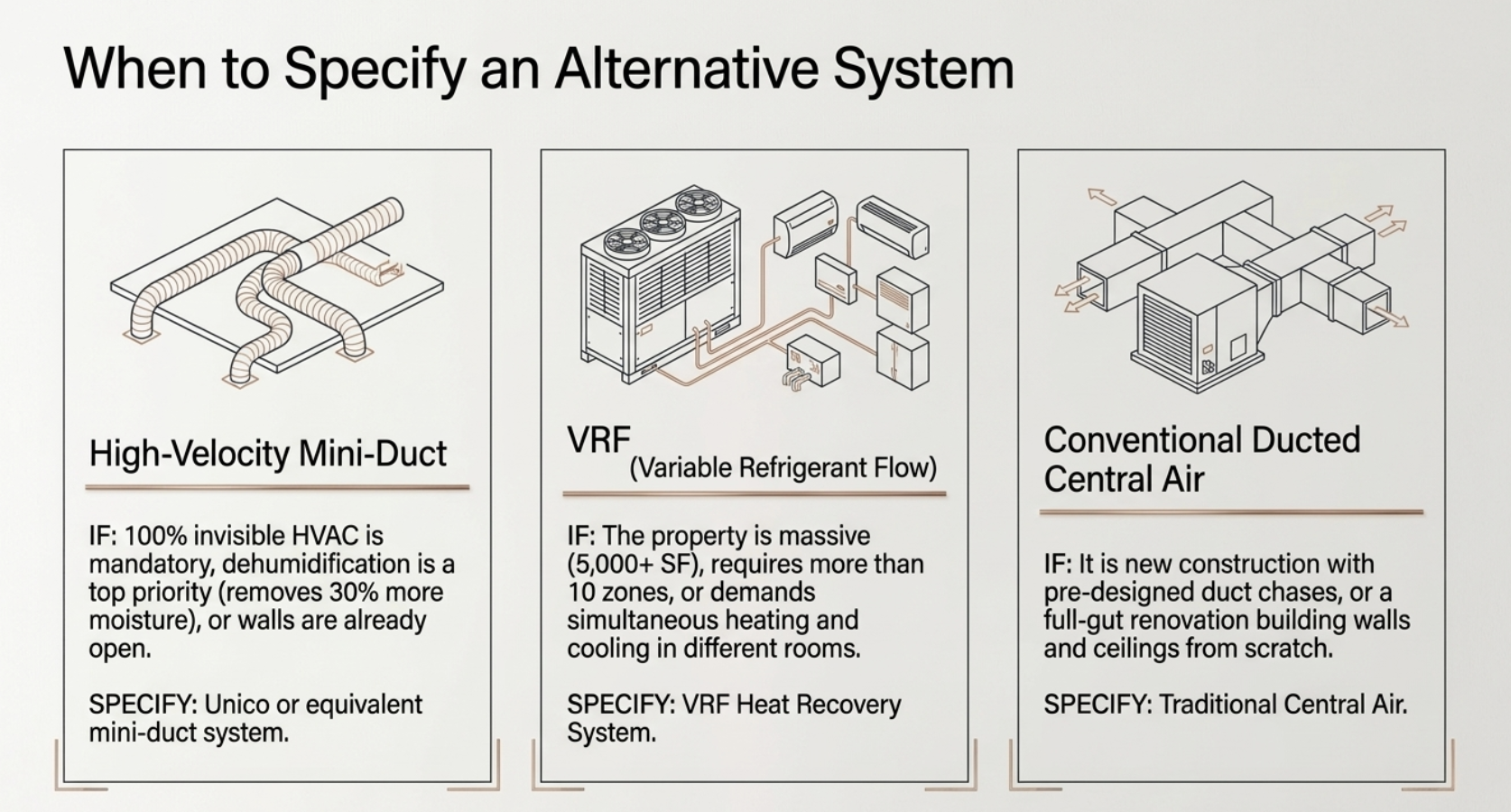
Mini-splits are the right answer for most NYC residential HVAC retrofits, but not all.
Specify a high-velocity mini-duct system if the visible indoor unit is unacceptable (the client wants completely invisible HVAC), the project is already in renovation (walls are open and duct routing is easy), or dehumidification is a top priority (Unico systems remove up to 30% more moisture than mini-splits). See our mini-duct guide for NYC brownstones.
Specify a VRF system if the building is large (5,000+ SF, multi-floor townhouse), the zone count exceeds what multi-zone mini-splits handle efficiently (more than 8-10 zones), or the project needs simultaneous heating and cooling in different zones (VRF heat recovery systems can do this; standard mini-splits cannot).
Specify conventional ducted central air if the building is new construction with duct chases already designed, or the renovation is a full gut where ductwork can be installed in new walls and ceilings from scratch.
Frequently Asked Questions
Are ductless mini-splits worth it?
For most NYC residential renovations, yes. They install faster and cost less than ducted alternatives, provide per-room temperature control, and double as heat pumps for year-round comfort. The primary trade-off is the visible indoor unit, which may not be acceptable in design-sensitive interiors.
What are the disadvantages of mini-split systems?
Visible indoor units, multiple exterior line penetrations on multi-zone systems, limited dehumidification compared to ducted systems, no centralized high-grade air filtration, and condenser placement constraints in dense urban settings. For high-end projects where invisible HVAC is required, high-velocity mini-duct systems are the better specification.
What is the lifespan of a mini-split?
15 to 20 years with proper installation and maintenance. All three major brands (Mitsubishi, Daikin, Fujitsu) warrant the compressor for 12 years. Actual compressor life often exceeds 20 years, though system efficiency degrades gradually after year 15.
How many mini-split heads do I need per floor?
Typically 3-5 heads per brownstone floor, depending on room count and layout. Each room that needs independent temperature control gets its own indoor unit. Open-plan living/dining areas can often share one unit if the space is under 500 SF.
Can a mini-split replace my boiler?
In many cases, yes. Cold-climate heat pump models (Mitsubishi Hyper-Heat, Fujitsu XLTH+) produce heat down to -13°F to -15°F, which covers NYC winters. Many brownstone owners keep the existing boiler as backup and use mini-splits as the primary heating source, which significantly reduces fuel consumption.
Do mini-splits work in pre-war co-ops?
Yes. Pre-war co-ops are one of the most common applications. The installation requires board approval, DOB permits, and careful condenser placement, but the mechanical installation itself is straightforward. Wall-mounted units mount on interior walls with line sets routed to the exterior.
Ductless mini-split systems are the most practical HVAC solution for the majority of NYC residential renovations. They install faster, cost less, and provide more granular temperature control than any ducted alternative. The trade-offs (visible indoor units, limited dehumidification, multiple exterior penetrations) are real and should be evaluated against the specific project's design goals and budget.
If you are planning a renovation that includes HVAC and need guidance on system selection, brand specification, or how ductless mini-splits compare to mini-duct and VRF options for your building, start a conversation with us. CooperBuild is a design build construction company whose general contracting team coordinates HVAC alongside electrical, plumbing, and millwork so every trade is planned before the walls close. See completed renovations in our project portfolio.
Planning HVAC for a High-End Renovation?
CooperBuild coordinates HVAC design and installation for custom residential projects in NYC, the Hamptons, and South Florida. From mini-split brand specification to mini-duct and VRF alternatives, DOB permits, and LPC filings, we plan the mechanical system before the walls close.
Start a ConversationSubscribe to Our Newsletter
Get the latest insights, trends, and news from the construction industry delivered straight to your inbox.
We respect your privacy. Unsubscribe at any time.