

Resin Bound Surfacing: NYC Guide for Architects
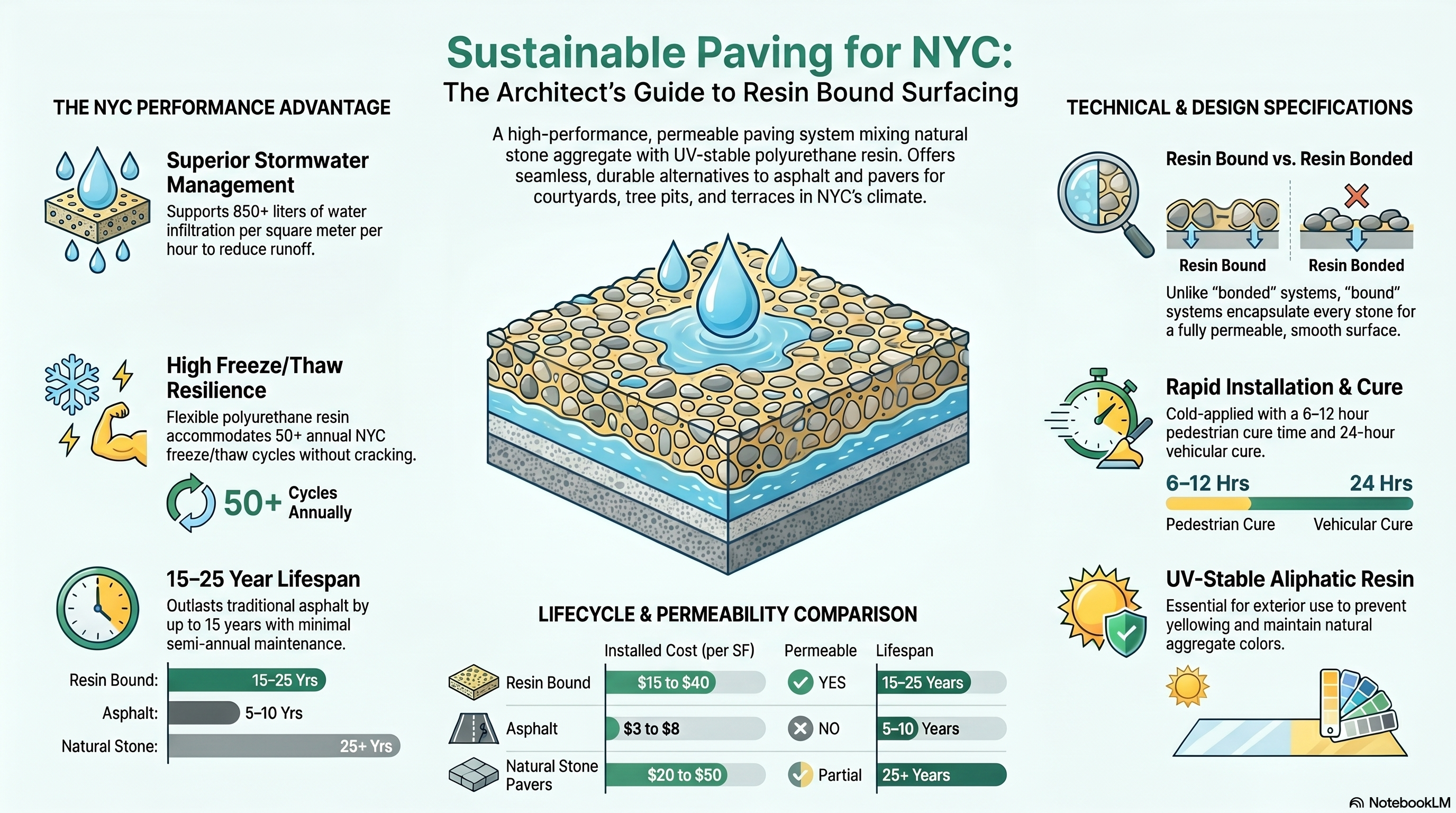
Resin bound permeable paving surface for NYC exterior applications
Resin bound surfacing is a permeable paving system made by mixing natural aggregate stones with a UV-stable polyurethane resin, then troweling the mixture onto a prepared base to create a smooth, seamless, fully drainable surface. It is not the same as asphalt, not the same as pavers, and not the same as resin bonded surfacing (a different product with a different installation method). For NYC projects where permeability, aesthetics, and freeze/thaw durability all matter, it's one of the strongest options available.
If you're an architect specifying exterior surfaces, a designer working on a courtyard or terrace, or a property owner evaluating driveway options, this guide covers everything you need to make a decision: what resin bound surfacing is, how it's installed, what it costs, how it compares to alternatives, and how it performs in New York City's climate. Permeable paving in NYC is increasingly relevant as the city tightens stormwater management requirements, and resin bound systems are one of the few surface options that deliver both drainage performance and design flexibility.
What resin bound surfacing is (and what it isn't)
Resin bound surfacing is a two-component system. The first component is kiln-dried aggregate (natural stone, quartz, marble, granite, or recycled materials like glass). The second is a clear, UV-stable polyurethane resin. The two are mixed together in a forced-action mixer on site, then spread and troweled onto a prepared base. Every aggregate particle is fully coated in resin before it touches the ground. The result is a continuous, porous surface with no loose stones, no joints, and no standing water.
This is different from resin bonded surfacing, which is a separate product that's often confused with resin bound. In a resin bonded system, resin is applied to the base surface first, and then dry aggregate is scattered on top and pressed into the wet resin. The aggregate is only bonded on one side. Over time, stones can come loose. The surface is impermeable. It's a thinner, less durable system. The NYC DOT has a published specification for resin bonded aggregate surfacing for use in streetscape and pedestrian applications. This guide covers the resin bound system, which is a different and generally preferred product for projects where permeability and longevity matter.
| Feature | Resin bound | Resin bonded |
|---|---|---|
| Method | Aggregate mixed with resin, then laid | Resin applied to base, aggregate scattered on top |
| Permeability | Fully permeable | Impermeable |
| Surface texture | Smooth, seamless | Rough, textured |
| Loose stones | None (fully encapsulated) | Common over time |
| Typical depth | 16mm to 50mm | 3mm to 6mm |
| Lifespan | 15 to 25+ years | 5 to 10 years |
| Freeze/thaw performance | Strong (flexible, drains through) | Weaker (aggregate loss, surface flaking) |
Resin bound surfacing specification and build-up
A resin bound surface is an overlay system. It requires a stable, monolithic base. The typical build-up from the bottom up: prepared sub-grade, geotextile separation membrane, permeable sub-base layer (clean aggregate, typically 4-20mm, retained within a cell matrix or loose-laid), and the resin bound surface course on top.
The surface course depth depends on the application. For pedestrian paths and patios, 16mm minimum. For driveways and areas with vehicular traffic, 20mm minimum. For tree pits using larger aggregate, 40 to 50mm. Aggregate size for driveways and paths is typically 1-3mm or 2-5mm. Tree pits use 5-8mm or 10mm aggregate to maximize porosity and allow water and air to reach the root zone.
The resin is a two-part UV-stable polyurethane. "UV-stable" means it resists yellowing over time, which is critical for maintaining the natural color of the aggregate. Cheaper resin systems use aromatic polyurethane, which will yellow within 12 to 18 months. Always specify aliphatic polyurethane for exterior applications.
Substrate requirements. The base must be monolithic: asphalt or concrete. Block pavers, flagstones, and loose gravel are generally not suitable because the joints between units cause reflective cracking in the resin surface above. New asphalt must cure a minimum of 30 days before the resin bound overlay is applied. Existing concrete must be structurally sound with no active heaving or settlement. Some systems (like Ace Resin's ResiMesh) use a reinforcement layer that allows installation over cracked concrete or existing pavers, but this adds cost and requires manufacturer specification.
Temperature and timing. Resin bound surfacing is cold-applied (no heat, no fumes). Minimum installation temperature is 5°C (41°F) air temperature, and the surface must be at least 3°C above the dew point. For NYC, this means the practical installation window runs roughly April through November. Cure time is 6 to 12 hours for pedestrian traffic and 14 to 24 hours for vehicles.
| Application | Aggregate size | Minimum depth | Cure time (pedestrian) | Cure time (vehicular) |
|---|---|---|---|---|
| Paths and patios | 1-3mm or 2-5mm | 16mm | 6-12 hours | N/A |
| Driveways | 2-5mm | 20mm | 6-12 hours | 14-24 hours |
| Commercial / vehicular | 2-5mm | 24mm+ | 6-12 hours | 14-24 hours |
| Tree pits | 5-8mm or 10mm | 40-50mm | 6-12 hours | N/A |
Colors, textures, and design possibilities
Resin bound aggregate is available in a wide range of natural stone colors: buff, honey, silver grey, golden gravel, charcoal, terracotta, and white marble, among others. Custom blends are possible by mixing two or more aggregate types. Recycled glass aggregate adds color accents (blues, greens, ambers) that catch light differently than stone. Rubber aggregate is available for softer, impact-absorbing surfaces around play areas.
Because the resin is clear, the finished surface shows the natural color and texture of the aggregate, not a coating on top. This means the color is consistent throughout the depth of the surface and won't wear away. The finish is smooth and seamless, with no joints, no grout lines, and no expansion gaps (the flexible resin accommodates thermal movement).
Design applications include color banding for wayfinding, contrasting borders, inset logos, and gradient color transitions. The seamless nature of the surface makes it particularly effective for courtyards and terraces where architects want a continuous plane that flows between planted areas, seating zones, and entry paths. Resin bound can be laid up to the edge of planters, walls, and other hard landscape elements without the need for transition strips.
Resin bound surfacing cost
Installed cost for resin bound surfacing typically ranges from $15 to $40 per square foot, depending on aggregate choice, surface depth, base preparation requirements, and site access conditions. Premium natural stone aggregates and larger project areas with complex base prep push the price toward the upper end. Simple pedestrian overlays on existing sound concrete come in at the lower end.
For context, here's how that compares to other common NYC exterior surfacing options:
| Surface type | Installed cost (per SF) | Lifespan | Permeable | Maintenance |
|---|---|---|---|---|
| Resin bound surfacing | $15 to $40 | 15-25 years | Yes | Low (sweep/wash 2x/year) |
| Asphalt | $3 to $8 | 5-10 years before resurfacing | No | Moderate (crack sealing, resurfacing) |
| Poured concrete | $6 to $15 | 15-25 years | No (unless pervious mix) | Low to moderate |
| Natural stone pavers | $20 to $50 | 25+ years | Partial (joint dependent) | Moderate (joint maintenance, weeds) |
| Porcelain pavers | $25 to $60 | 25+ years | Partial (joint dependent) | Low to moderate |
NYC costs run above national averages due to labor rates, access logistics (the same freight elevator and narrow pathway issues that affect interior renovation work), and the curing window that blocks site access for 12 to 24 hours after installation. Lifecycle cost is where resin bound surfacing makes its financial case: a single installation lasts 15 to 25 years with minimal maintenance, compared to asphalt that typically needs resurfacing every 5 to 10 years.
Resin bound vs asphalt for NYC conditions
Asphalt is the default exterior surface in New York City. It's cheap, fast to install, and every paving crew in the five boroughs knows how to lay it. For utility surfaces (back alleys, service areas, loading zones), asphalt is fine.
Where resin bound surfacing is worth the premium: any application where permeability matters (stormwater compliance, tree pit health, reduced ponding), where aesthetics matter (entry courtyards, townhouse driveways, commercial frontage), or where durability matters (asphalt potholes, cracks, and oxidizes; resin bound doesn't). Asphalt is impermeable. Resin bound systems typically allow 850+ liters per square meter per hour of water infiltration. That's the difference between a surface that contributes to combined sewer overflow during heavy rain and one that lets water return to the ground.
NYC gets 50+ freeze/thaw cycles per winter. Resin bound surfacing handles this better than asphalt or rigid concrete because the polyurethane resin is flexible. It accommodates the expansion and contraction of the base without cracking. Water drains through rather than sitting on the surface, which means there's less ice formation in the first place. Permeable pavement studies show up to 75% less de-icing material is needed compared to conventional asphalt.
Resin bound vs pavers
Natural stone and porcelain pavers are the other premium option NYC architects spec for courtyards, terraces, and driveways. The choice between resin bound and pavers comes down to joints.
Pavers have joints. Joints collect organic debris, which grows weeds. Joints accumulate sand and silt, which reduces permeability over time unless the jointing material is regularly maintained. Pavers can settle, shift, and develop lippage (where one unit sits higher than its neighbor), creating trip hazards. Individual pavers can be replaced if damaged, which is an advantage, but the replacement is usually visible because the new unit hasn't weathered to match.
Resin bound has no joints. No weed growth between units. No settlement or lippage. Fully permeable without needing specialty permeable jointing sand. The seamless aesthetic reads as a continuous surface, which architects often prefer for modern and transitional designs. Installation is faster than individually setting and leveling pavers. Damaged sections can be cut out and patched, though the patch will be visible initially.
The two systems combine well. Resin bound as the field surface with natural stone paver borders is a common detail that gives the seamless permeability of resin bound with the heritage edge detail of stone. For projects near historic streetscapes (brownstone Brooklyn, West Village, Upper East Side), this hybrid approach satisfies both the design intent and the context.
Permeable paving and NYC stormwater management
New York City's combined sewer system serves about 60% of the city. When it rains hard, stormwater and sewage mix and overflow into waterways. NYC DEP's green infrastructure program increasingly favors permeable surfaces as a way to reduce runoff volume and delay the peak flow that triggers combined sewer overflows.
Resin bound surfacing is one of the most effective permeable paving options for urban conditions. The porous surface allows rainwater to pass through to the sub-base, where it's attenuated, filtered, and released gradually into the ground. This is a Low Impact Development (LID) technique recognized by the EPA. For projects pursuing LEED certification, permeable resin bound surfacing contributes to credits under Sustainable Sites (stormwater management) and Heat Island Reduction (lighter-colored aggregate reflects more heat than black asphalt).
NYC-specific applications where resin bound surfacing excels: tree pits (replacing metal grates that get stolen for scrap, trap litter, and restrict water infiltration to the root zone), townhouse courtyards where impervious lot coverage is a zoning concern, commercial building entrance plazas that need ADA-compliant slip resistance and drainage, and rooftop terraces where weight matters (resin bound at 20mm depth is significantly lighter than stone pavers on pedestals). Caltrans, NYC DOT, PennDOT, and the US Army Corps of Engineers have all specified polyurethane resin surfacing systems for various applications, per Complete Streets USA.
Installation considerations for NYC projects
Access. Resin and aggregate are mixed on site using a forced-action mixer. The mixing station needs space: a flat area close to the installation zone with room for aggregate bags, resin drums, and the mixer itself. In a tight NYC site (townhouse backyard, building courtyard accessed through a service corridor), material staging and mixing location need to be planned in advance.
Noise and disruption. Resin bound installation is quieter than jackhammering out old pavers or rolling hot asphalt. The system is cold-applied, so there's no heat, no tar fumes, and no heavy roller equipment. This is an advantage for residential neighborhoods and occupied commercial buildings where noise and odor restrictions apply.
Curing restrictions. The surface cannot be walked on for 6 to 12 hours after application, and vehicular traffic must wait 14 to 24 hours. For a building entrance or a surface adjacent to an active sidewalk, this requires phased installation and temporary access paths. Plan for it.
Permits. Any work in the NYC public right-of-way (sidewalks, tree pits, curb cuts) requires DOT permits and potentially a street closure or lane closure. Private property work (courtyards, driveways, terraces) typically falls under standard building department oversight.
Installer qualification. Resin bound is a specialty trade. Not every paving contractor in NYC has experience with it. The resin-to-aggregate ratio, mixing time, troweling technique, and ambient temperature management all affect the finished result. Ask for project references. Verify the installer is trained or certified by the resin manufacturer. Major systems in the US market include GeoBondX (Complete Streets USA), Ace Resin (AceBound UVR), and SureSet. Each has its own certification and training programs.
Maintenance and longevity
Resin bound surfacing requires minimal maintenance. Sweep or power wash the surface twice a year to prevent organic debris from accumulating in the pores and reducing permeability. That's the primary maintenance task. Quality polyurethane resin systems resist oil, fuel, and most chemical spills. Clean stains promptly for best results.
The seamless surface prevents root establishment, so weeds don't grow through resin bound the way they grow through paver joints. If organic material sits on the surface for extended periods without cleaning, moss or algae can grow on top of the surface (not through it). Regular sweeping prevents this.
Damaged sections can be cut out with a diamond blade and patched with matching aggregate and resin. The patch will be visible initially because the new material hasn't weathered, but it blends over time. This is similar to how you'd patch a section of poured concrete or asphalt, but with a better color match.
Lifespan is 15 to 25 years depending on traffic volume, maintenance consistency, and UV exposure. The UV-stable polyurethane resin prevents the yellowing that affects cheaper resin systems. In NYC's winter conditions, the surface can be shoveled and treated with standard de-icing products. Avoid metal-edged snow plows directly on the surface. The flexible resin accommodates freeze/thaw cycling without the cracking that affects rigid surfaces.
When CooperBuild recommends resin bound surfacing
We recommend resin bound for projects where the surface needs to do more than one job at once: look good, drain water, resist freeze/thaw, meet ADA requirements, and last 15+ years without constant maintenance. Specific applications where we've seen it perform well in NYC conditions:
Townhouse courtyards and driveways where the owner wants a clean, modern surface that also satisfies impervious lot coverage concerns. Commercial building entrance plazas where slip resistance, drainage, and visual continuity with the surrounding streetscape all matter. Rooftop terraces where weight is a constraint and the alternative (stone pavers on pedestals) adds structural load the building may not support. Tree pit surrounds that replace metal grates, reduce litter accumulation, and allow water and air to reach the roots. Any exterior surface where an architect or designer wants a seamless, permeable finish in a specific color or aggregate blend that can't be achieved with concrete or asphalt.
It's not the right choice for every surface. High-traffic service areas, loading docks, and utility zones where cost is the only consideration are still better served by asphalt. Heavy truck traffic requires thicker, engineered pavement sections. And any surface that can't be kept clear of heavy organic debris (leaf accumulation from overhead trees, for example) will need more frequent cleaning to maintain permeability.
If you're specifying resin bound surfacing for a NYC project or evaluating permeable paving options, you can see our exterior and landscape work in our project portfolio, or read more about our approach to sustainable construction practices.
- Category: Expert Advice / Materials & Surfaces
- Topic: Resin Bound Surfacing for NYC Projects
- Author: CooperBuild Team
- Published: April 2026
- References:
- • NYC DOT Resin Bonded Aggregate Specification
- • Complete Streets USA
- • Paving Expert
- • Wikipedia: Resin-bound paving
Specifying Exterior Surfaces for a NYC Project?
We work with architects, designers, and property owners on exterior surfacing, landscape construction, and site work across Manhattan, Brooklyn, the Hamptons, and South Florida. If you're evaluating resin bound surfacing or other permeable paving options, we can help.
Start a ConversationSubscribe to Our Newsletter
Get the latest insights, trends, and news from the construction industry delivered straight to your inbox.
We respect your privacy. Unsubscribe at any time.