

Metal Stud Framing vs Wood Framing: What's Best for NYC Projects?
Metal stud framing installation on a CooperBuild NYC project
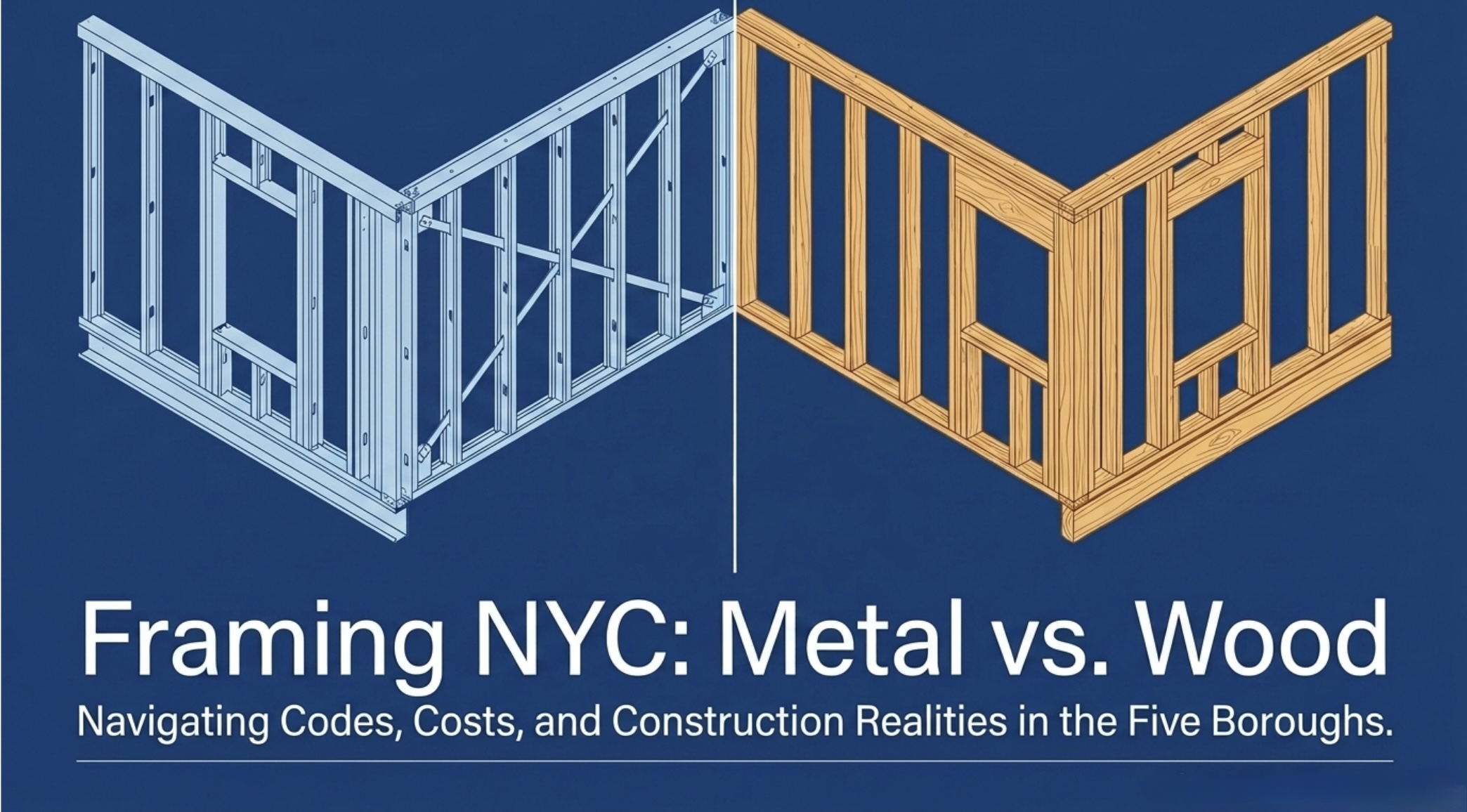
The question of metal stud framing vs wood framing comes up on nearly every NYC project we take on. And in most cases, the answer has already been decided by the building code before anyone opens a budget spreadsheet. If you're working in Manhattan, Brooklyn, or anywhere else in the five boroughs, understanding when each system is required (and when you actually get to choose) will save you from costly mid-project changes.
Metal stud framing in NYC is not optional for the majority of commercial and multi-family buildings. Non-combustible framing is mandated by the NYC Building Code (Chapter 6) for Type I and Type II construction. That covers high-rises, most co-ops and condos, mixed-use buildings, and virtually all commercial spaces. Wood framing is only permitted in specific residential conditions. Here's how to sort through it.
Start with the building code, not the budget
New York City classifies every building by construction type, from Type I (the most fire-resistant) down to Type V (which allows combustible materials). Type I and Type II require non-combustible materials for structural elements, bearing walls, and most interior partitions. In practical terms, that means cold-formed steel framing. The code does allow fire-retardant-treated wood for non-bearing partitions rated at 1 hour or less, but public corridors and exits must still be non-combustible.
If your project is in a multi-family residential building, a commercial office, a gallery, a retail space, or anything classified as a high-rise, metal studs are a code requirement. Requesting a variance to use wood in those conditions is unlikely to succeed and introduces risk you don't need. For a deeper look at how NYC building codes affect renovation planning, we've covered that separately.
The choice between metal stud framing vs wood framing only opens up in low-rise residential: townhouses, brownstones, single-family homes, and certain small multi-family buildings classified under Type V construction. Even then, many co-op and condo boards mandate non-combustible construction in their alteration agreements regardless of what the code technically allows. Always check the alteration agreement before committing to a framing system for a co-op renovation in NYC.
What metal studs actually are
Metal studs are cold-formed steel components. The two primary pieces are C-shaped studs (vertical members) and U-shaped tracks (horizontal channels at the floor and ceiling that receive the studs). They're fastened with self-tapping screws, not nails. Light gauge steel framing is the industry term for the complete system.
The gauge number indicates the thickness of the steel, and lower numbers mean thicker material. Non-load-bearing interior partitions typically use 20 to 25 gauge studs. Load-bearing walls and exterior applications require 16 or 18 gauge. Standard widths match wood equivalents: 2-1/2", 3-5/8", 6", and 8". If you need a complete breakdown of stud types, gauges, and load ratings, our metal stud framing guide covers it in detail.
The key practical difference: metal studs are manufactured to tight tolerances. They don't warp, shrink, twist, or have knots. A wall framed with steel studs will be straighter than one framed with lumber, which matters when you're hanging drywall to a Level 4 or Level 5 finish standard.
Where metal wins on performance
Fire resistance. Metal studs are non-combustible. They don't contribute fuel in a fire. In NYC, where fire-rated assemblies between units, between floors, and around exit corridors are mandated, this simplifies everything. A 1-hour fire-rated wall assembly with steel stud framing is straightforward to detail, build, and pass DOB inspection. With wood, you need fire-retardant treatment, and even then, the approved assembly options are more limited.
Moisture resistance. Metal studs don't rot, swell, or attract mold the way untreated wood does. In a city where basements flood, plumbing leaks happen in pre-war buildings, and humidity levels in below-grade spaces are consistently high, that durability matters. We've opened walls on renovation projects and found wood framing with active mold growth behind the drywall. Steel framing doesn't have that problem.
Dimensional stability. This is the one contractors care about most. Metal studs are straight when they arrive on site and straight when the drywall goes on. Wood studs can arrive bowed, cupped, or twisted. You sort the pile, reject the bad ones, and still end up shimming and planing to get flat walls. On a project where every wall is getting a Level 5 skim coat, the time lost straightening wood framing adds up fast.
Weight. Metal studs are lighter than equivalent wood members. That's an advantage when you're carrying material up narrow stairwells in a walk-up or bundling loads for a freight elevator with a strict weight limit. On a Manhattan project where elevator scheduling is shared with every other contractor in the building, lighter material means more wall gets framed per elevator run.
Where wood framing still makes sense
Thermal performance. Wood is a natural insulator. A 2x4 wood stud has an R-value around 4.4. A steel stud of the same depth has an R-value close to zero because steel conducts heat directly. In an exterior wall, metal studs create a thermal bridge: heat transfers through the stud from the warm side to the cold side, reducing the effective R-value of the entire wall assembly. Solving this requires exterior continuous insulation (rigid foam or mineral wool board outside the stud cavity) or thermal break clips, both of which add cost and wall thickness.
On-site modification. Wood is easier to notch, drill, and cut. If a plumber needs to route a pipe through a stud, they drill a hole with a spade bit. With metal studs, they use the pre-punched knockouts or cut openings with aviation snips. The sharp edges then need grommets so they don't damage wire or pipe insulation. Metal stud framing for renovation work in older buildings, where conditions change daily, gives the mechanical trades less flexibility than wood.
Attachment. Hanging heavy items (cabinets, TV mounts, grab bars) on wood-framed walls is straightforward: find the stud, drive a screw. On metal-framed walls, standard screws don't grip steel the same way. You need toggle bolts, specialty anchors, or (better) plywood backing installed during framing at every location where something heavy will hang later. That requires coordination during framing, not after drywall is up.
Cost on small projects. For a single-family townhouse or brownstone where code allows either material, wood framing is typically less expensive. The metal stud framing cost for materials runs roughly $2 to $4 per square foot, compared to $1 to $5 for wood. But the real difference shows up in labor: most residential framing crews in NYC have been working with wood their entire careers. Speed and familiarity reduce labor cost on small scopes.
Metal stud framing vs wood framing: cost comparison
| Category | Metal Stud Framing | Wood Framing |
|---|---|---|
| Material cost (per SF) | $2 to $4 | $1 to $5 |
| Labor cost (per SF) | $5 to $10 | $5 to $10 |
| Total installed (residential) | $17 to $32 per SF | $11 to $25 per SF |
| Commercial (with insulation) | $12 to $40 per SF | Rarely used |
| Fire rating | Non-combustible | Combustible (FRT available) |
| Moisture resistance | High (galvanized steel) | Low without treatment |
| Thermal conductivity | High (thermal bridging) | Low (natural insulator) |
| Dimensional stability | Excellent | Variable (warp, twist, shrink) |
| Weight | Lighter | Heavier |
| On-site modification | Requires snips, grommets | Drill, notch, cut easily |
| NYC code (Type I/II) | Required | Not permitted (with exceptions) |
Pricing reflects 2025/2026 national averages. NYC costs typically run 15% to 25% higher due to labor rates, freight elevator scheduling, and building access logistics. For current metal stud pricing by gauge, US Frame Factory publishes updated rates.
NYC-specific factors that affect the framing decision
Freight elevator access. In most Manhattan buildings, material comes in through a freight elevator with a weight limit and a time window shared with every other contractor in the building. A stack of 3-5/8" 25-gauge metal studs weighs a fraction of the equivalent in 2x4 lumber. More wall gets framed per elevator run, and the lighter bundles are easier for two workers to carry through a narrow service corridor.
DOB inspections. The NYC Department of Buildings inspects fire-rated assemblies. Metal stud walls with the correct gauge, spacing, and gypsum board layers are a standard assembly that inspectors can verify quickly against the approved drawings. Non-standard assemblies (wood framing with fire-retardant treatment in a Type I building, for example) will draw questions and potentially slow your inspection schedule.
Co-op and condo alteration agreements. This is the one that catches people off guard. Even if the building code technically allows fire-retardant-treated wood for certain non-bearing partitions, the co-op or condo board's alteration agreement often mandates non-combustible construction for all new partitions within the unit. The alteration agreement is a contract between the owner and the building, and it overrides any code flexibility. If you're planning a framing system for a co-op renovation in NYC, read the alteration agreement before you price the job.
Acoustic isolation. This cuts both ways. A metal stud touching drywall on both sides without resilient channel or acoustic isolation creates a direct sound path between units. Sound transmits through the rigid steel more efficiently than it does through wood. For any party wall or demising wall, we specify resilient channel or staggered stud framing with mineral wool insulation in the cavity, regardless of whether the studs are metal or wood. The stud material matters less than the assembly detail when it comes to noise.
When CooperBuild uses metal and when we use wood
On our commercial and gallery projects (Faurschou Foundation in Greenpoint, Luhring Augustine in Tribeca, Phillips Gallery in Midtown, Nahmad Contemporary in Chelsea), the answer is always metal. These are Type I or Type II buildings. The fire rating requirements alone determine the framing system. There's no decision to make. You can see these and other completed projects in our project portfolio.
On our residential projects in Manhattan co-ops and condos, the answer is almost always metal. The building's construction classification, the alteration agreement, and the fire-rated assembly requirements between units all point to steel stud framing. We frame interior partitions with 25-gauge or 20-gauge studs depending on wall height and loading, and we use heavier gauge (16 or 18) only where the structural engineer specifies it.
Where we use wood is in townhouse renovations, brownstone gut jobs, and situations where the existing framing is wood and we're sistering, blocking, or extending existing walls. Matching the existing material simplifies connection details and mechanical rough-in. We also use wood blocking within metal-framed walls at specific locations: cabinet mounting points, grab bar locations, heavy mirror or art hanging points, and any spot where something heavier than 50 pounds will be attached after drywall. That blocking is planned during framing and marked on the as-built drawings so the finish trades know exactly where it is.
The practical decision
If your project is in a Type I or Type II building, you're using metal studs. That's the code talking, not a preference. If you're in a co-op or condo, check the alteration agreement before assuming you have a choice. If you're doing a townhouse or low-rise residential project where code allows both, the decision comes down to what's behind the walls: if you need fire-rated assemblies, metal is simpler to detail and inspect. If you need thermal performance in an exterior wall, wood avoids the thermal bridging problem. If you need both, the answer is usually metal studs with exterior continuous insulation.
The framing system affects every trade that follows: electrical, plumbing, HVAC, drywall, cabinetry, finish carpentry. Getting it right at the start means fewer problems and fewer change orders later. Getting it wrong means retrofitting backing, adding insulation, or explaining to an inspector why the assembly doesn't match the approved drawings. If you're not sure which system your project requires, start a conversation with us before you price the framing package.
- Category: Expert Advice
- Topic: Metal Stud Framing vs Wood Framing in NYC
- Author: CooperBuild Team
- Published: April 2026
- Related: Metal Stud Framing: Load-Bearing vs Non-Load-Bearing Walls & Installation Guide
Planning a Project in NYC?
We handle framing, millwork, MEP coordination, and finish work for residential renovations, commercial buildouts, and new construction across Manhattan, Brooklyn, the Hamptons, and South Florida.
Start a ConversationSubscribe to Our Newsletter
Get the latest insights, trends, and news from the construction industry delivered straight to your inbox.
We respect your privacy. Unsubscribe at any time.