

Concealed Cabinet Hinges: What to Spec, What to Skip, and Why It Matters
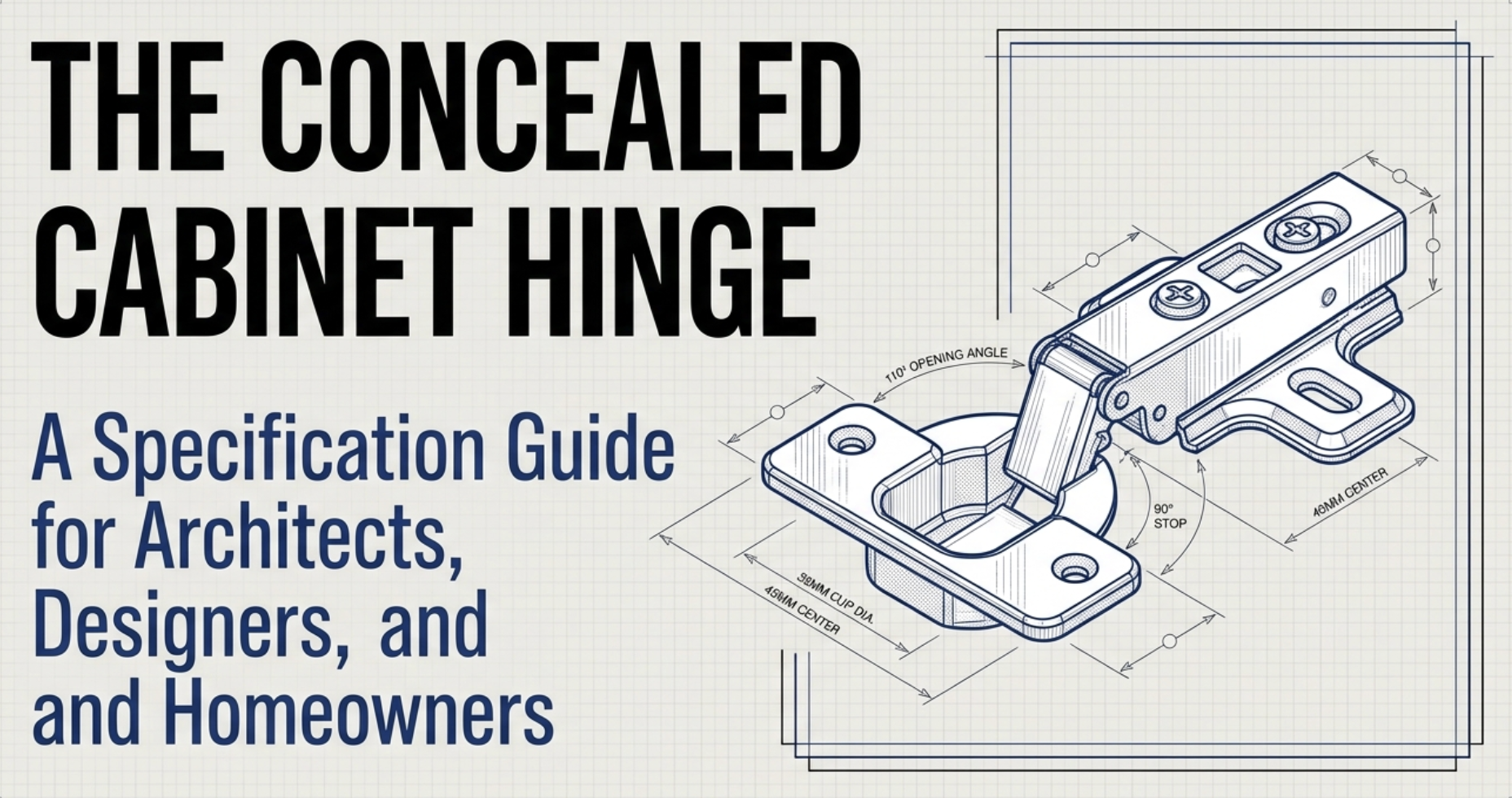
Understanding concealed cabinet hinge specification for custom millwork projects
Concealed cabinet hinges (also called European hinges) use a 35mm cup that recesses into the back of a cabinet door, hiding the hardware completely when closed. They come in three overlay configurations: full overlay, half overlay, and inset, matched to either frameless or face-frame cabinet construction. Every major brand (Blum, Salice, Grass, Hettich) offers three-way post-installation adjustment for side, height, and depth, which is why they are the default specification for custom cabinetry. Soft-close is available across all brands but must be specified separately. For custom millwork projects, hinge selection should happen during the shop drawing phase, not on site.
Concealed cabinet hinges are the standard specification for modern custom cabinetry. When the door is closed, the hardware is invisible. When the door is open, the hinge provides three-way adjustment that allows every gap, reveal, and alignment to be fine-tuned without removing the door. That combination of aesthetics and precision is why concealed hinges dominate residential and commercial millwork.
The problem is that "concealed hinge" covers dozens of configurations across multiple brands. Selecting the wrong overlay type means doors that bind or won't close. Choosing the wrong mounting plate means the hinge doesn't fit the cabinet construction. Mixing brands on the same project means nothing is interchangeable.
This guide covers how concealed hinges work, which overlay type matches which cabinet construction, how the major brands compare, how to install concealed cabinet hinges correctly, and when to let the millwork shop handle the specification. For the broader overview of all hinge types (butt, surface-mounted, piano, and others), see the complete guide to cabinet hinge types.
What Concealed Cabinet Hinges Are and How They Work
The 35mm Cup Mechanism
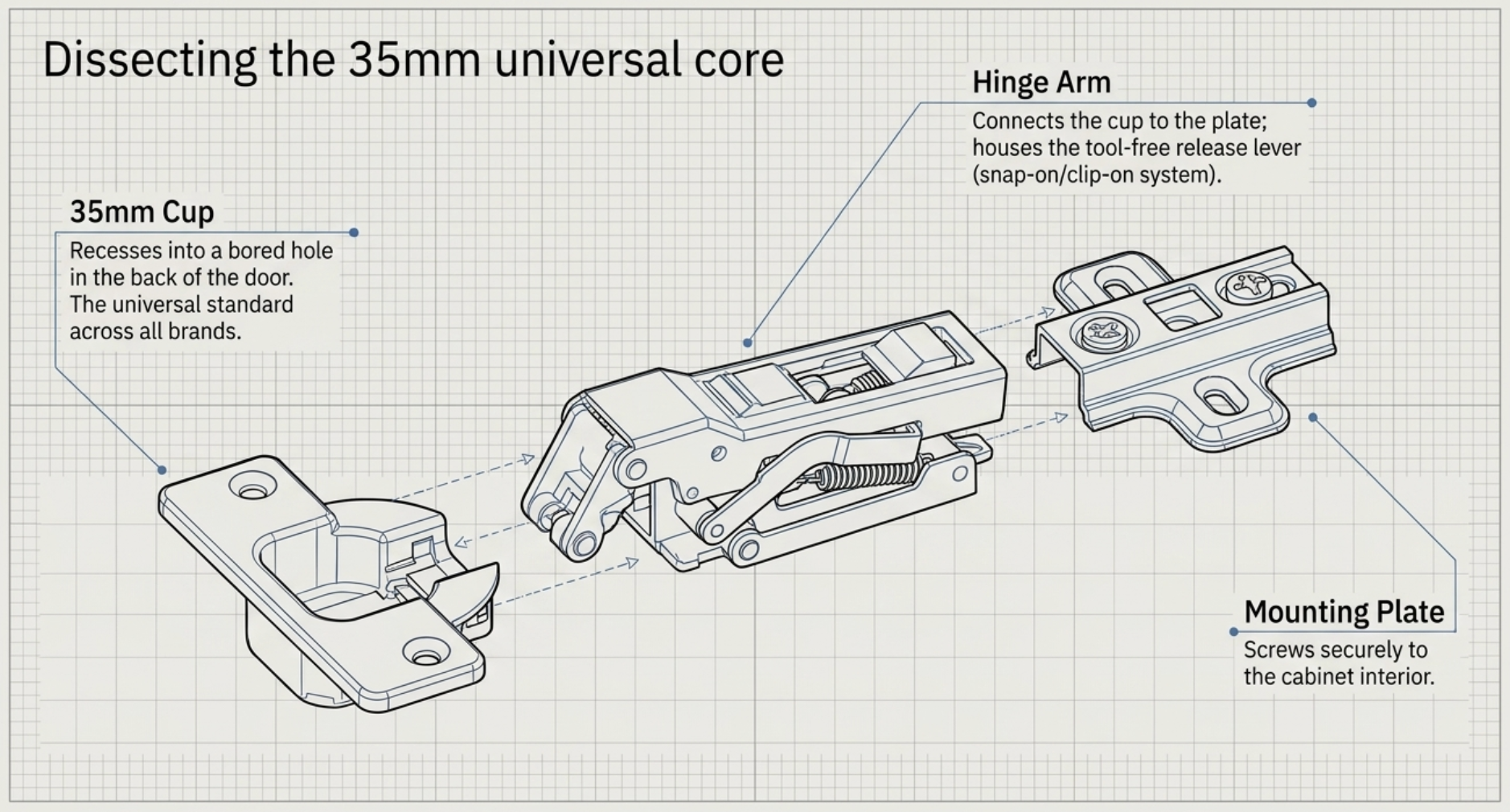
Every concealed hinge is built around the same core: a 35mm diameter cup that recesses into a bored hole in the back of the cabinet door. The cup connects to an arm, and the arm connects to a mounting plate screwed to the inside of the cabinet side panel (on frameless cabinets) or to the face frame (on face-frame cabinets). When the door is closed, the entire mechanism sits inside the cabinet box. Nothing is visible from the outside.
The 35mm cup is a universal standard that originated in European cabinet manufacturing and is now used globally. This is why concealed hinges are sometimes called European concealed hinges. Every major manufacturer (Blum, Salice, Grass, Hettich) builds around the 35mm format, though mounting plates, arm geometry, and adjustment mechanisms are proprietary to each brand.
Modern concealed hinges use a clip-on or snap-on system. The hinge arm slides over the mounting plate and locks with a click. No tools required for attachment or removal. To take a door off for painting, finishing, or transport: open the door fully, pull the release lever on the arm, and lift the door away. This is a significant advantage over butt hinges and surface-mounted hinges, which require unscrewing to remove.
Three-Way Adjustment: Side, Height, and Depth
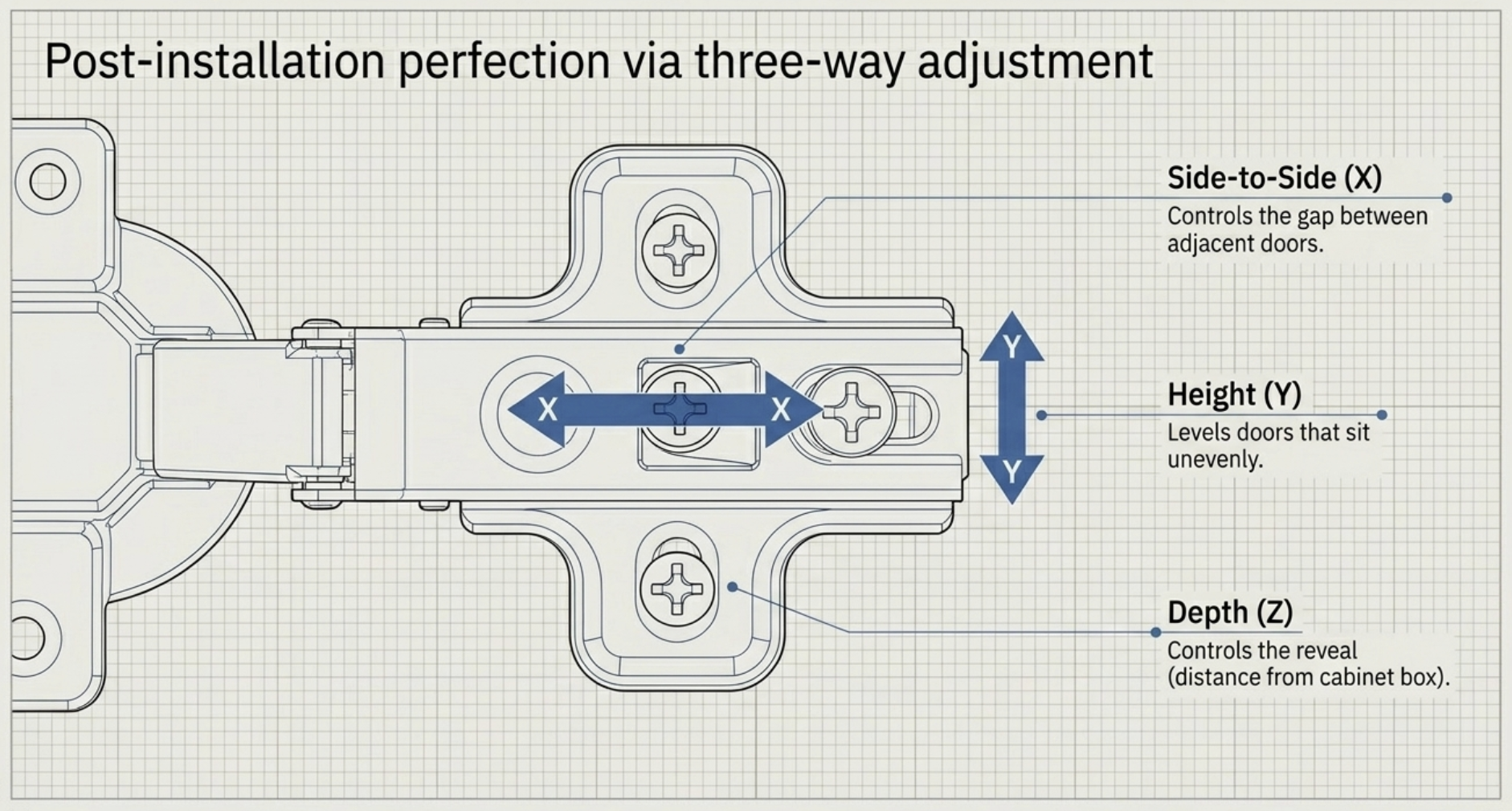
The feature that makes concealed cabinet doors hinge the professional standard is three-way post-installation adjustment. Three screws on the hinge arm control three directions independently.
Side-to-side adjustment moves the door left or right relative to the cabinet box. This controls the gap between adjacent doors. Height adjustment moves the door up or down, leveling doors that sit unevenly. Depth adjustment moves the door closer to or farther from the cabinet box, controlling the reveal (how far the door face sits proud of the cabinet edge).
Typical adjustment ranges vary by brand. Blum offers +/- 2mm in all three directions. Salice's patented parallel adjustment system provides a wider side range (-1.5mm to +4.5mm) while maintaining a constant 1.5mm reveal as the door moves. This is the entire advantage of concealed hinges over every other type: after installation, every door can be precision-aligned without removing it.
Concealed Hinge Overlay Types: Full, Half, and Inset
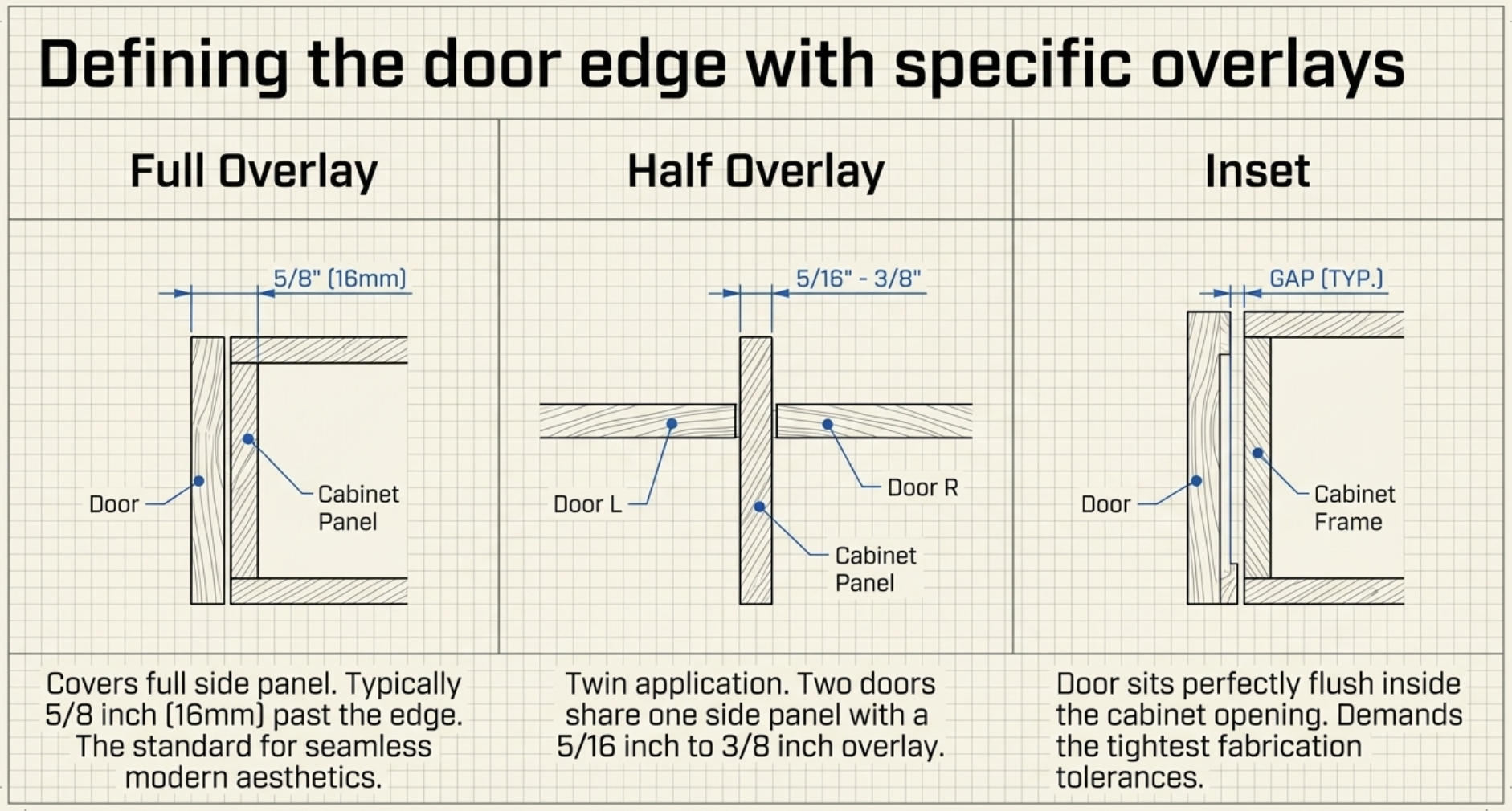
The overlay type determines how the door sits relative to the cabinet box. Getting this right is the single most important specification decision.
Full Overlay Concealed Hinges
The door covers the full width of the cabinet side panel. This is the most common configuration in modern frameless cabinetry. The typical overlay is 5/8" (16mm), meaning the door extends 5/8" past the edge of the cabinet panel on the hinge side. Full overlay is the standard for kitchen cabinets, bathroom vanities, and built-in storage where a seamless face is the design intent.
Half Overlay Concealed Hinges
When two doors share the same cabinet side panel, each door can only cover half the panel thickness. The typical overlay is 5/16" to 3/8" (8-10mm). Half overlay hinges are used wherever a center stile is not present and two doors meet at a shared partition. Also called "half crank" or "twin application" in some manufacturer catalogs.
Inset Concealed Hinges
The door sits flush inside the cabinet opening, with the door face level with the cabinet frame. This produces the cleanest look but demands the tightest tolerances during fabrication. The gap around the door is fully visible and must be uniform on all sides. There is no overlay to hide imprecision. Inset concealed hinges are common in high-end custom cabinetry where the flush aesthetic is part of the design intent. They are more demanding to install and less forgiving if the cabinet box is even slightly out of square.
Matching Overlay to Cabinet Construction
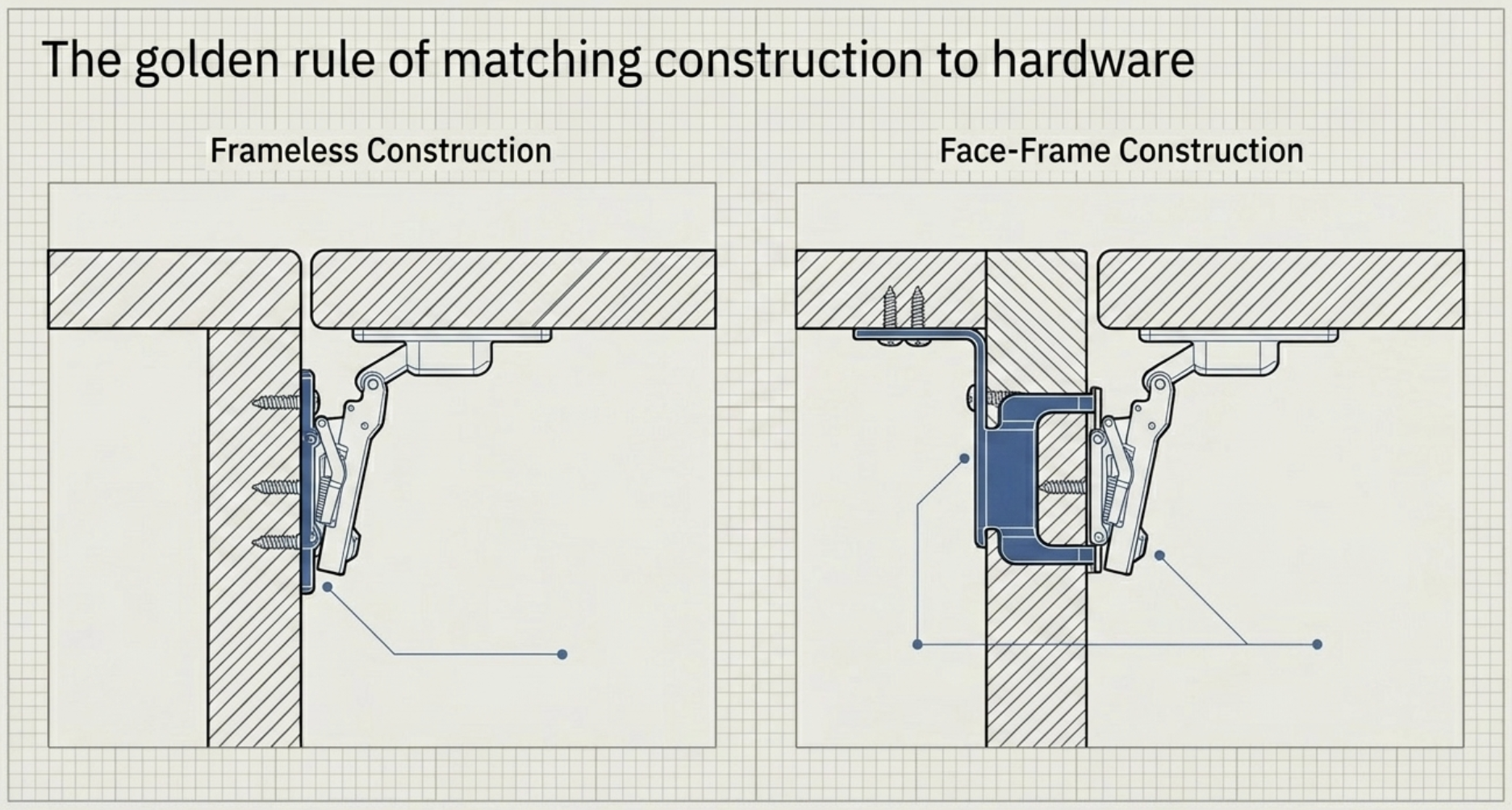
The overlay type must match the cabinet construction. Specifying incorrectly is the most common error in hinge selection. This table covers every standard combination:
| Cabinet Type | Door Style | Overlay Type | Hinge Config | Notes |
|---|---|---|---|---|
| Frameless | Single door | Full overlay | Full crank + system mounting plate | Most common modern kitchen config |
| Frameless | Double door, shared panel | Half overlay | Half crank + system mounting plate | Two doors share one side panel |
| Frameless | Flush/inset | Inset | Straight arm + system mounting plate | Tight tolerances required |
| Face-frame | Full overlay | Full overlay | Full crank + face-frame adapter plate | Adapter clips to frame edge |
| Face-frame | Partial overlay | Half overlay | Half crank + face-frame adapter plate | Some frame visible between doors |
| Face-frame | Flush/inset | Inset | Straight arm + face-frame inset plate | Flush within frame opening |
For concealed hinges for frameless cabinets, the mounting plate screws or dowels directly into the cabinet side panel. For concealed hinges for face frame cabinets, an adapter plate clips over the edge of the face frame, often requiring no drilling into the frame itself.
Brand Comparison: What CooperBuild Specs and Why
Blum CLIP top BLUMOTION
Austrian manufacturing. Widest distribution in North America. The Blum CLIP top BLUMOTION is the industry default for a reason: integrated BLUMOTION soft-close (built into the arm, not an add-on), CLIP mechanism for tool-free door removal, EXPANDO mounting plate for quick dowel installation in frameless cabinets, and consistent quality across millions of units. Standard opening is 110 degrees, with 155 degree and 170 degree models for corner and wide-angle applications. Adjustment: +/- 2mm in all three directions. Rated for 200,000+ cycles.
Salice Silentia+
Italian manufacturing. The Salice concealed hinge system is the stronger choice when the project involves specialty configurations: thick doors (over 3/4"), unusual panel depths, or tight spaces requiring the 94 degree narrow opening model. Salice's patented parallel adjustment system is unique. Unlike Blum and Grass, Salice's side adjustment maintains a constant 1.5mm reveal as the door moves, which means the gap stays uniform even as alignment changes. Wider side adjustment range (-1.5mm to +4.5mm) than any competitor. Snap-on Domi mounting plate.
Grass TIOMOS and Hettich Intermat
The Grass TIOMOS is a German-engineered system popular with architects who specify visible interior hardware. The arm design is sleeker than Blum's, and the Obsidian (black) finish option appeals to design-forward projects. Hettich's Intermat 9943 offers a wider adjustment range (+/- 3mm side) and Silent System integrated soft-close. Both are professional-grade. Both are less common in US supply chains than Blum, which can affect lead times and replacement part availability.
Brand Comparison Table
| Feature | Blum CLIP top | Salice Silentia+ | Grass TIOMOS | Hettich Intermat |
|---|---|---|---|---|
| Origin | Austria | Italy | Germany | Germany |
| Soft-close | BLUMOTION (integrated) | Silentia+ (integrated) | Silent System | Silent System |
| Side adjustment | +/- 2mm | -1.5 to +4.5mm | +/- 2mm | +/- 3mm |
| Standard opening | 110° | 110° | 110° | 110° |
| Tool-free removal | CLIP | Domi snap-on | Tool-free | Tool-free |
| Cycle rating | 200,000+ | 200,000+ | 200,000+ | 200,000+ |
| US availability | Excellent | Good | Moderate | Moderate |
| Best for | Standard specification | Specialty / thick doors | Design-forward projects | Wide adjustment needs |
Soft Close vs Standard Concealed Hinges
Soft close concealed hinges use a hydraulic damper to decelerate the door in the last 20 to 30 degrees of closing. The door slows gradually and pulls itself shut without slamming. Integrated soft-close (Blum BLUMOTION, Salice Silentia+) is preferred over clip-on add-on dampers because the mechanism is built into the hinge arm, producing more consistent deceleration without increasing the hinge profile.
Soft-close adds $3 to $5 per hinge over standard models. On a full kitchen with 20+ doors, that amounts to $120 to $200 in total hardware cost. That premium is worth it on every kitchen, bathroom vanity, and high-use cabinet. It can reasonably be skipped on utility cabinets, garage storage, and low-traffic closet interiors where the cost doesn't justify the benefit.
Do all concealed hinges have soft close? No. Soft-close is available on all major brands but is a separate product line (or model variant) from standard hinges. It must be explicitly specified. Ordering "Blum CLIP top" without specifying "BLUMOTION" gets a standard hinge without soft-close.
How to Install Concealed Cabinet Hinges
Boring the Door
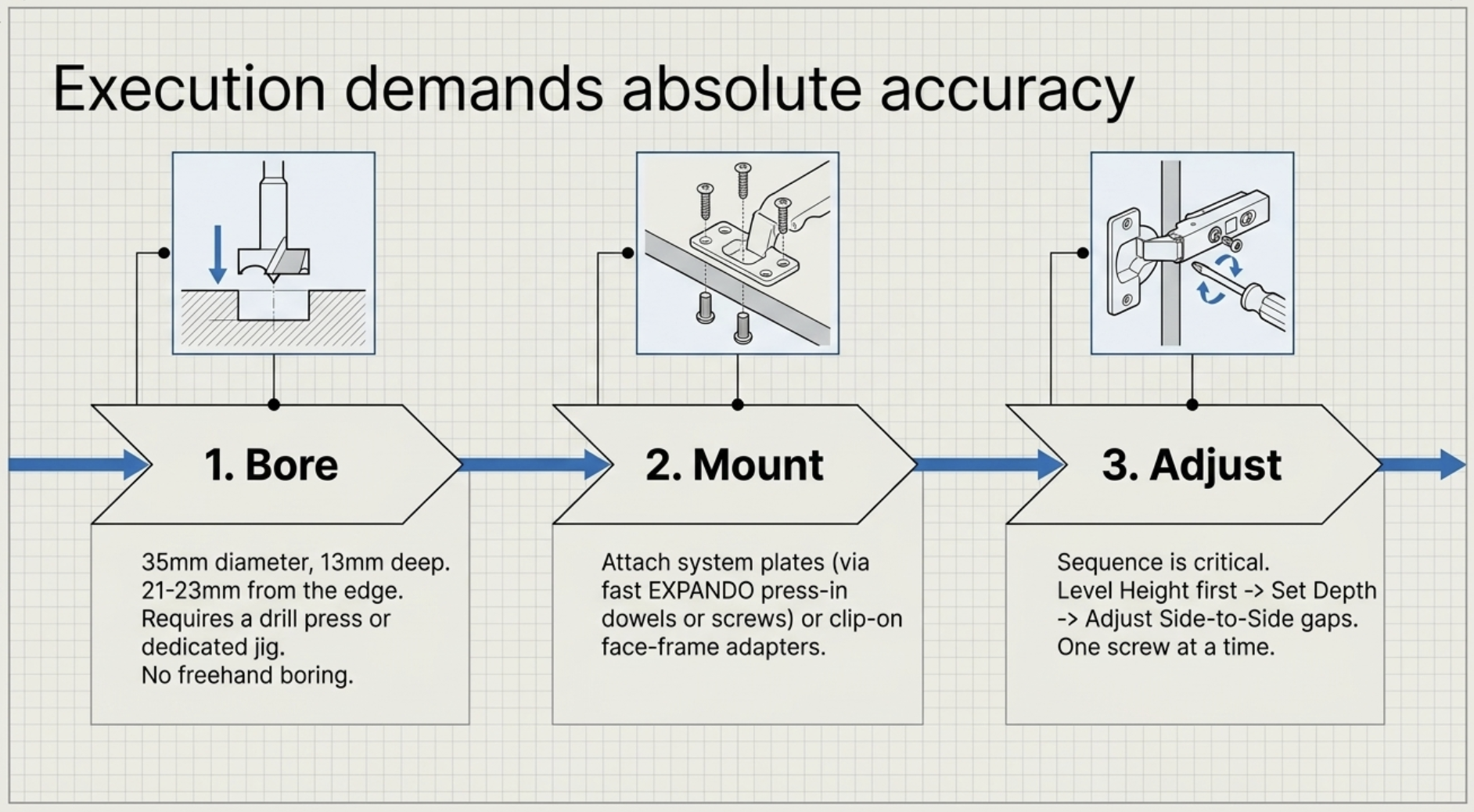
This is the most critical step in the process. The standard boring is a 35mm diameter hole, 13mm deep, in the back face of the cabinet door. The distance from the door edge to the center of the hole is typically 21 to 23mm, but this varies by brand and overlay type. Always check the spec sheet for the specific model being installed.
The distance from the top or bottom of the door to the center of the first hinge hole is typically 70 to 120mm (85mm is the most common default). For doors over 40 inches tall, a third hinge is required, centered between the top and bottom hinges. The tool is a 35mm Forstner bit in a drill press or a dedicated boring jig (Blum makes one; aftermarket jigs from Rockler and others work for most brands).
Accuracy matters here. A hole that is 1mm off-center means the door sits crooked, and the three-way adjustment may not have enough range to compensate. Boring on a drill press or with a jig is standard practice. Freehand boring with a handheld drill is not recommended for finish-quality cabinetry.
Mounting the Plate
For frameless cabinets, the system mounting plate attaches to the cabinet side panel with screws or press-in dowels. Blum's EXPANDO system uses press-in dowels that are faster than screws and provide a stronger hold in particleboard and MDF. For face-frame cabinets, an adapter plate clips over the edge of the face frame. In most cases, no drilling into the frame is required.
The mounting plate position is determined by the overlay type and the desired door gap. Every hinge manufacturer publishes a spec sheet with exact plate positions for each model and overlay combination. See the Wurth Louis installation reference for brand-specific mounting details across Blum, Grass, and Salice.
Attaching the Door and Adjusting
With the plate mounted and the cup bored, the door goes on: slide the hinge arm over the mounting plate until it clicks. No tools. Open and close the door a few times to let the hinge settle before adjusting.
The adjustment sequence matters. Level the door height first (eliminates the most visible misalignment). Then set the depth to control the reveal. Finally, adjust side-to-side for even gaps between adjacent doors. Always turn one screw at a time and check before moving to the next. Over-adjusting multiple screws simultaneously makes it difficult to isolate what moved.
Common Specification Mistakes
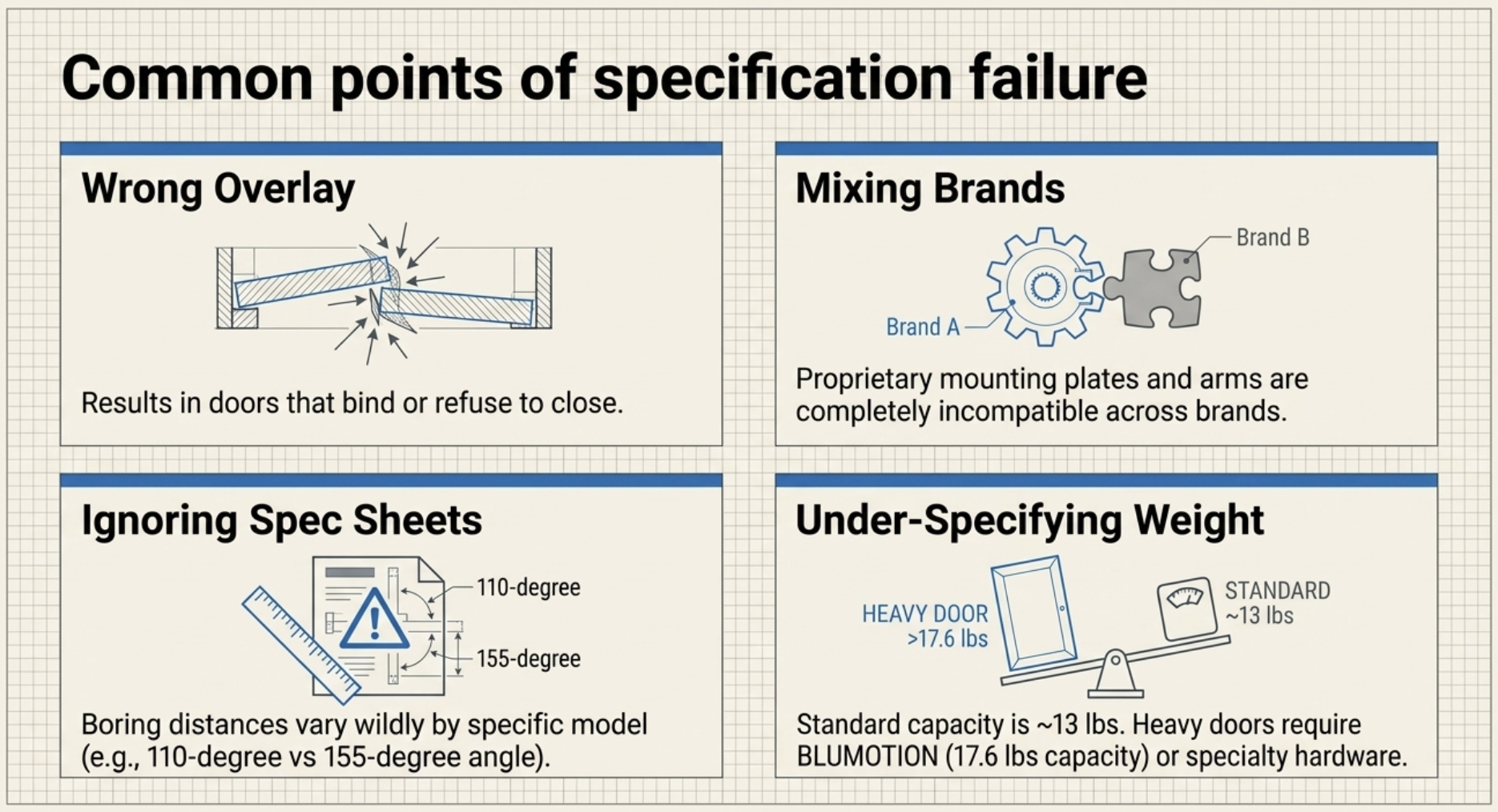
Wrong overlay for the cabinet construction. Specifying a full overlay hinge for a shared-panel application (which needs half overlay) is the most common error. The door either won't close or will bind against the adjacent door. The overlay-to-construction table above exists to prevent this.
Mixing brands on the same project. Blum mounting plates do not accept Salice hinges. Grass arms do not clip onto Hettich plates. Every brand's system is proprietary. Mixing brands on the same project creates a service and replacement nightmare. Pick one brand and stay consistent.
Skipping the spec sheet. Every hinge model has a spec sheet with exact boring dimensions, overlay values, and mounting plate positions. These numbers vary by model, even within the same brand. A Blum concealed hinge CLIP top 110 degree has different boring distances than a CLIP top 155 degree. Always check the spec sheet for the specific model being installed.
Under-specifying for door weight. Standard concealed hinges support doors up to about 13 lbs. Heavier doors (solid wood panels, thick MDF, glass inserts) need heavy-duty models rated for higher weights. Blum's CLIP top BLUMOTION handles up to 17.6 lbs per hinge pair. For doors exceeding 40 lbs, specialty hinges or additional hinges are required.
When to Let the Millwork Shop Handle the Specification
On a standard frameless kitchen with Blum CLIP top in full overlay, the specification is straightforward. Any competent cabinet shop handles this daily.
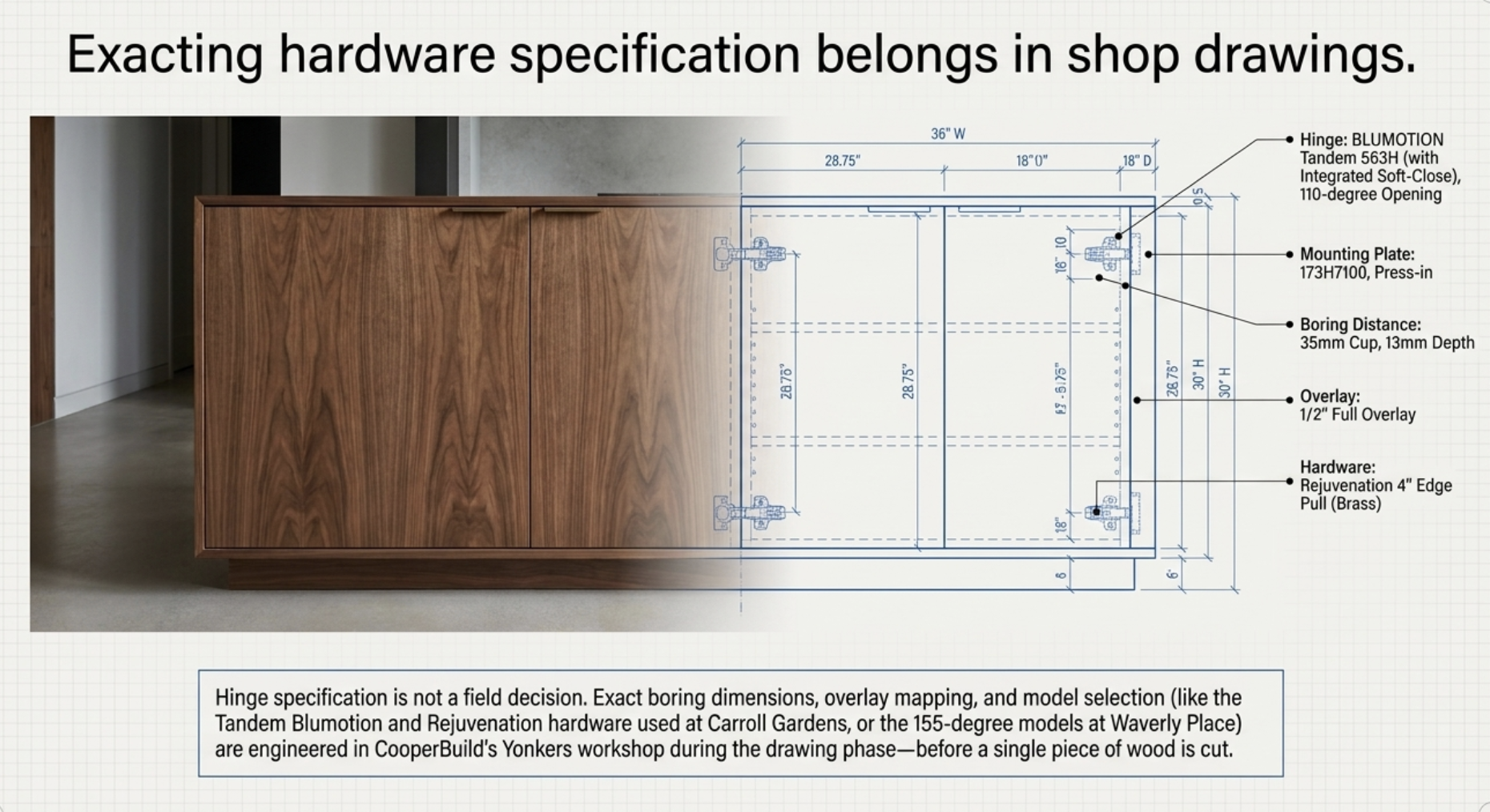
On projects with mixed overlay types, inset doors, angled cabinets, thick door panels, or specialty opening angles (155 degree for blind corners, 170 degree for pantry pull-outs), the hinge specification should be part of the shop drawing review. Not a field decision. Not a last-minute procurement call.
Our approach at CooperBuild: hinge specification happens during the millwork shop drawing phase in our Yonkers workshop. The shop drawings show every hinge location, overlay type, boring dimension, and mounting plate position before a single hole is drilled. On the Waverly Place project, the four custom interior doors had their own shop drawing package with hardware specified down to the hinge model and screw type. On the Carroll Gardens project, the walnut vanities specified Tandem Blumotion drawer slides and Rejuvenation hardware alongside the concealed hinges, all documented in drawings reviewed with the designer before fabrication.
That level of documentation is standard for custom millwork services. The hinge is a small component, but selecting it wrong affects every door on the project. Getting it right in shop drawings means getting it right on site. See completed examples in our project portfolio.
Concealed cabinet hinges are the professional standard for custom cabinetry because they are invisible when closed, adjustable after installation, and durable across 200,000+ cycles. The decisions that matter: overlay type matched to cabinet construction, one brand across the entire project, soft-close on every high-use cabinet, and the correct boring dimensions for the specific hinge model. These are specification decisions, not field decisions. They belong in shop drawings.
If you are specifying concealed hinges for an upcoming project or need guidance on brand and overlay selection, start a conversation with us. CooperBuild fabricates custom cabinetry and millwork in our Yonkers workshop. Hardware specification, including hinge selection, is part of the shop drawing process.
- Category: Expert Advice / Cabinet Hardware & Millwork
- Topic: Concealed Cabinet Hinges Specification
- Author: CooperBuild Team
- Published: June 2026
- Sources:
- • Blum CLIP top BLUMOTION
- • Salice Hinges
- • Grass TIOMOS
- • Hettich Concealed Hinges
- • Wurth Louis Installation Guide
Need Hardware Specification for Your Millwork Project?
We fabricate custom cabinetry and millwork in our Yonkers workshop. Hardware specification, including concealed hinge selection, overlay type, and installation details, is part of our shop drawing process. Let us help you specify the right hinges for your project.
Discuss Your Cabinetry ProjectSubscribe to Our Newsletter
Get the latest insights, trends, and news from the construction industry delivered straight to your inbox.
We respect your privacy. Unsubscribe at any time.